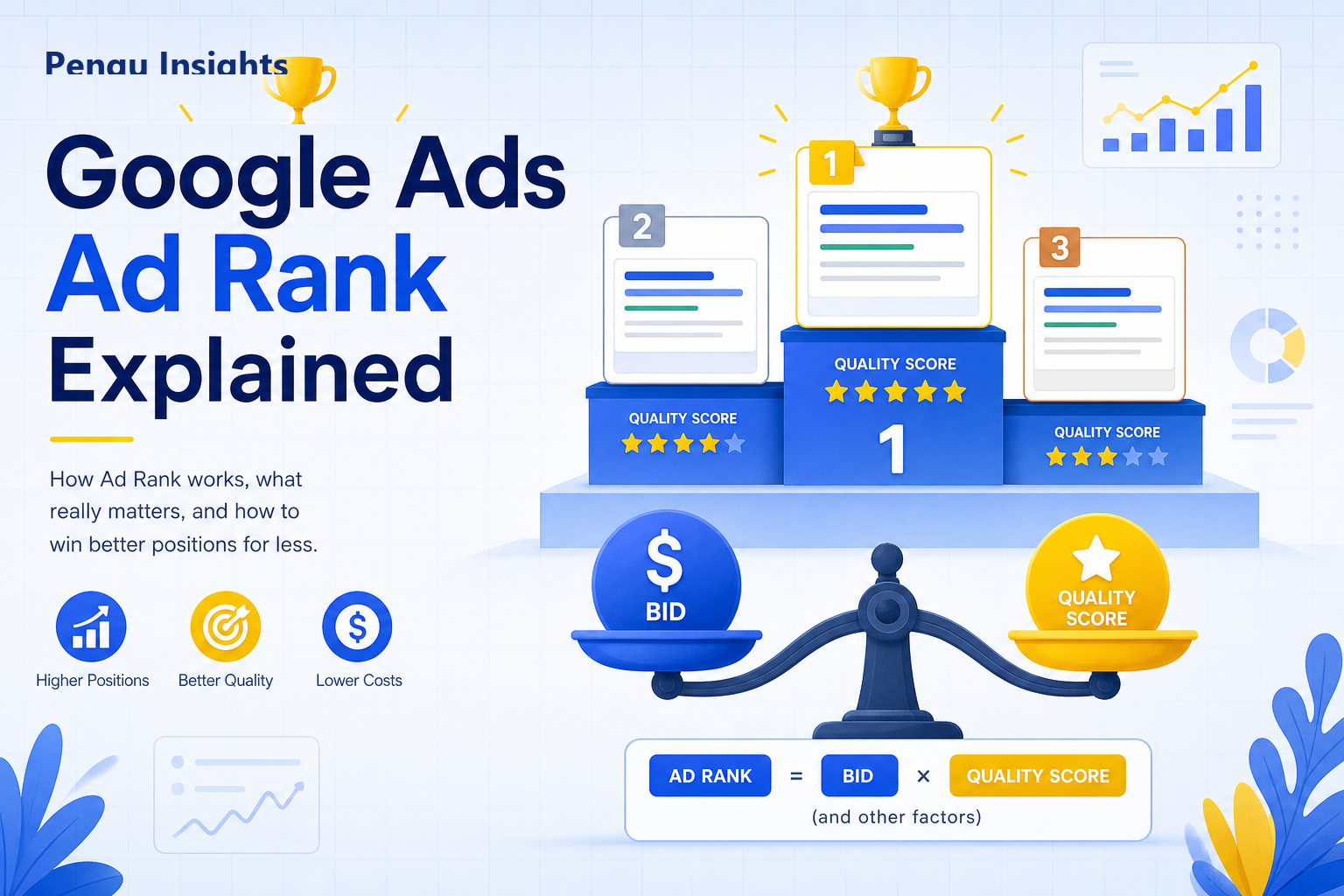
Think of Google Ads like a job interview for every search, and Google Ads Ad Rank as the score that decides who gets the job.
You can raise your hand and bid the most money, but that does not automatically win the position. Google also scores how well you fit the search (quality), how helpful your extras are (extensions), and the specifics of that moment (device, location, time).
You can raise bids all day and still lose auctions. Ad Rank is why.
Google Ads does not rank ads by bid alone. It scores each eligible ad in real time using bid amount, quality signals, expected impact of assets, and context like device and location. Google documents this framework in its support materials (Google Ads Help, Ad Rank). This post translates that documentation into decisions you can make in the next hour.
Key takeaways
- Ad Rank determines eligibility and position, not your bid alone.
- Quality Score reflects expected CTR, ad relevance, and landing page experience at the keyword level.
- Extensions and formats matter. Their predicted impact feeds Ad Rank.
- Auction context changes every query. Device, location, time, and competitor set shift outcomes.
- Raising bids without fixing quality is expensive. Improve relevance first, then bid strategically.
Video: Ad Rank explained with a real account open
Six minutes with a Google Ads account on screen, showing where Quality Score lives and what it does to Ad Rank.
Three things worth taking from it:
- The auction runs on every search. Ad Rank is recomputed each time someone hits enter, from your bid, expected CTR, ad relevance, landing page experience and the context of the search.
- The three quality components are visible per keyword. Expected CTR, ad relevance and landing page experience each show as below average, average or above average. Three "above average" marks is a 10 out of 10.
- Specific beats broad at every layer. His example: a keyword for braided leather bracelets, an ad about braided leather bracelets, a page of twenty braided leather bracelets. The generic version of the same funnel ranks lower and pays more.
That is the practical version of the formula in this post: quality is the multiplier you control without raising the bid.
What is Google Ads Ad Rank?
Ad Rank is Google's real-time score for each ad in a given auction. Higher Ad Rank wins better placement (or any placement at all). When Google says "better placement," it means higher on the page, eligible for certain formats, and visible for more queries.
Think of Ad Rank as:
Bid × Quality × Context adjustments
Google's public language emphasizes:
- Your bid (or Smart Bidding target that translates into effective bids)
- Quality of your ads and landing pages
- Expected impact of ad extensions and other formats
- Auction-time context (search context, device, location, time, other ads)
You do not see a single Ad Rank integer in the UI. You see outcomes: impression share, lost share due to rank, average CPC, and Quality Score diagnostics.
How does Quality Score fit into Ad Rank?
Quality Score is a 1 to 10 diagnostic at the keyword level. Think of it as Google's report card for how relevant your ad setup looks for that keyword. It summarizes three things:
Expected click-through rate (CTR): How likely people are to click your ad compared with others for similar searches.
Ad relevance: Whether your headlines and descriptions sound like they answer the search. If someone searches "crm for dentists" and your ad only says "business software," relevance drops.
Landing page experience: After the click, does the page load fast, match the promise, work on mobile, and feel trustworthy?
Quality Score is related to Ad Rank, but it is not the same number Google uses in every auction. Practically: a low Quality Score usually means you pay more for the same position, or you lose impression share.
Action step: filter keywords with spend over $50 and Quality Score below 5. For each one, check that the keyword, the ad headlines, and the landing page H1 all talk about the same thing.
Time estimate: 45 minutes to review and note alignment gaps.
Do bids still matter if quality is strong?
Yes. Auctions still have floors. Strong quality lets you win more auctions at lower CPC, not win every auction for free.
Smart Bidding complicates the picture. Target CPA and Target ROAS strategies set goals; Google adjusts bids per auction. Your "max CPC" may be exceeded when conversion likelihood is high. That is by design.
If Smart Bidding underperforms, the issue is often weak conversion data or poor landing pages, not the bidding algorithm alone. Fix signal quality before reverting to manual bids everywhere.
How ad extensions influence Ad Rank
Extensions (assets) like sitelinks, callouts, structured snippets, call extensions, and image assets improve expected CTR and user experience. Google includes their expected impact in Ad Rank calculations.
Common gaps we see in audits:
- Brand campaigns missing sitelinks to key pages
- No callouts highlighting proof points (shipping, warranty, certifications)
- Structured snippets empty on product or service categories
- Location extensions not linked for local businesses
Time estimate: 30 minutes to fill core assets at the account or campaign level. Extensions are not decoration. They are auction leverage.
What is auction context and why it changes results
Every search is a unique auction. Context includes:
- Device: Mobile versus desktop performance differs
- Location: Geo modifiers and proximity for local services
- Time of day / day of week: Bidding adjustments or schedule rules apply
- Search term and intent signals: Same keyword, different user history
- Competitor presence: More rivals in the auction raises effective costs
This is why exported CPC averages lie. Your Tuesday mobile auction in Chicago is not the benchmark national desktop average.
How to diagnose Ad Rank problems
Use these UI signals:
Search impression share (IS). Low IS means you are missing auctions.
Lost IS (rank). High lost IS due to rank means quality or bid is too weak versus competitors.
Lost IS (budget). Budget caps, not Ad Rank, limit you.
Auction insights. Compare overlap rate and outranking share with top competitors.
Search terms report. Irrelevant queries drag quality and waste spend.
If lost IS (rank) is high on core terms, run a three-part fix: tighten keyword-ad-LP alignment, add missing extensions, then adjust bids or tCPA modestly.
For cost planning context, see how much Google Ads cost.
Practical Ad Rank improvement checklist
Week 1: Structure
Time estimate: 60 minutes.
- Separate brand, competitor, and generic campaigns
- One theme per ad group where possible
- Match landing pages to ad group intent
Week 2: Creative
Time estimate: 90 minutes.
- RSAs with keyword themes in headlines (not stuffed)
- Test distinct value props, not synonym spam
- Ensure display paths and descriptions answer objections
Week 3: Assets and LP
Time estimate: 60 minutes.
- Complete sitelinks, callouts, snippets
- Improve LP load time (Core Web Vitals matter for experience)
- Message match: ad promise equals above-the-fold LP content
Week 4: Bidding review
Time estimate: 30 minutes.
- Compare manual versus Smart Bidding on mature ad groups
- Raise targets only where rank-lost IS persists after quality fixes
Ad Rank myths to ignore
Myth: Quality Score is the whole story. It is a diagnostic, not the auction formula printed in your account.
Myth: Always bid first position. Top slot can inflate CPC without proportional conversion gains. Test average position outcomes against CPA.
Myth: Copy competitors' ads to win. Matching hooks without matching landing experience recreates their CTR, not their CVR.
What to do next
Export keywords with Quality Score below 6 and meaningful spend. Fix alignment and assets before you touch bids. Re-check lost impression share due to rank after two weeks. Ad Rank rewards relevance sustained over time, not one-day bid spikes.
To check the CPC and competition behind a keyword before you bid on it, use the Keyword Research tool in Pengu Insights. Free plan, no card.
FAQs
What is Ad Rank in Google Ads?
Ad Rank is the score Google uses to decide ad position and whether your ad is eligible to show. It combines your bid, ad quality, expected impact of extensions and formats, and auction-time context like device and location.
Does the highest bid always win top position?
No. A lower bidder with stronger quality and relevant extensions can outrank a higher bid. Ad Rank is multi-factor, not a pure auction.
What is a good Quality Score?
Quality Score runs from 1 to 10 at the keyword level. Seven and above is healthy for most accounts. Below five signals weak expected CTR, ad relevance, or landing page experience on that keyword.
How do ad extensions affect Ad Rank?
Extensions improve expected click-through rate and user experience. Google includes their predicted impact in Ad Rank. Missing sitelinks, callouts, or structured snippets can reduce competitiveness even at the same bid.
Can I see my Ad Rank score in Google Ads?
Google does not publish a single Ad Rank number in the interface. You infer it from impression share, average position metrics (where available), Quality Score, and auction insights comparing you to competitors.
Written by

Founder of Pengu Insights. Competitive intelligence practitioner for DTC brands and marketing agencies.