Imagine walking into a bakery and asking, "How much does bread cost?" The baker would need to know: sourdough or white? Large or small? Fresh or day-old?
"How much do Google Ads cost?" is the same question. The real answer depends on what you sell, who you compete with, and how much a customer is worth to you.
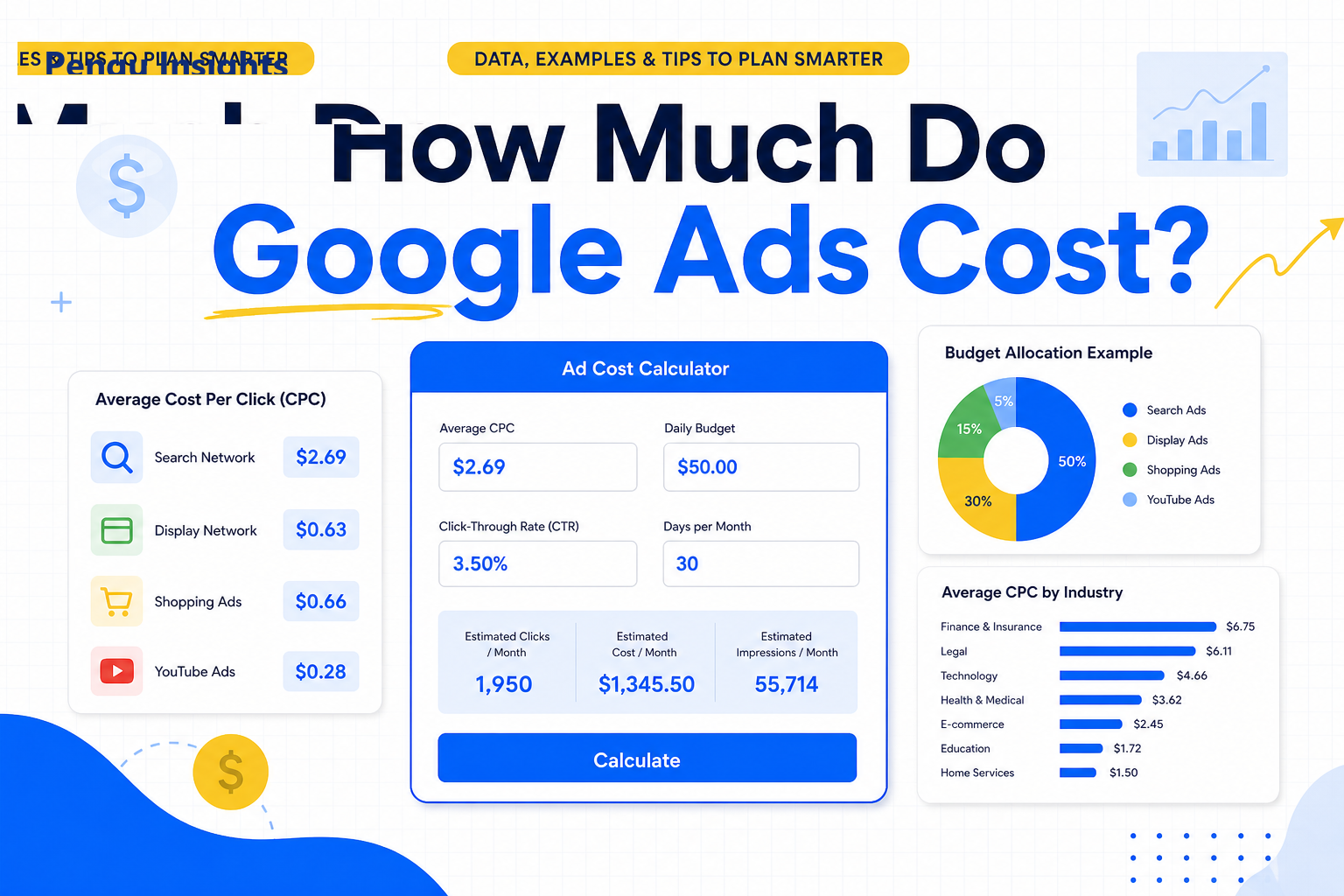
Google Ads pricing is an auction. You pay per click (CPC) or per thousand impressions (CPM) depending on campaign type. Your monthly bill is a function of bids, competition, relevance, and how aggressively you cap spend. This guide breaks down the math practitioners use to plan budgets without fantasy forecasts.
Key takeaways
- Google Ads has no fixed price. You set daily budgets; Google spends up to that cap based on auctions.
- CPC varies wildly by industry and intent. Legal and insurance can exceed $50 per click; local services may sit under $5.
- Budget from CPA targets, not clicks. Start with allowable cost per acquisition, then estimate volume.
- Quality Score lowers effective CPC. Better ads and landing pages buy more clicks for the same budget.
- Monthly spend equals CPC times clicks. Raise budget only when conversion tracking proves profitable unit economics.
Video: the four-minute answer for local service businesses
A short, blunt answer from a practitioner who builds campaigns for electricians and similar trades. It disagrees with the "start with $5 a day" advice, and the disagreement is worth hearing.
Three things worth taking from it:
- You pay per click, so cost is your budget. The question "how much do Google Ads cost" resolves to "how many clicks at your keyword's price". Look up the CPC before you set anything.
- $50 a day, weekdays, is his floor for local services. Below that, there is not enough data to learn from, and a campaign that never learns never gets cheaper.
- Give it 90 days. Not 7, not 30. Campaigns take a quarter to reach a stable cost per lead, which is why the first month's numbers should not decide anything.
His other warning matches ours: do not accept the platform's default recommendations or a "smart" campaign type on day one. They spend faster than a beginner can read the results.
How much do Google Ads cost: how the pricing works
Google Ads charges when someone clicks your ad (Search, Shopping, Performance Max on Search inventory) or when your ad earns impressions (Display, YouTube). Most performance advertisers think in CPC.
Three forces set your CPC:
1. Advertiser competition. More bidders on a keyword raise prices. "CRM software" costs more than "CRM for landscaping crews" because more companies want the first term.
2. Ad Rank. Your bid times Quality Score plus auction context determines position and actual CPC. You can pay less than competitors if your ad and landing page are more relevant.
3. Smart Bidding. Automated strategies may pay above your manual bid when Google predicts a conversion. The system bids higher for clicks that look profitable.
Your daily budget is a spending ceiling, not a guarantee. Google can overspend up to 2x on a given day if monthly pacing allows. That surprises new advertisers who expect rigid daily caps.
What is a typical Google Ads CPC by industry?
Published averages are directional. WordStream's 2025 benchmarks analyzed 16,000+ campaigns and found CPC rose for most industries (WordStream, 2025). Here is what the data looked like directionally:
Local home services: $2 to $15 per click on Search. Emergency intent (plumbers, locksmiths) spikes costs during crises.
Ecommerce retail: $0.50 to $3 per click. Shopping and Performance Max compress CPC by spreading budget across formats.
B2B SaaS: $3 to $12+ per click. Long sales cycles mean tracking pipeline CPA, not just form fills.
Legal and insurance: $20 to $80+ per click. Highest auction pressure because of high customer lifetime value.
Healthcare adjacencies: $5 to $25 per click. Compliance limits ad copy creativity, which can hurt Quality Score.
Treat ranges as planning brackets, not gospel. Your Keyword Planner export beats any blog table.
Time estimate: 20 minutes in Keyword Planner with your geo and language settings to pull CPC estimates for 20 core terms.
How to calculate your Google Ads monthly budget
Use backward math from business goals. Do not guess.
Formula:
Monthly budget = (Target conversions per month) × (Target CPA)
Example: You need 40 qualified leads. Finance approves $35 per lead.
40 × $35 = $1,400 per month baseline
Add 15 to 25% test budget when launching new campaigns or match types. Learning phases need room to fail and adjust.
If you do not know target CPA yet, run a 2 to 4 week proof period at controlled daily spend ($50 to $150 per day for many SMBs) with conversion tracking verified. Do not scale until CPA stabilizes.
Clicks needed estimate
Use this formula when you know your conversion rate:
Clicks needed = Target conversions ÷ Conversion rate
If CVR is 5% and you need 40 conversions:
40 ÷ 0.05 = 800 clicks
At $4 average CPC: 800 × $4 = $3,200 per month
This is why CVR matters as much as CPC. A $6 CPC with 8% CVR beats a $3 CPC with 2% CVR every time.
What factors increase Google Ads costs?
Competitive keywords. Head terms like "CRM software" cost more than "CRM for landscaping crews." Niche long-tail queries often convert better and cost less.
Broad match without guardrails. Smart Bidding plus broad can spend on tangential queries. Review search terms weekly to catch waste early.
Poor landing page experience. Low Quality Score raises CPC and reduces impression share. A slow page or generic form can double your costs.
Geographic targeting. Targeting entire countries when you serve one metro wastes spend. Segment geos to control budget.
Seasonality. Q4 retail and tax season legal inflate auctions predictably. Plan budgets around known spikes.
Ad format gaps. Missing extensions, weak RSA asset diversity, and no brand separation inflate costs indirectly through lower CTR and Quality Score.
For Ad Rank mechanics, read our Google Ads Ad Rank explained guide next.
Google Ads cost by campaign type
Search (brand). Lowest CPC, highest CVR. Protect brand terms cheaply. These are people who already know you.
Search (non-brand). Core demand capture. CPC follows category competition. This is where most budgets go for growth.
Performance Max. Blended costs across Search, Display, YouTube, Gmail. Harder to isolate CPC; judge on CPA or ROAS instead.
Shopping. Product-level auctions. Feed quality drives visibility and effective cost. Poor product data costs you clicks.
Display and YouTube. Lower CPC, lower intent. Use for remarketing and awareness, not primary lead gen unless funnels prove out.
How much should small businesses spend on Google Ads?
Common starting ranges by business type:
Local service business: $1,000 to $3,000 per month after tracking proof. Start smaller if you are testing a new service line.
Ecommerce store: 10 to 20% of revenue on paid media total; Google is one slice. Balance with organic and email.
B2B lead gen: $3,000 to $15,000 per month when LTV supports $100+ CPL. Track pipeline value, not just MQLs.
Spending less is fine if goals are modest. Spending more without tracking is gambling.
We see teams ask for a "minimum budget" as if Google sells packages. There is no minimum that guarantees results. There is a minimum that generates enough clicks to learn, often 100 to 200 clicks per ad group before major structural changes.
How to lower Google Ads costs without killing volume
1. Split brand and non-brand campaigns. Stop paying premium CPC on your own name mixed with generic terms. Brand should be cheap.
2. Build negative keyword lists. Block irrelevant modifiers early. "Free," "jobs," and "DIY" are common junk terms.
3. Improve landing page speed and message match. Quality Score rewards relevance. Faster pages with clear offers earn discounts.
4. Use exact and phrase for control until Smart Bidding has conversion data. Do not jump straight to broad match in week one.
5. Import offline conversions. Smart Bidding optimizes toward revenue, not form fills alone. Connect CRM data for better bids.
Pair cost work with Google Ads benchmarks context so you know whether your market moved or your account slipped.
What to do next
Open Keyword Planner. Export CPC estimates for your top 20 queries. Multiply by realistic CTR and CVR assumptions. Set a 30-day test budget from CPA math, not competitor gossip. Review search terms every week for the first month. Cost control is a weekly habit, not a one-time setup.
To see the real CPC of your keywords before you set a budget, use the Keyword Research tool in Pengu Insights. Free plan, no card.
FAQs
How much do Google Ads cost per month?
Most small businesses spend $1,000 to $10,000 per month on Google Ads, but the range is enormous. Monthly cost equals average CPC times clicks, and clicks depend on budget caps and auction competition. Start from a target CPA and work backward.
What is the average cost per click on Google Ads?
Average CPC varies by industry from roughly $1 to $8 on Search for many categories, with legal, insurance, and B2B SaaS often higher. Use Google Keyword Planner and your account data for estimates, not generic averages alone.
How do I calculate a Google Ads budget?
Divide your monthly revenue or lead goal by target CPA to get allowable spend. Example: 50 leads at $40 CPA equals $2,000 monthly budget. Add 20% test buffer for new campaigns.
Why is my Google Ads CPC so high?
High CPC usually comes from competitive keywords, low Quality Score, broad match on expensive queries, or limited ad relevance. Check search terms, auction insights, and landing page experience before raising budgets.
Is Google Ads cheaper than Facebook Ads?
Neither platform is universally cheaper. Google Search captures high intent and often costs more per click but can deliver faster conversions. Meta can be cheaper per click for prospecting but may need longer nurture. Compare CPA and LTV, not CPC alone.
Written by

Founder of Pengu Insights. Competitive intelligence practitioner for DTC brands and marketing agencies.