
A social media content calendar does not fail because the template was wrong. They fail in week six, when the person filling it runs out of ideas and starts inventing posts to fill cells.
A calendar that survives plans inputs, not just slots.
Key takeaways
- Plan two to four weeks of posts and one quarter of themes.
- Every row needs a reason it exists, or you cannot learn anything later.
- Ideas come from four repeatable sources. A blank page is not one of them.
- The column most calendars miss is what happened after publishing.
Video: a content calendar built in a spreadsheet, tab by tab
Twenty minutes inside a spreadsheet calendar, which is the format most small teams use before any tool, and often after.
Three things worth taking from it:
- One table drives everything. Each post is a row with a date, a channel, a format and a status; the calendar view is generated from it, not maintained separately. Keep one source of truth.
- An ideas tab with no dates. Ideas are parked without commitment and pulled into the plan when ready. That separation is what stops calendars from filling with placeholders.
- Caption, call to action and hashtags in separate cells, joined by formula. Small thing, and it is what makes copy-pasting into each platform fast.
The template we describe below follows the same shape; the spreadsheet is a fine place to run it until the team is larger than three people.
The columns a social media content calendar needs
| Column | Why |
|---|---|
| Date and time | The commitment |
| Channel | Same idea, different execution per platform |
| Format | Carousel, reel, static, text, video |
| Pillar | Which of your four themes this serves |
| Hook | The first line, written now and not at 9am on publishing day |
| Asset status | Idea, drafted, designed, approved, scheduled |
| Owner | One name |
| Link + UTM | So GA4 can attribute the click |
| Result | Reach, engagement rate, saves. Filled in a week later |
That last row is what separates a calendar from a to-do list. Without it, month three looks exactly like month one.
The four-pillar mix
Pick four themes and hold them for a quarter. A workable default split:
- 40% useful: teach something the audience can apply today
- 30% proof: results, cases, process, receipts
- 20% point of view: the opinion that separates you from the category
- 10% offer: what you sell, said plainly
The ratios matter less than having them written down. A calendar without pillars drifts toward whatever was easiest to make that week, which is usually the offer.
Where the ideas actually come from
1. Questions you answer repeatedly. Sales calls and support tickets are the highest-converting content source that exists, and it costs nothing to mine them.
2. Search demand. Terms with real volume, checked rather than assumed. Our post on search intent and keyword types covers how to read them.
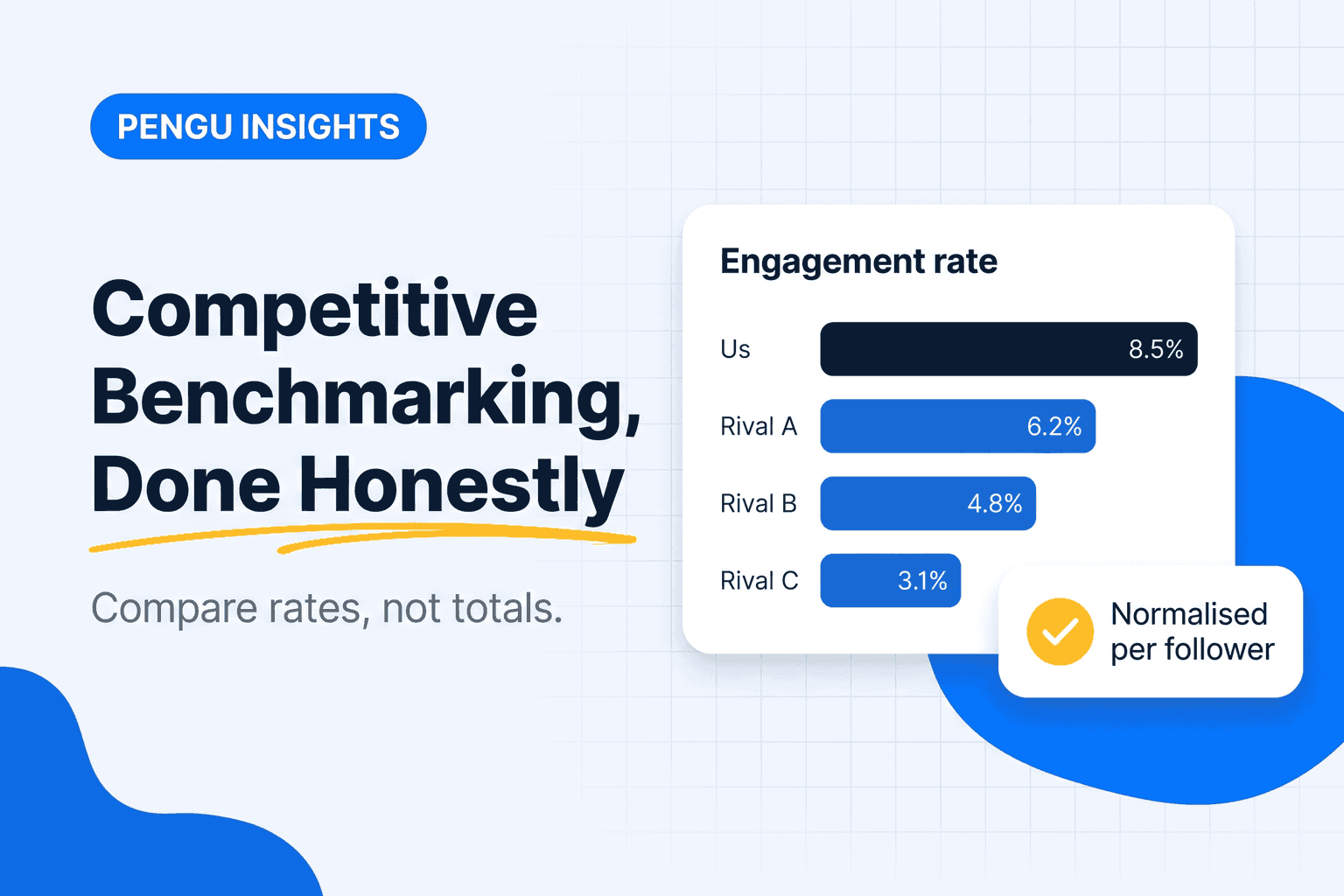
3. Competitor posts that beat their own average. Not their best-looking posts, the ones that outperformed their own baseline. That gap is what an engagement-rate benchmark surfaces, and competitive benchmarking covers the method.
4. Your own winners, reworked. A carousel that worked becomes a reel, a thread, and a blog section. For video specifically, YouTube video ideas lists nine sources that never run dry. Most teams publish a hit once and move on.
The rhythm that holds
Track the result in a social media dashboard rather than in the calendar itself.
Monthly, 90 minutes. Pick the themes, fill the next four weeks' rows with hooks. Not full copy, just hooks and formats.
Weekly, 2 hours. Batch-produce the assets for next week. Batching is the single biggest determinant of whether a calendar survives, because it removes the daily decision.
Weekly, 15 minutes. Fill in the Result column for last week. This is where the next month's ideas come from.
Quarterly, half a day. Review pillar performance, cut the one that never worked, replace it.
Tools, honestly
You do not need a tool. A spreadsheet with the columns above outperforms most software, because the constraint is never storage, it is ideas and batching.
When you do buy something, split the two jobs:
Publishing and scheduling: Buffer from around $6 per channel, Metricool with a free tier, SocialPilot for agencies with many clients. Compared properly in our Hootsuite alternatives post.
Knowing what to put in the calendar: a different job entirely. Pengu Insights covers the research half from $39 a month: competitor content and engagement across Instagram, TikTok and LinkedIn, the ad creatives rivals keep running, and the search demand behind a topic. It does not schedule posts, so it sits beside a publisher rather than replacing one.
Common failure modes
- Planning too far out. Six weeks of specific posts will be rewritten. Plan themes far, posts near.
- No batching. Producing on publishing day guarantees the calendar dies the first busy week.
- No result column. You will repeat what felt good rather than what worked.
- One calendar for four channels. The idea travels; the execution does not.
- Filling cells to avoid gaps. An empty slot is better than a post nobody needed. The calendar exists to serve the audience, not itself.
Frequently asked questions
What is a social media content calendar?
A schedule of what you publish, where and when, planned far enough ahead that publishing stops being a daily decision. The useful ones also record why each post exists.
How far ahead should you plan content?
Two to four weeks of specific posts, one quarter of themes.
What should a content calendar include?
Date, channel, format, pillar, hook, asset status, owner, link with UTM, and a performance column filled in after publishing.
How many times a week should you post?
Three to five per channel suits most brands. Consistency matters more than volume.
Where do content ideas come from?
Questions sales and support answer repeatedly, searches with real volume, competitor posts that beat their own average, and your own winners reworked into other formats.
Written by

Founder of Pengu Insights. Competitive intelligence practitioner for DTC brands and marketing agencies.