Picture someone walking into a library versus someone walking into a store. Same building. Different goals. Search engines see the same split.
Ranking without intent alignment is how teams publish 2,000-word guides that never convert, or product pages that never rank. Search intent is the filter that tells you which keyword type deserves which asset.
Key takeaways
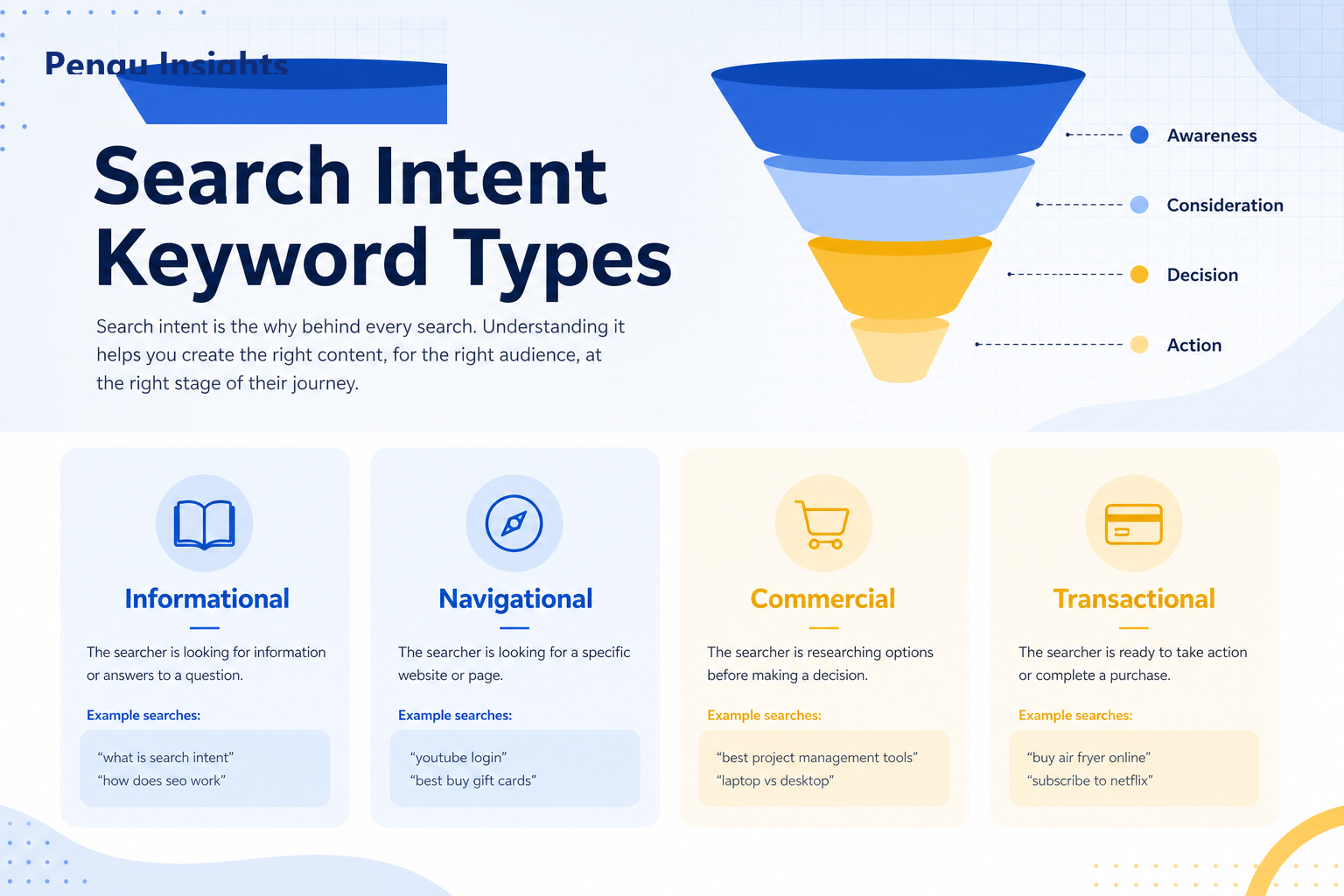
- Four core intent types: informational, navigational, commercial investigation, transactional.
- SERP shape reveals intent faster than volume metrics.
- One URL, one primary intent. Mixed pages confuse users and algorithms.
- Paid and organic must agree on intent between ad or query and landing page.
- AI Overviews absorb informational queries first. Plan citation-ready answers on those terms.
Video: how search engines went from keywords to intent
Nine minutes on the shift that made intent matter: from an algorithm that counted keywords and links to one that reads behaviour and meaning.
Three things worth taking from it:
- Keywords and links did not die; they got company. Early ranking rested on anchor text, keyword placement and inbound links. Behaviour signals and semantic understanding were added on top, not instead.
- Same intent, one page. The video's example: "home workouts" and "how to lose weight at home" once justified two articles and now cannibalise each other. This is why the classification step below comes before writing.
- Intent decides the format, not just the topic. A keyword that wants a comparison table will not rank with a 3,000-word essay, however good the essay is.
Our addition: intent is visible in the results page before you write a word. The SERP feature table further down is the fastest way to read it.
What is search intent?
Search intent is the goal behind a query. Google's systems infer intent from query text, user behavior, location, device, and historical SERP engagement. When results satisfy intent, users click, dwell, and return. When they do not, rankings shift.
Keyword tools show volume and difficulty. Intent classification shows whether you should write a guide, build a comparison table, or optimize a checkout flow.
Informational intent keywords
Users want knowledge. Examples:
- "what is keyword match type"
- "how to fix Quality Score"
- "calories in cold brew"
Best formats: blog guides, tutorials, videos, FAQs, glossary pages. Educational content that answers questions completely.
Monetization path: email capture, internal links to commercial pages, brand trust. Do not force hard sells above the fold. Build authority first.
SERP signals: featured snippets, People Also Ask, video carousels, AI Overviews. If Google is pulling text into a feature, the query is informational.
Time estimate: 10 minutes per keyword to skim page-one formats before outlining.
Informational content still needs business discipline. Tie each guide to a cluster that supports money pages with internal links. See types of keywords marketers should know for taxonomy overlap.
Navigational intent keywords
Keyword navigational intent is the easiest to spot and the easiest to waste time on: the searcher already knows where they want to go.
Users want a specific destination. Examples:
- "Spotify login"
- "Pengu Insights blog" (brand navigational)
- "Gmail app"
Best formats: homepage, login, support hub, branded landing pages. The user already decided where to go. Get them there fast.
SEO note: You should own your brand navigational queries. If you do not, fix technical SEO, reputation, or impersonation issues first. Losing your own brand traffic is an emergency.
Paid note: Brand campaigns are cheap defensive insurance. Competitors may bid your name. Protect it.
Navigational queries are poor targets for long blog posts. Serve the destination fast. Do not make users hunt.
Commercial investigation intent keywords
Users compare before buying. Examples:
- "best project management software for agencies"
- "Ahrefs vs Semrush"
- "top CRM for nonprofits"
Best formats: comparison pages, "best X for Y" guides with methodology, alternative pages, review roundups with transparent criteria.
Trust signals: pricing with verification dates, pros and cons lists, screenshots, author credentials, clear methodology. Show your work.
SERP signals: listicles, review stars, Reddit threads, YouTube comparisons. If page-one is full of roundups, the query is commercial.
Commercial pages bridge SEO and revenue. They compete with affiliates and media brands. Original testing beats rewritten spec sheets.
For competitive research workflows, use competitor website analysis before you publish another "best tools" list.
Transactional intent keywords
Users ready to act. Examples:
- "buy running shoes online"
- "CRM free trial"
- "book dentist appointment near me"
Best formats: product pages, pricing, signup, booking flows, local service pages with clear CTAs. Remove friction. Make the next step obvious.
SERP signals: shopping ads, local pack, product rich results, sitelinks to pricing. If ads dominate page-one, the query is transactional.
Paid note: Highest CPC often lives here. Conversion tracking must be clean. Broken tracking on transactional terms is expensive.
Transactional SEO without fast pages and clear offers wastes crawl budget. Speed matters. Clarity matters.
How to classify intent in practice
Run this SERP lab for any priority keyword:
Step 1: Search in incognito with target geo and language. Do not use your logged-in account. You want clean results.
Step 2: Label each page-one result. Guide, homepage, product, forum, video. What formats dominate?
Step 3: Note SERP features. Ads, local pack, shopping carousel, AI Overview. Features reveal intent.
Step 4: Assign dominant intent. Count the formats. Blog posts plus videos equals informational. Product grids equal transactional.
Step 5: If split 50/50, pick the intent that matches your business goal or create two URLs. Do not force one page to serve two masters.
Document decisions in your keyword map. Future writers will not re-debate intent.
SERP features by intent type
Search Console shows you position; the SERP shows you why. Features are the fastest intent signal because Google only builds them where the pattern is stable.
| SERP feature | Intent it signals | What it means for you |
|---|---|---|
| Featured snippet, People Also Ask | Informational | Answer in the first 60 words or the snippet goes to someone else |
| Video carousel | Informational, how-to | A written page alone will struggle. Ship video |
| AI Overview | Informational, early commercial | Get cited, not just ranked. Structure for extraction |
| Sitelinks under one domain | Navigational | Somebody owns the brand. Do not compete for it |
| Ads above the fold, four or more | Commercial, transactional | Money is in the query. Organic click share drops hard |
| Shopping carousel, product grid | Transactional | A blog post cannot rank here |
| Local pack | Local transactional | You need a Business Profile, not a page |
| Reddit or forum results in the top five | Informational, distrustful | The market wants opinions, not brochures. Say something |
A page-one result set with no features at all usually means low competition and unclear intent, which is where a well-targeted long-tail page wins fastest.
The modifier table
Most keywords declare their intent in one word. Learn these and you classify 80% of a list without opening a SERP.
| Modifier | Intent | Example |
|---|---|---|
| what, why, how, guide, tutorial, examples | Informational | "what is competitive intelligence" |
| brand name, login, pricing page, app | Navigational | "semrush login" |
| best, top, review, comparison, vs, alternative | Commercial investigation | "semrush alternative" |
| buy, price, cost, discount, near me, free trial | Transactional | "how much do google ads cost" |
| for [audience], for [use case] | Sharpens whichever intent is already there | "crm for agencies" |
Two cautions. "Free" swings both ways: "free sitemap generator" is transactional in the sense that the user wants the thing now, not an article about it. And "best" is drifting toward AI Overviews faster than any other modifier, which changes what winning looks like.
A keyword mapping template: category, keyword, type, search intent, priority
The spreadsheet most teams end up with has five columns, and the order matters because it is the order of the decisions.
| Category | Keyword | Type | Search intent | Priority |
|---|---|---|---|---|
| Analytics | instagram analytics tools | Commercial list | Commercial investigation | High: pos 12, 155 impressions |
| Analytics | instagram engagement rate formula | Question | Informational | Medium: H3 in existing post |
| Traffic | check website traffic | How-to | Informational with tool intent | High: 1,800 impressions, no clicks |
| Traffic | similarweb pricing | Brand plus modifier | Commercial investigation | High: pos 4, add section |
| Ads | facebook ad library | Tool | Navigational, then informational | Medium: pos 10 |
| Ads | how much do google ads cost | Question | Informational, pre-purchase | Medium |
How to fill each column:
- Category is your site's topic cluster, not the industry's. Four to eight categories is normal; twenty means the site has no focus.
- Keyword is the exact phrase as searched, lower case, no punctuation.
- Type is the content shape the SERP rewards: list, how-to, question, comparison, tool, definition. Read it off the top results.
- Search intent is one of the four buckets above, with a note when it is mixed.
- Priority comes from your own data: position and impressions from Search Console, or volume and difficulty when you have no history. A keyword you already rank 8 to 20 for outranks a bigger keyword you rank 60 for.
One row per keyword, one page per row. When two rows point at the same page, one of them is a section, not a page.
Diagnosing an intent mismatch with your own data
You do not need a tool for this. Search Console tells you when a page is serving the wrong intent, if you know the pattern.
High impressions, near-zero CTR, position 20 to 60. Google is testing your page against a query it does not quite fit. Usually an intent mismatch: your guide is showing for a query that wants a product page, or the reverse.
Decent position, CTR far below the curve for that position. Intent is right, packaging is wrong. Fix the title and description before you touch the content.
Impressions climbing, position frozen. Google understands the topic and does not yet trust the domain on it. More words will not fix this. Internal links from your strongest pages and a genuine external citation will.
Clicks with high bounce and no scroll. The click was a mismatch. The snippet promised something the page does not deliver, which costs more than a missed click.
Run the check quarterly on your top 20 pages by impressions. Most intent problems are visible in the first two columns.
Intent and the AI search shift
AI Overviews and chat answers eat informational and simple commercial queries first. Transactional and local intents still send clicks to sites, apps, and phone calls.
Practical response:
Structure informational content with clear headings, tables, and cited stats models can quote. Make your content citation-ready.
Keep transactional pages fast and unambiguous. Checkout flows and signup forms should be frictionless. AI cannot complete transactions for users yet.
Monitor zero-click trends per cluster. Adjust KPIs from traffic alone to visibility plus assisted conversions. Brand exposure matters even when clicks drop.
Read how AI will affect the future of search for the broader strategic picture.
Intent mapping in practice
Here is how to map keywords to pages and CTAs:
Example 1: Informational keyword
Keyword: "what is ASO"
Volume: 2,400
Dominant intent: Informational
Target URL type: Guide or glossary page
Primary CTA: Newsletter signup or link to related guide
Example 2: Commercial keyword
Keyword: "AppTweak alternative"
Volume: 880
Dominant intent: Commercial investigation
Target URL type: Comparison page with methodology
Primary CTA: Demo or trial link
Example 3: Transactional keyword
Keyword: "download fitness app"
Volume: 1,200
Dominant intent: Transactional
Target URL type: App landing page
Primary CTA: Store buttons, clear download path
Review quarterly. SERPs change when Google tests new layouts or competitors publish new formats.
Common intent mistakes
Publishing blogs on transactional SERPs dominated by product grids. You will not outrank Shopify stores with a guide. Match the format.
Sending paid traffic to homepage when query names a specific offer. "CRM free trial" should land on the trial signup page, not your homepage.
Treating "best X" as purely informational when Google shows affiliate commerce layouts. Commercial investigation needs product links and CTAs.
Ignoring local intent modifiers ("near me," city names) on service businesses. Local pack and maps dominate. Optimize for local.
What to do next
Take your top 25 non-brand keywords. SERP-check each one this week. Reassign URLs where intent and format mismatch. Update internal links so informational clusters feed commercial pages. Intent alignment is unglamorous. It is also the highest ROI fix in most content audits.
The Keyword Research tool in Pengu Insights labels every keyword with its intent, so you can map informational, commercial and transactional terms to pages without guessing. Free plan, no card.
FAQs
What are the four types of search intent?
The standard four are informational (learn something), navigational (find a specific site or brand), commercial investigation (compare options before buying), and transactional (complete an action like purchase or signup).
How do I identify search intent for a keyword?
Search the keyword in an incognito window and study the SERP. Blog posts and videos suggest informational intent. Brand homepages suggest navigational. Comparison lists and reviews suggest commercial. Product pages and ads suggest transactional.
Why does search intent matter for SEO?
Google ranks page types that satisfy intent. A blog post rarely outranks product pages on transactional queries. Matching format to intent prevents wasted content and poor rankings.
Should paid ads match the same intent as landing pages?
Yes. Transactional ads should land on checkout, demo, or product pages. Informational queries may need softer offers or lead magnets. Intent mismatch kills Quality Score and conversion rate.
Can one keyword have mixed intent?
Yes. SERPs sometimes blend formats, especially mid-funnel terms. Choose the dominant intent or split content across multiple URLs with clear primary targets.
What is keyword navigational intent?
A navigational keyword is one where the searcher already knows the site or page they want, such as a brand name plus login, pricing or app. You can only rank for it if you are that brand; for anyone else, the useful version is the comparison query next to it.
Written by

Founder of Pengu Insights. Competitive intelligence practitioner for DTC brands and marketing agencies.