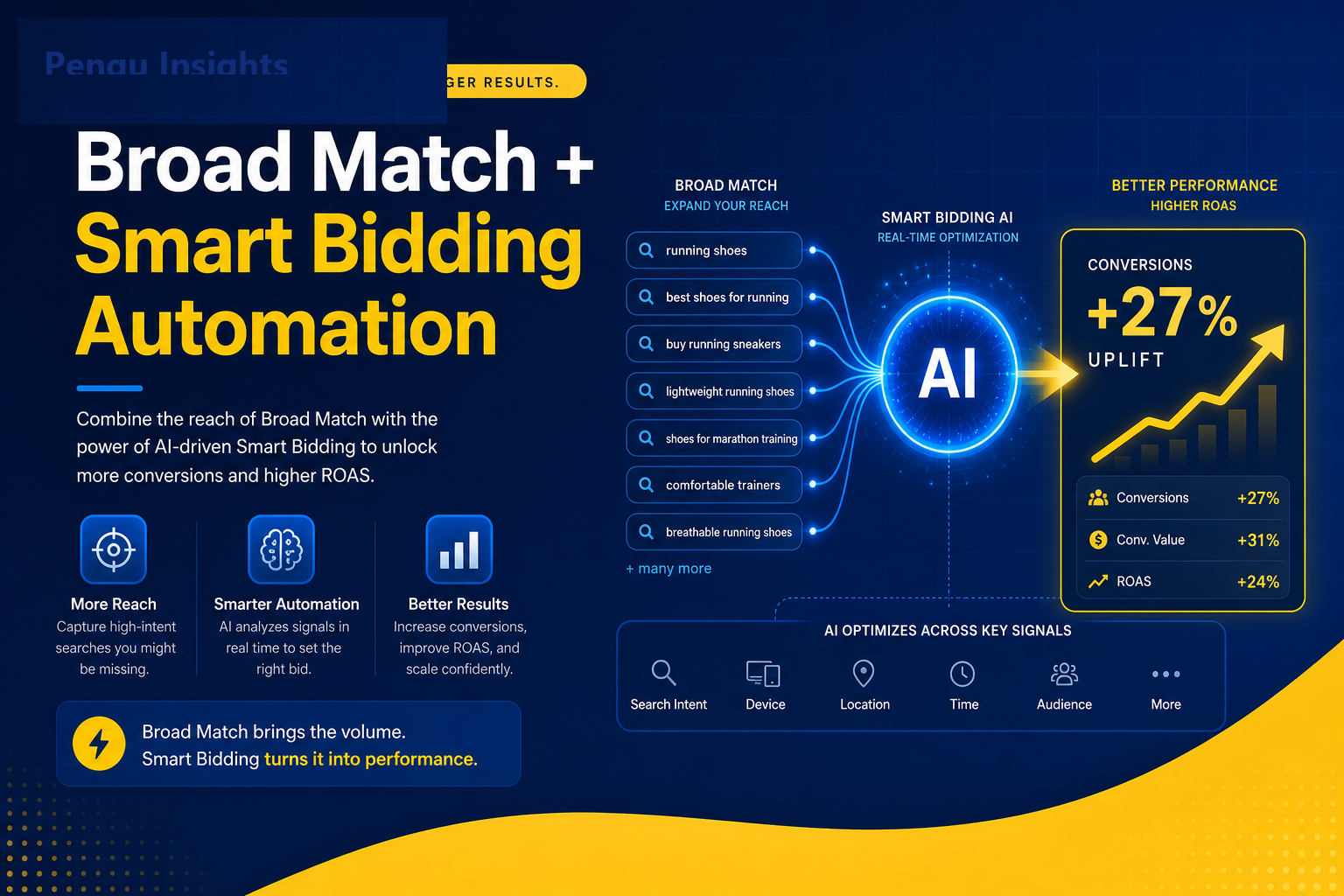
Think of broad match plus Smart Bidding like giving a smart assistant your shopping list and letting them pick the store, the brand, and the checkout lane.
It works great if the assistant knows your taste and you check the receipts. It fails if they guess wildly and you never review what they bought.
Broad match used to be the match type you accidentally left on. In 2026, paired with Smart Bidding and AI automation, it is a deliberate scale lever for eligible accounts.
Brainlabs documented tests where broad match plus Smart Bidding increased conversions by about 27% at similar CPA in accounts that met readiness criteria (Brainlabs, broad match automation). This guide explains eligibility, setup, and the CPA tradeoffs practitioners should expect.
Key takeaways
- Broad match needs Smart Bidding, not manual CPC, for most modern accounts.
- Eligibility checklist matters more than hype. Tracking, volume, negatives, and LP quality come first.
- Brainlabs-style 27% conversion lifts happened in controlled conditions. Your mileage varies.
- CPA may wobble during learning. Budget caps and kill rules protect downside.
- Structure still wins. Separate brand, competitors, and generic discovery.
Video: should you actually use broad match?
Ten minutes from a Google Ads practitioner who is neither a broad match evangelist nor a refuser, which is the right place to stand.
Three things worth taking from it:
- Google has a commercial reason to push broad match. Broader matching monetises searches that exact keywords would never touch. That does not make it wrong for you, but it explains the constant prompts to switch.
- Not for a first campaign. His rule: test broad match once you have conversion data, negatives and a working landing page. Starting there burns budget on searches you cannot yet judge.
- Expect the account to argue. Remove broad match and the recommendations panel will keep asking you to add it back. Treat that as a default, not as advice.
The section on Smart Bidding above is the other half: broad match without a conversion signal is a wider net with no one holding it.
Why Google pushes broad match plus automation
Query diversity grew. Users search in questions, fragments, and voice-like phrases. Exact-only accounts miss converting variants. Google's answer: broad match for reach, Smart Bidding for bid decisions, automation rules for ops.
This aligns with Google's documented guidance to pair broad match with conversion-based Smart Bidding. The algorithm needs freedom to probe queries and feedback from conversion signals to prune waste.
That does not remove human responsibility. It shifts human work from daily bid tweaks to structure, creative, landing pages, negatives, and signal quality.
The eligibility checklist
Before you scale broad match, answer these questions honestly:
1. Do you trust your conversion tracking?
Smart Bidding optimizes to whatever you measure. If the pixel fires on the wrong page, the algorithm learns the wrong lesson.
2. Do you get enough conversions?
A practical rule of thumb is 30+ conversions per month in the campaign or ad group you want to expand. Thin data makes cost per acquisition bounce around.
3. Can you block junk searches?
Broad match without negatives is how budgets leak into "free," "jobs," or wrong-product queries. Keep shared negative lists and update them weekly.
4. Do landing pages match what people searched?
If broad match finds "cheap X" but your page sells premium X, relevance and conversion rate suffer.
5. Is brand traffic separated from generic discovery?
Mixing them muddies metrics. You may think broad match is winning when brand is carrying the results.
6. Will someone review search terms every week?
Automation still misses patterns a human spots in ten minutes.
If you fail a critical item, fix it before expanding. No automation rescues broken tracking.
Time estimate: 45 minutes to audit tracking and list negatives before launching a broad test cell.
How Brainlabs-style testing framed results
Brainlabs case material described accounts moving from tighter match types to broad match with Smart Bidding under controlled tests. Reported outcomes included roughly 27% more conversions at similar CPA when prerequisites were met.
Interpret carefully:
- Tests ran in accounts with mature tracking and ops discipline
- Verticals with high intent variance may see smaller lifts
- CPA "similar" is an average; weekly variance still happens
- Lift is incremental to existing optimization, not magic
Run your own A/B or geo split when possible. Hold budget constant for 2 to 4 weeks. Compare incremental conversions and CPA against a phrase/exact control.
Setup workflow for broad match + Smart Bidding
Step 1: Clone a winning ad group
Time estimate: 30 minutes.
Pick an ad group with stable CPA on phrase or exact. Duplicate into a Broad Test ad group. Keep ads and landing pages identical initially.
Step 2: Choose bidding strategy
Time estimate: 15 minutes.
Pick the strategy that fits your goal:
- Target CPA if lead gen with fixed value
- Target ROAS if ecommerce with varied AOV
- Maximize Conversions only with budget caps you accept
Set targets from trailing 30-day performance, not hope.
Step 3: Add broad keywords
Time estimate: 15 minutes.
Convert core terms to broad match syntax. Avoid dumping hundreds of keywords. Start with 5 to 15 seeds per ad group theme.
Step 4: Layer negatives
Ongoing task.
Import shared account negatives. Add campaign-specific exclusions. Review search terms twice weekly during learning.
Step 5: Automate ops where helpful (optional)
Rules examples:
- Pause keywords with spend > 3x CPA and zero conversions (7-day window)
- Alert email when daily spend spikes 50%
- Scheduled negative list updates from approved search term exports
Automation assists review. It does not replace reading queries.
For match type basics, see Google Ads keyword match types.
CPA tradeoffs and learning phases
Expect 2 to 4 weeks of instability after major broad launches. CPA may rise before the model prunes queries.
Mitigations:
- Daily budget caps on test campaigns
- Portfolio bid strategies to share learning across similar ad groups
- Kill switch: revert ad group if CPA exceeds target by 40% for 14 days with adequate spend
Do not panic-adjust targets daily. Weekly changes with enough conversion volume per Google guidance.
In our reviews, broad match fails most often on offer weakness, not algorithm weakness. If landing pages convert at 1%, broad match finds more 1% traffic. Fix the page before you fix the match type.
AI automation beyond Google's black box
Agency and in-house teams add:
- Scripts to flag new search terms by spend threshold
- Looker or Sheets dashboards on search term categories
- Creative rotation tests feeding RSAs that cover broader intent angles
- Offline conversion imports so Smart Bidding values sales, not form spam
Brainlabs-style "AI-powered automation" is this full stack, not toggling broad match alone.
When to avoid broad match automation
- New accounts under 15 conversions/month
- Regulated categories requiring literal query control
- Promos with tight legal copy requirements per exact wording
- Single-offer pages that cannot support query diversity
- Brand campaigns (keep brand exact/phrase tight)
Measuring success
Track test vs control:
- Conversions and CPA
- Incremental conversion volume at marginal CPA
- Impression share and new query coverage
- Quality Score and LP experience trends
- Sales quality (lead scoring, refund rate, LTV)
A 27% conversion lift that drops lead quality is a failure even if CPA looks fine.
Pair paid scale with organic context in Google organic and paid search in 2026.
What to do next
Score your account against the eligibility checklist. If you pass, clone one proven ad group into a broad Smart Bidding test with budget guardrails. Schedule weekly search term reviews for one month. Promote winners, kill losers, document CPA delta. Automation rewards discipline, not shortcuts.
To see the ads your competitors are running while you test broad match, open the Ad Spy in Pengu Insights. Free plan, no card.
FAQs
Should I use broad match with Smart Bidding?
Use broad match with Smart Bidding when your account has reliable conversion tracking, sufficient monthly conversion volume, strong negative keyword discipline, and landing pages that match varied query intent. Skip it on brand-new accounts with thin data.
What is AI-powered automation for broad match?
Google bundles broad match with Smart Bidding strategies (Target CPA, Target ROAS, Maximize Conversions) so the system can explore related queries while optimizing bids toward your goal. Some agencies add automated rules and scripts for negatives and budget pacing.
Did broad match tests show conversion lifts?
Brainlabs published testing where broad match plus Smart Bidding delivered around 27% more conversions at similar CPA in eligible accounts. Results vary by vertical, offer, and tracking quality. Treat published lifts as hypotheses to test, not guarantees.
What are the risks of broad match automation?
Irrelevant spend, CPA spikes during learning, brand traffic mixing with generic if structure is loose, and overconfidence in automation when landing pages or offers are weak.
How many conversions do I need before broad match scale?
Rule of thumb: 30 or more conversions per month per campaign or ad group for Smart Bidding to stabilize, though Google suggests more for Target ROAS. Low volume accounts should stay tighter on phrase and exact.
Written by

Founder of Pengu Insights. Competitive intelligence practitioner for DTC brands and marketing agencies.