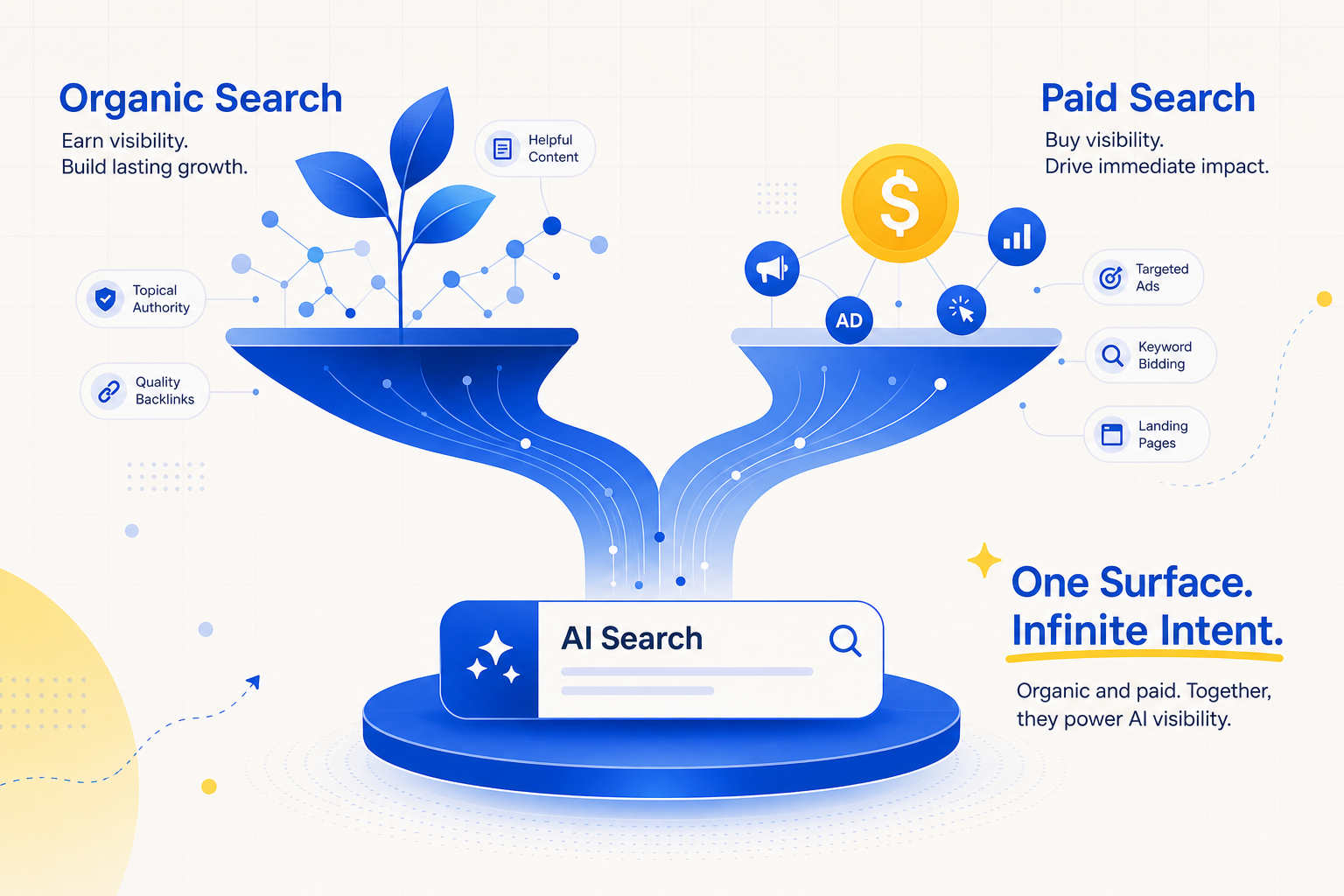
Organic and paid search used to live in different meetings. SEO owned blue links. Media owned auctions. In 2026, AI surfaces blur that wall. OpenAI reported that ChatGPT reached about 700 million weekly active users by mid-2025 (OpenAI, 2025), accelerating the shift toward conversational answers. Google responded by expanding AI experiences and testing deeper ad integration. Your brand now trains both ranking systems and ad systems with the same public footprint.
This article explains how organic discovery and paid search evolve together when users chat instead of typing three-word queries. You will see what changes in intent, what "brand profile" means for ads, and which ops moves to make this quarter. For citation-focused organic strategy, pair this with generative engine optimization (GEO). For research workflows, see dominating AI search with live SEO data.
Key takeaways
- Organic and paid share one brand signal layer. Site copy, reviews, social proof, and product feeds train AI matching.
- ChatGPT scaled to roughly 700M weekly users (OpenAI, 2025), forcing search platforms to own conversational experiences.
- Keywords become context. Conversation-length queries reveal budget, constraints, and goals traditional match types never saw.
- Reward the right conversions. Import offline or CRM value so smart bidding learns profitable customers, not lead volume alone.
- Early movers compound. Clean data compounds like interest. Messy feeds and thin pages teach the system the wrong story.
Why is Google rewriting the search business model?
For roughly 25 years, Google's core model was simple: query, list of links, paid click. Alphabet reported that Google Search and other advertising remained the company's dominant revenue engine, with Google advertising revenues exceeding $260 billion for full-year 2024 (Alphabet Q4 2024 earnings). Protecting that engine while users migrate toward chat is the strategic tension of 2026. AI Mode and AI Overviews keep people inside Google longer. Ads must follow that behavior without destroying trust.
Gartner predicted traditional search volume could drop by 25% by 2026 as AI answers absorb demand (Gartner, February 2024). Whether the exact percentage lands, the direction is clear: fewer casual clicks, richer remaining intent. Organic teams win by becoming citable. Paid teams win by teaching systems which customers are valuable. Leadership wins when both teams share data.
Google is not abandoning search ads. It is moving the auction closer to conversation context. Brands that still optimize only for isolated keywords will miss the intent sitting in the surrounding chat.
How does conversational intent change keyword strategy?
Classic searches look like "best running shoes." AI Mode style prompts look like "I am training for my first marathon, I overpronate, and my budget is $300. What shoes fit?" The second query contains beginner status, a biomechanics constraint, a budget, and a goal. Google has publicly described AI experiences as using more context than a single keyword string (Google Search blog / AI features). That is why "keywords are dead" headlines spread. The accurate version: seed keywords still map markets. Creative and landing pages must answer conversations.
What organic teams should change (30 to 60 minutes per priority URL)
Rewrite money pages so H2s answer constraint-led questions. Add specs plus use cases. Publish comparison and fit guides that models can quote. Structure still matters: Ahrefs found 76% of AI Overview citations came from top-10 organic pages (Ahrefs, July 2025). Organic strength remains the citation ticket.
What paid teams should change (this week)
Expand negative and audience thinking into value rules. Feed product attributes that match conversational facets. Stop writing ads that only echo the head term. Mirror the constraints users actually type.
How do brand signals influence ads and organic visibility?
Google's AI systems read more than your bid. They observe your site quality, reviews, social consistency, and product data. Alphabet and Google Ads documentation increasingly stress asset and feed quality for automated campaigns (Google Ads Help, asset and feed guidance). In practice, a luxury brand with consistent positioning trains a different matching model than a store with thin descriptions and angry reviews.
Organic pages are part of that training set. So are testimonials, About copy, and public social posts. If your website looks abandoned and your ads claim premium service, the system sees the conflict. Competitive intelligence helps here: map how rivals present proof across search, social, and ads. Start with a structured competitor website analysis, then extend to social and creative patterns.
Feed hygiene checklist (20 to 40 minutes per catalog segment)
- Titles and descriptions answer use-case questions, not only SKU jargon.
- Attributes cover the filters people chat about (budget band, skill level, compatibility).
- Images and reviews stay current.
- Discontinued or out-of-stock items do not poison matching.
- Landing pages match the promise in the feed.
Garbage in still means garbage out. Rich, specific, current data teaches automated campaigns to find better customers.
What playbook should marketers run for organic and paid search together?
Treat the Google Ads account as an AI training system, not a daily keyword micromanagement console. Smart bidding already outperforms most manual bid tweaks when conversion data is clean (Google Ads, Smart Bidding overview). Your job is instructions and rewards.
Shared operating system (weekly, 60 to 90 minutes)
- Define valuable customers. Import offline conversions or CRM values when you can (45 minutes first setup).
- Align landing pages and feeds. Organic briefs and product copy share the same constraint language.
- Cover campaign types carefully. Performance Max and max-for-search style campaigns may access AI Mode inventory as rollouts continue. Confirm in-account, then prioritize data quality over endless new campaign shells.
- Measure assisted outcomes. Track branded search lift, assisted conversions, and AI citation presence, not only last-click ROAS.
- Watch competitors. See which rivals win the conversation with proof, not only with bids. Use competitor product mapping for offer gaps.
Will users click ads inside AI conversations?
Nobody has a final public answer with perfect precision. If conversations resolve in-product, click-out rates may fall. SparkToro and Datos have repeatedly documented high zero-click shares on traditional Google results already (SparkToro / Datos, 2024). AI Mode can intensify that pattern. The counterweight is intent quality. Someone who spent five minutes clarifying budget and constraints is often closer to purchase when they do click.
Pricing models may evolve toward impressions, engagements, or in-flow conversions. Plan for measurement flexibility. Do not freeze strategy until the final rate card drops. Train the system now with clean conversions and coherent brand data.
To see which keywords a competitor ranks for organically and which ones they pay for, run their domain through Competitor Keywords in Pengu Insights. Free plan, no card.
Frequently asked questions
How do organic and paid search work together in 2026?
They share brand, product, and intent signals more than ever. Strong organic pages, clean product feeds, reviews, and consistent messaging help Google's AI understand who you serve. That context influences both classic rankings and when ads appear inside AI-assisted search experiences.
Are keywords dead in Google AI Mode?
Short head keywords are less sufficient, not irrelevant. Conversational queries carry budget, constraints, and use cases. Keyword research still maps demand. Creative, landing pages, and feeds must answer the full conversation, not only the two-word seed term. For AI-answer formatting, see GEO.
Should I run Performance Max if I care about AI Mode?
Google has indicated Performance Max and related max-style search campaigns can participate as AI Mode ad inventory expands. Exact availability varies by market and account. Treat campaign type coverage as necessary but not sufficient. Feed quality and conversion signals matter more than the label on the campaign.
Will AI Mode kill website clicks?
Some queries will resolve inside the conversation. Others still send high-intent traffic. Zero-click behavior already exists on classic SERPs. The practical response is stronger citation-ready content, cleaner feeds, and conversion tracking that teaches which customers are valuable.
What is feed hygiene for Google Ads in 2026?
Feed hygiene means product and business data that is complete, current, and written for how people ask questions. Specs alone are weak. Add use cases, constraints, and proof. Garbage in still means garbage out when AI systems match ads to conversational intent.
What should you do next?
Unify SEO and paid standups around one brand signal checklist. Fix feeds and money-page copy for conversational constraints. Import better conversion values. Confirm which automated campaign types can enter AI Mode inventory in your account. Track competitors' proof assets as carefully as their bids. For a live walkthrough of AI marketing ops and competitive research, join penguinsights.io/webinar/marketing-ai.
Organic and paid are no longer parallel hobbies. They are two interfaces to the same AI understanding of your brand. Train that understanding on purpose.
Written by

Founder of Pengu Insights. Competitive intelligence practitioner for DTC brands and marketing agencies.