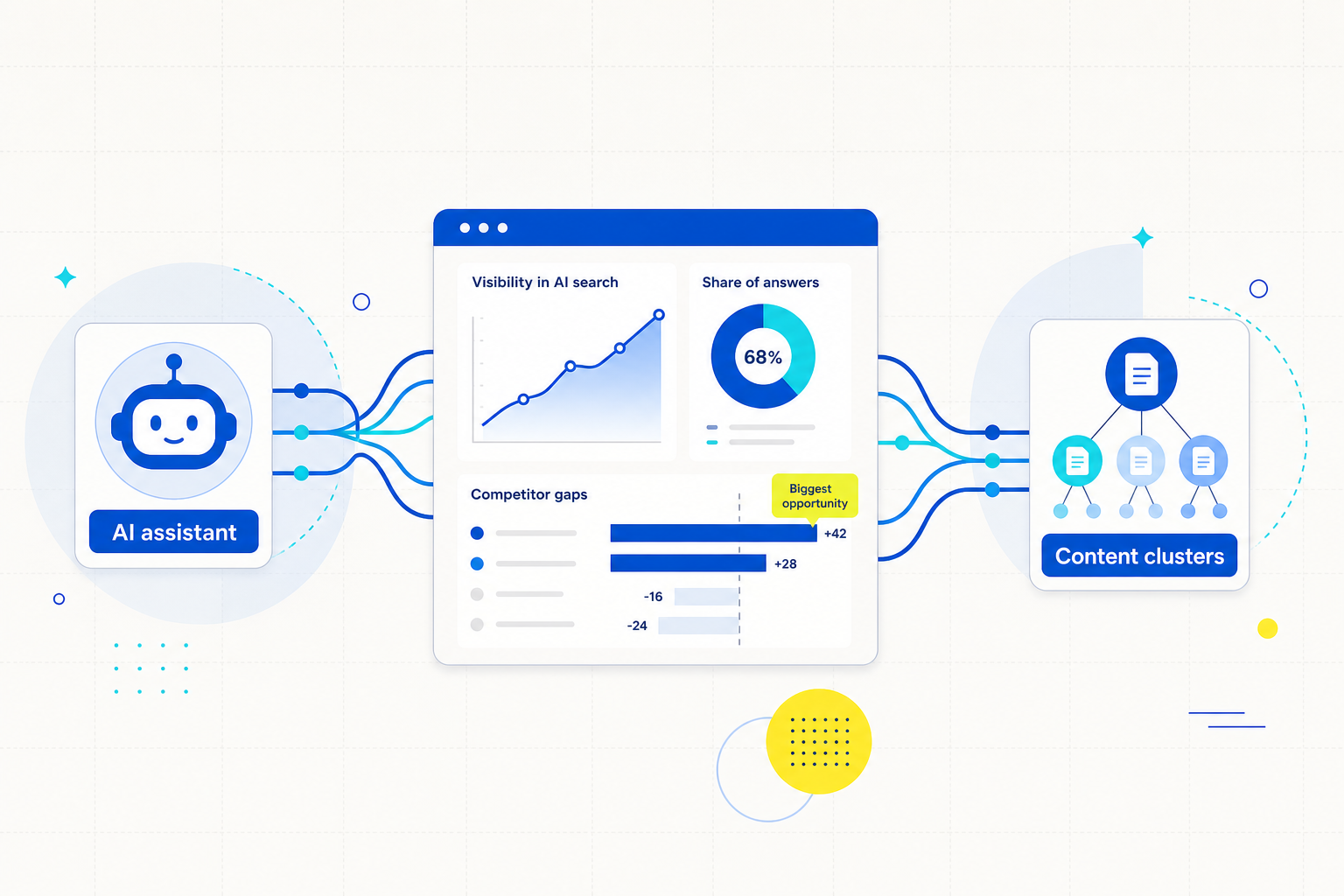
AI search results are not a side channel anymore. Buyers ask ChatGPT, Perplexity, Claude, Gemini, and Google AI Overviews before they click ten blue links. If your pages are not structured for citation, you lose the answer slot even when you rank.
In 2025, Ahrefs reported that 76% of AI Overview citation sources came from pages already ranking in the top 10 organic results (Ahrefs, July 2025). That is the core insight for 2026: AI visibility still rides on strong SEO fundamentals, then rewards pages that are easy for models to quote. This guide shows a practical workflow: connect an AI assistant to live SEO data, find competitor gaps, and ship content clusters built for LLM citation. What is generative engine optimization (GEO)? covers the concept layer. Here we focus on the operating system.
Key takeaways
- AI citation still follows organic strength. Roughly three in four AI Overview sources sit in the classic top 10 (Ahrefs, 2025).
- The advantage is live data inside the chat. Claude, ChatGPT, or Gemini alone guesses. Connected to volumes, difficulty, and competitor traffic, they prioritize like an analyst.
- Gaps beat brainstorming. Pull what rivals own, score citation potential, then cluster topics before you write.
- Stack choice is flexible. Semrush One via MCP, DataForSEO APIs, or custom pipelines all work if the workflow is the same.
- Distribution still matters. Pair SEO gaps with competitor social and ad signals so you know which angles already convert attention.
Why do AI search results reward pages that already rank?
In 2025, Ahrefs' AI Overviews study found that 76% of cited domains already held a top-10 organic position for the query (Ahrefs, July 2025). Models prefer sources they can trust from the open web, and ranking is a noisy but useful trust proxy. That means "GEO" without SEO is incomplete. You still need authority, topical depth, and crawlable structure. AI search amplifies winners. It rarely invents new ones from nowhere.
Gartner predicted that traditional search engine volume could fall by 25% by 2026 as users shift toward AI answers (Gartner, February 2024). Whether the exact percentage lands, the direction is clear: fewer clicks per query, more answer extraction. Your job is to become the paragraph that gets pulled.
Treat AI search as a citation market. You win by publishing the clearest, most verifiable passage on a topic where you already have (or can earn) organic credibility. Volume without quotability loses. Quotability without authority rarely gets selected.
For the concept layer, see what is generative engine optimization (GEO).
What workflow connects an AI assistant to live SEO data?
In our experience, teams that cut research time the most follow one pattern: assistant + live metrics + competitor list. SparkToro's zero-click research has long shown that a large share of searches end without a click (SparkToro / Datos, 2024). That pressure makes slow spreadsheet SEO harder to justify. Live data in the chat compresses analysis from hours to minutes.
Option A: Claude (or similar) via MCP to an SEO platform
Model Context Protocol (MCP) lets an assistant call tools instead of inventing numbers. Semrush One is one example of an SEO + AI visibility suite you can wire in. Ask for keyword volumes, difficulty, competitor organic pages, and traffic estimates in one thread. The value is not the brand name. It is fresh data inside the reasoning loop.
Option B: DataForSEO-style APIs and custom stacks
Many agencies prefer API-first stacks. DataForSEO, Ahrefs APIs, or internal warehouses feed the same questions. You can expose them through MCP servers, scripts, or notebooks. Claude remains one strong front-end. ChatGPT with tools, Gemini with grounding, or a private agent all fit if the data layer is real.
Option C: Hybrid for competitive intelligence
SEO APIs explain search demand. They do not show how competitors promote winning pages on Instagram, TikTok, LinkedIn, or Meta Ads. Soft stack tip: use your SEO connector for gaps, then a CI layer like Pengu Insights for competitor content and ad patterns around those same topics. That combination answers "what should we publish" and "how are rivals distributing it."
How do you run competitor gap analysis in minutes?
In 2024, HubSpot's State of Marketing reported that 70% of marketers already used AI tools in some form (HubSpot, 2024). The teams that win in 2026 are not the ones who "use AI." They are the ones who ask AI the right questions against live competitor data. Gap analysis is the highest leverage ask.
Step 1: Define the competitive set (10 minutes)
List 3 to 5 true competitors, not aspirational brands. Include search rivals and commercial rivals. Need a refresher on what counts? See examples of competitors and how to analyze a competitor website.
Step 2: Pull live overlap and unique keywords (15 minutes)
Ask the connected assistant:
- Which keywords do competitors rank for that we do not?
- What is search volume and keyword difficulty for each?
- Which of their pages drive the most organic traffic?
- Which gaps look like definitional or how-to queries (high citation potential)?
Without live data, you get generic advice. With it, you get a prioritized list.
Step 3: Score for LLM citation potential (15 minutes)
Not every high-volume keyword is citation-friendly. Favor queries where a model needs a crisp answer: definitions, comparisons, step lists, pricing ranges, methodology notes. Deprioritize vague brand vanity terms.
We score gaps on three axes: demand (volume), winnability (difficulty + your current topical authority), and quotability (can a model lift a 40-60 word answer?). High on all three becomes the next cluster seed. High volume with low quotability often wastes a quarter of writing capacity.
Full site teardown steps live in how to analyze a competitor website.
How do you build topic maps optimized for LLM citation?
In 2025, Semrush's AI search research emphasized that visibility in AI answers correlates with multi-page topical coverage, not one-off posts (Semrush, 2025). One pillar page rarely feeds every related prompt. Topic maps do. Build clusters where each URL owns one clear question and links to siblings.
Cluster design rules (20 minutes)
- One primary question per URL. Match the H1/H2 answer-first pattern models extract well.
- Seed from gaps, not from a brainstorm board. Live competitor data keeps you honest.
- Add evidence blocks. Stats with year and source, short methodology notes, original tables.
- Write citation capsules. Self-contained 40-60 word passages an assistant can quote without context loss.
- Link the cluster. Internal links from intro, each H2 support page, FAQ, and conclusion.
Time savings for agencies and in-house SEO
Manual gap sheets for five competitors often burn 3 to 5 hours. With a connected assistant, we routinely finish a first-pass map in under 90 minutes, then spend human time on editorial judgment. That is the real ROI: more cycles on writing and distribution, fewer on copy-paste research.
Need help defining the set? Use examples of competitors before you pull keyword gaps.
What questions should you ask the assistant with live data?
McKinsey estimated generative AI could add $4.4 trillion in annual productivity value across use cases, with marketing and sales among the top functions (McKinsey, 2023). Productivity only shows up if prompts are operational. Vague "write me a content strategy" prompts waste tokens. Live-data prompts create decisions.
Try these with your connected stack:
- "Compare our domain to [Competitor A/B/C]. List keyword gaps with volume over 200 and difficulty under 50."
- "Which competitor pages look most citable for AI answers (definitions, how-tos, comparisons)?"
- "Build a topic cluster of 8 URLs from the top gaps, with H1 questions and internal link suggestions."
- "Flag gaps where we have social or ad proof from rivals but no ranking page yet."
- "Estimate research time saved vs a manual Semrush export workflow for this same brief."
Notice the last prompt. It forces the assistant to stay grounded in the data you provided, not invent case studies.
How should SEO, GEO, and competitive intelligence work together?
BrightEdge and other SEO firms have documented that AI Overviews appear on a growing share of informational queries, often compressing click-through to classic results (BrightEdge, 2024). Winning the citation and winning the click are related jobs. Treat them as one program.
| Layer | Job | Typical tools |
|---|---|---|
| SEO data | Volumes, difficulty, traffic gaps | Semrush, Ahrefs, DataForSEO |
| AI assistant | Prioritize, cluster, draft outlines | Claude, ChatGPT, Gemini |
| GEO craft | Answer-first structure, citation capsules | Editorial process |
| Competitive intelligence | How rivals promote topics on social and ads | Pengu Insights, ad libraries |
Skip the last row and you publish into a vacuum. You might own the page and still lose attention to a competitor's creative that already validated the angle.
Putting the workflow into practice this week
You do not need a perfect stack on day one. Start with one assistant, one data connection, and three competitors. Run a 90-minute sprint. Ship one cluster outline. Then measure whether new pages earn organic positions and, later, AI mentions for their target questions.
Want the live walkthrough of how teams wire this into weekly marketing ops? Join our free session on AI for marketing teams: Marketing AI webinar.
Next step: pick your competitive set, connect live SEO data to your assistant of choice, and score gaps for quotability before you write another outline. That is how you dominate AI search results without treating any single vendor as the strategy.
Claude can query the same data directly: Pengu Insights ships an MCP server (beta), and the AI Visibility Tracker shows who AI answers cite today. Free plan, no card.
Frequently asked questions
How do you get cited in AI search results?
Publish clear, citable answers on topics where you already rank or can realistically win. Use answer-first sections, sourced statistics, and self-contained passages. Ahrefs found that 76% of AI Overview citations come from top-10 organic pages (Ahrefs, July 2025), so classic SEO still feeds AI visibility.
Do I need Claude and Semrush to win AI search?
No. Claude is one capable assistant. Semrush One is one data suite. The winning pattern is any LLM connected to live keyword, difficulty, and competitor traffic data, including DataForSEO-style APIs through MCP or custom agents.
What is the fastest way to find AI content gaps?
Export or query competitor keywords you do not own. Score by volume, difficulty, and citation potential. Cluster the winners into topic maps before drafting. Connected assistants turn this into a single conversation instead of five browser tabs.
How long does an AI visibility research sprint take?
With live data in the chat, a solid gap map and cluster usually takes 45 to 90 minutes. Manual spreadsheet workflows for the same output often take half a day for agencies running multiple clients.
How does competitive intelligence support AI search strategy?
SEO tools show demand and ranking gaps. Competitive intelligence shows how rivals promote those topics through content and ads. Pair both so you publish citable pages and borrow distribution lessons that already work in your category. For website-level signals, start with how to analyze a competitor website.
Written by
Founder of Pengu Insights. Competitive intelligence practitioner for DTC brands and marketing agencies.