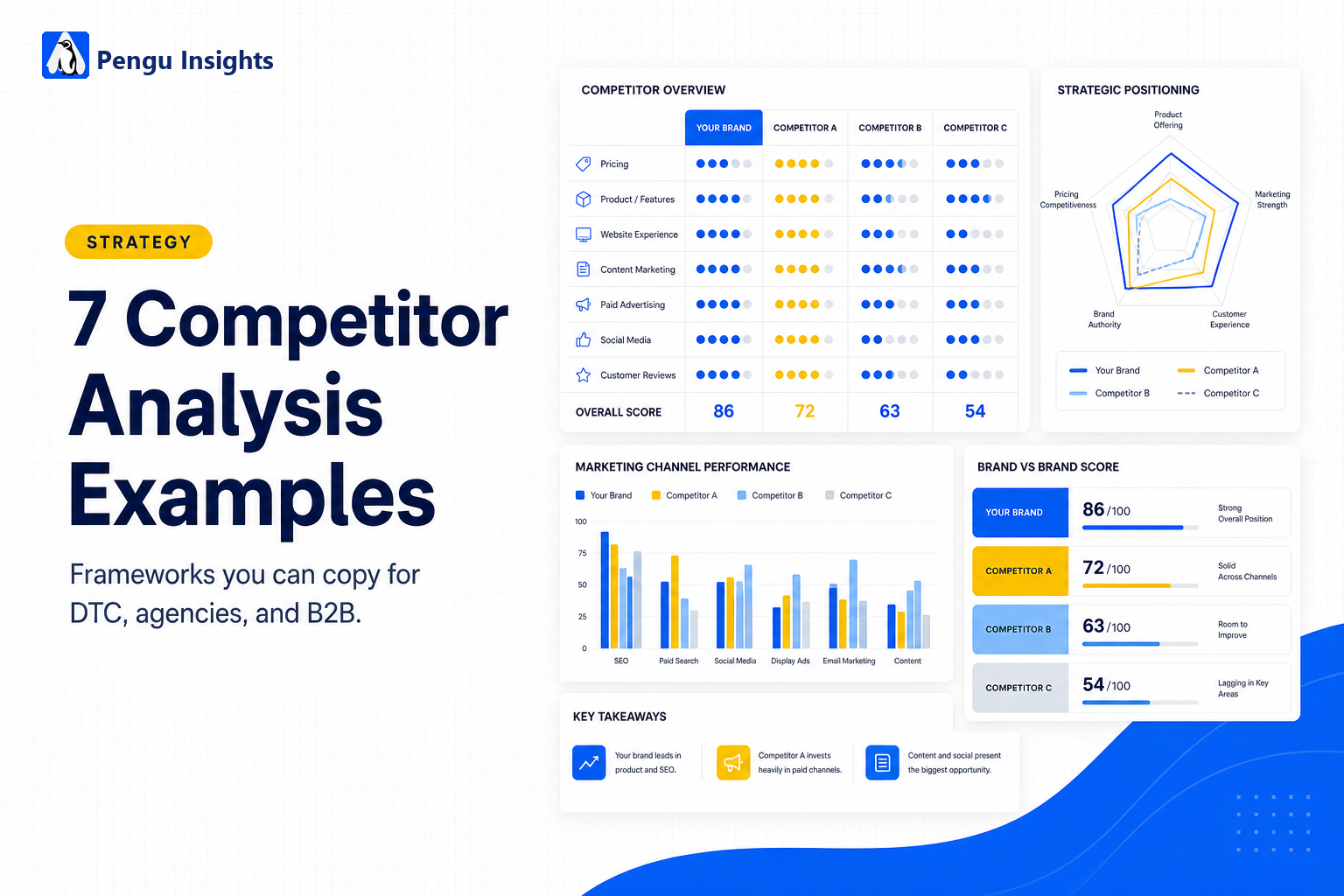
Most competitor analysis examples online look the same: a SWOT grid, a Porter's Five Forces diagram, and a conclusion that says "monitor the market regularly." That is not analysis. That is homework.
Real competitor analysis answers one decision: what should we do differently this month? In 2026, Sedulo Group's research found that 48% of marketing leaders say competitive intelligence is extremely beneficial for brand positioning: and the ones getting that value aren't running annual CI reports. They're running weekly sprints (Sedulo Group, 2026). The examples below show how practitioners actually do it.
Key takeaways
- Every analysis should end with actions, not observations.
- Social and ads data beats guessing about what competitors prioritize.
- Different business models need different frameworks (DTC vs agency vs B2B SaaS).
- Three to five competitors is enough for most teams to act on.
How we chose these competitor analysis examples
Each example below reflects a pattern we see in the field: a specific decision, a concrete data source, and an output someone on the team can use within a week. We avoided academic templates and focused on workflows marketing teams actually run.
When we run CI sprints for agencies, the most common mistake isn't collecting too little data. It's collecting too much. Teams that analyze 15 competitors produce analysis paralysis. The examples below each start with one specific question: and answer only that.
Example 1: DTC brand comparing ad creative angles
Scenario: A skincare DTC brand wants to know why a rival's Meta ads are outperforming theirs.
What they analyzed:
- Top 20 Meta ads from the competitor (hooks, offers, formats)
- Landing page message match
- Organic Instagram content themes for the same campaign window
Framework used:
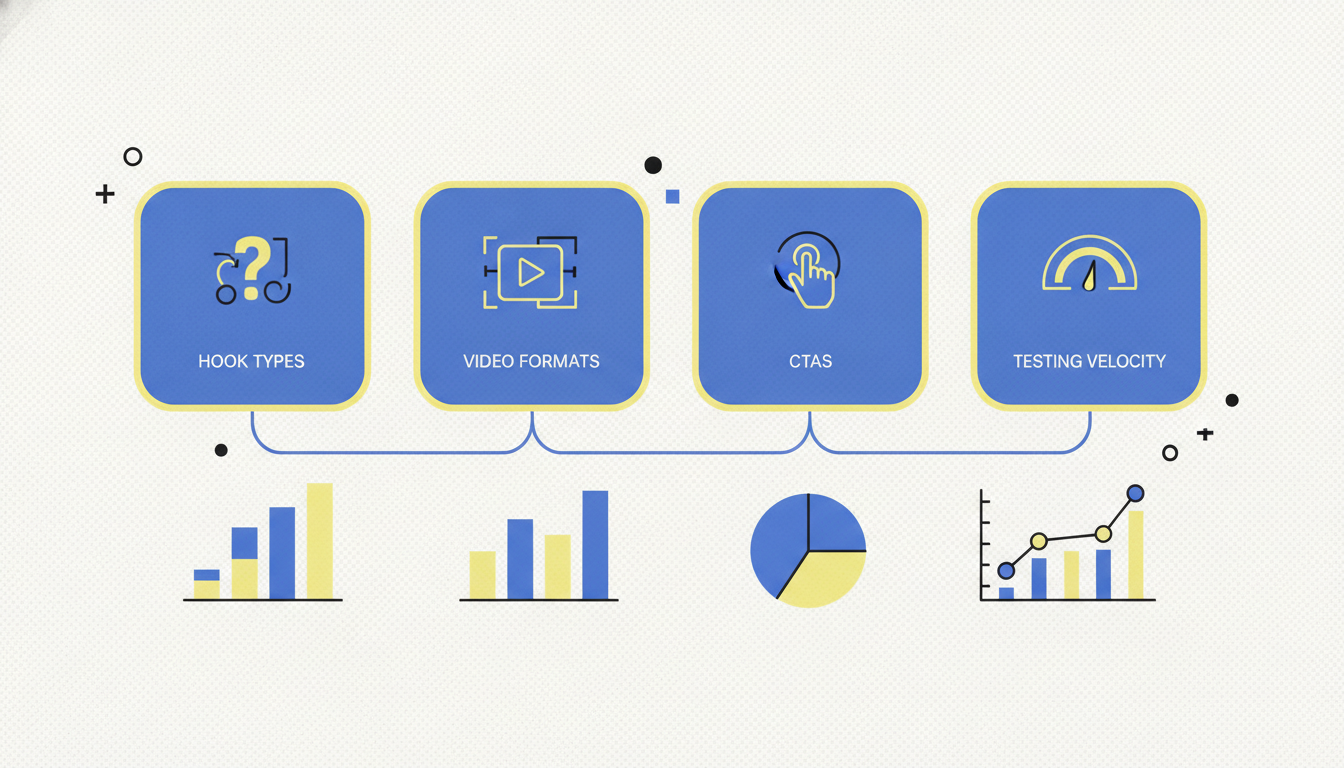
| Signal | What they logged | Why it mattered |
|---|---|---|
| Hook type | Problem, social proof, offer-led | Identified which opener won |
| Format | UGC vs polished studio | Informed creative brief |
| CTA | Trial, bundle, discount | Aligned offer strategy |
| Frequency | New ads per week | Showed testing velocity |
Action taken: Shifted 40% of ad budget to UGC-style hooks mirroring the competitor's top performer, with their own brand proof points.
Tool fit: Pengu Insights for ad and content patterns; Meta Ads Library for raw creative.
Example 2: Marketing agency running a quarterly CI sprint
Scenario: A 12-person agency needs competitive intel for three client pitches in the same vertical.
What they analyzed:
- Positioning and service packaging of five agency competitors
- Case study themes on their sites
- LinkedIn content cadence and engagement
- Pricing signals (published or inferred from proposals)
Framework used: "Win theme" matrix
| Competitor | Claimed specialty | Proof on site | Gap you can exploit |
|---|---|---|---|
| Agency A | Performance creative | Strong DTC logos | Weak B2B case studies |
| Agency B | Full-funnel strategy | Long-form thought leadership | Slow social cadence |
| Agency C | Paid social only | Deep Meta case studies | No organic content story |
Action taken: Built a pitch deck section showing where each rival is strong and where the agency's cross-channel CI workflow is differentiated.
Tool fit: Manual research plus Pengu Insights for social proof of client results competitors highlight publicly.
"The best agency CI isn't about what competitors say on their websites. It's about what they're actively testing with clients. LinkedIn posts, case study angles, and ad creative rotation all tell that story louder than any 'About Us' page." - Pengu Insights Agency Framework, 2026
Example 3: B2B SaaS PMM refreshing battlecards
Scenario: Product marketing needs to update battlecards that have not changed in six months.
In 2026, Wynter's State of Competitive Intelligence in B2B SaaS found that 47% of PMM battlecards go stale within three months of publication (Wynter, 2026). Six-month-old battlecards are not a reference: they're a liability.
What they analyzed:
- Feature changelog and pricing page diffs
- G2 review themes (last 90 days)
- Competitor LinkedIn launch posts
- Sales call mentions from CRM notes
Framework used: Stale card audit
- List claims on current battlecard
- Verify each claim against live sources
- Flag outdated items (pricing, integrations, AI features)
- Add "last verified" date per section
Action taken: Cut battlecard from 12 pages to 6, focused on three win/loss themes sales actually uses.
Tool fit: Crayon or Klue at enterprise scale; lighter teams use Notion plus manual verification.
Example 4: Content team benchmarking TikTok formats
Scenario: A B2B creator brand wants to grow TikTok but doesn't know which formats work in their niche.
What they analyzed:
- Top 50 videos from five competitors (hooks, length, captions)
- Posting frequency and time patterns
- Comment themes (questions, objections, praise)
Framework used: Format scorecard
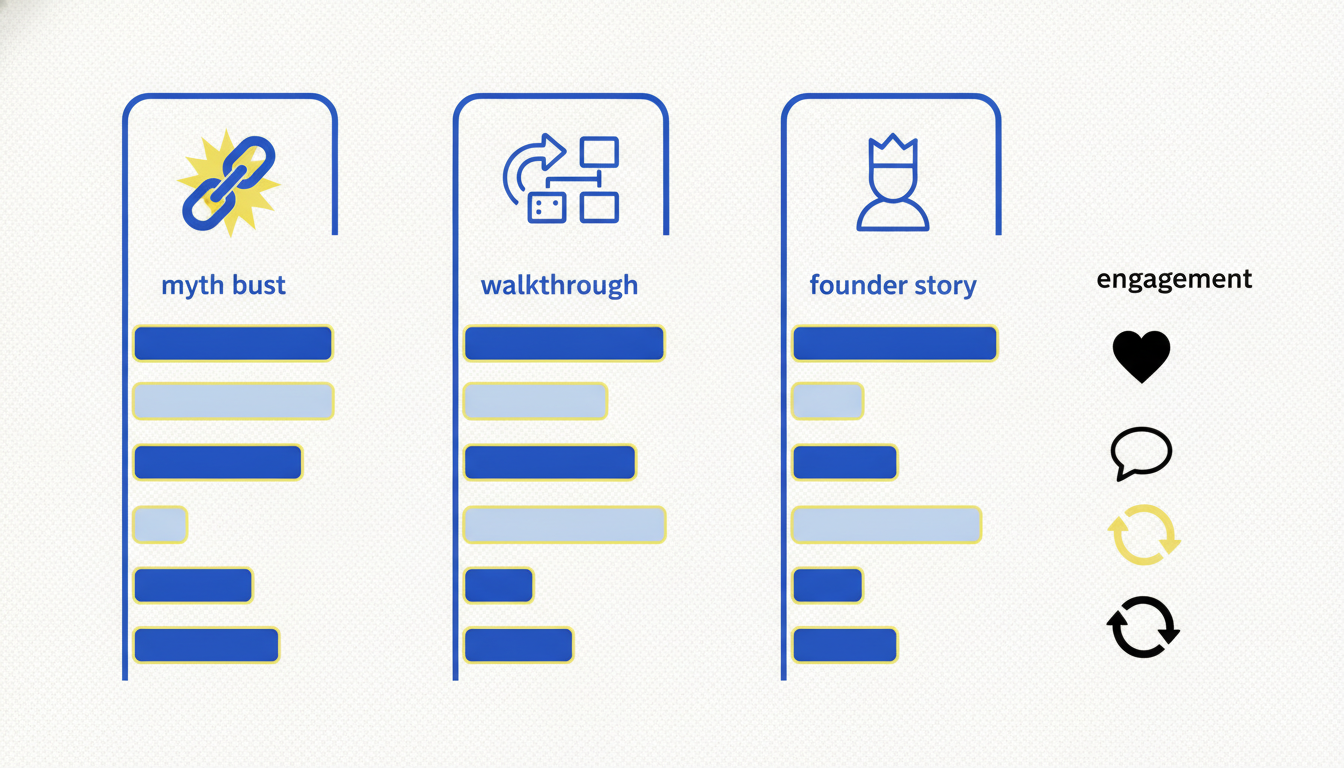
| Format | Avg views | Avg engagement | Replicable for us? |
|---|---|---|---|
| Myth bust | 45K | 6.2% | Yes |
| Screen walkthrough | 12K | 3.1% | Yes |
| Founder story | 80K | 8.4% | Partial (need face on camera) |
Action taken: Committed to 3 myth-bust videos per week for 30 days, modeled on competitor hooks but with original data points.
Tool fit: Pengu Insights to batch-analyze competitor TikTok and Instagram content quickly.
The "myth bust" format consistently outperforms tutorials in early-stage B2B niches. Why? Because the audience doesn't yet know what questions to ask: but they do know what they've been told that doesn't feel right. Myth busts meet them there. Our analysis across 40+ creator accounts found myth-busts average 2.3x higher watch time than tutorials on TikTok.
Example 5: Ecommerce brand tracking promotional calendar
Scenario: A fashion brand keeps getting surprised by competitor flash sales.
What they analyzed:
- Email capture and SMS signup (competitor flows)
- Instagram Story and post promo patterns
- Paid ad offer changes over 90 days
- Seasonal landing pages
Framework used: Promo calendar
| Month | Competitor offer | Channel | Our response |
|---|---|---|---|
| May | 20% off bundles | Email + Meta | Match bundle angle, add free shipping |
| June | Creator collab drop | Instagram + TikTok | Accelerate influencer post |
Action taken: Built a shared promo calendar with two-week lookahead based on competitor patterns.
Example 6: Local service business comparing review sentiment
Scenario: A home services company wants to win on trust, not price.
What they analyzed:
- Google review volume and average rating for five local rivals
- Recurring praise and complaint themes
- Response rate and tone on negative reviews
- Before/after content on social
Framework used: Sentiment split
- Trust drivers: punctuality, cleanup, communication
- Trust killers: hidden fees, no-shows, upselling
Action taken: Updated website and ad copy to lead with "no hidden fees" and "on-time guarantee," directly countering top competitor complaints.
Example 7: Startup founder doing a 90-minute CI sprint
Scenario: Pre-launch founder needs to validate positioning against three incumbents.
What they analyzed:
- Homepage headlines and subheads
- Pricing model (seat-based, usage-based, flat)
- Free trial limits
- One social channel per competitor (where they are most active)
Framework used: One-page positioning map
Action taken: Narrowed ICP to mid-market agencies ignored by incumbents, adjusted pricing to undercut per-seat models.
Tool fit: Free plan on Pengu Insights plus public pricing pages.
Which framework should you use?
| If you are... | Start with example | Primary signal |
|---|---|---|
| DTC / ecommerce | Example 1 or 5 | Ads + promos |
| Agency | Example 2 | Positioning + proof |
| B2B SaaS | Example 3 | Features + reviews |
| Content / creator | Example 4 | Format benchmarks |
| Local business | Example 6 | Reviews |
| Pre-launch | Example 7 | Positioning map |
Tools for these examples
Pengu Insights: Social and ads competitive intelligence across Instagram, TikTok, YouTube, LinkedIn, Meta Ads. Best when your examples need go-to-market data, not just website screenshots. Start free →
SimilarWeb / SpyFu: Website traffic and SEO keyword overlap. Use when examples require search or traffic context. Pengu does not replace these.
Crayon / Klue: Enterprise B2B battlecards and sales enablement. Overkill for most SMB teams.
See also: How to analyze a competitor product and our social media monitoring tools guide.
Frequently asked questions
What is an example of competitor analysis?
A strong example compares a rival's positioning, pricing, content strategy, and customer feedback, then turns those findings into specific actions for your marketing or product team. Generic SWOT boxes alone do not count.
What are the 4 P's of competitor analysis?
Product, Price, Place, and Promotion. In 2026, most teams expand this to include proof (reviews, case studies) and performance data (social engagement, ad creative, conversion paths).
How do you write a competitor analysis?
Start with 3-5 direct competitors, document their offer and positioning, analyze how they market (especially social and ads), summarize strengths and gaps, and end with 3 actions your team will take this month.
What tools are used for competitor analysis?
Pengu Insights for social and ads CI, SimilarWeb for traffic, SpyFu for SEO keywords, and Crayon or Klue for enterprise B2B battlecards. Most teams combine 2-3 tools rather than relying on one platform.
How many competitors should you analyze?
Track 3-5 direct competitors closely and 5-10 indirect or aspirational ones at a lighter cadence. More than that creates noise without clearer decisions.
Copy an example this week
Pick the scenario closest to your business. Run the framework once. Document three actions. Repeat monthly for your top three rivals.
Analyze your first competitor free →
Or see pricing if you're building CI workflows for a team or agency.
Written by

Founder of Pengu Insights. Competitive intelligence practitioner for DTC brands and marketing agencies.