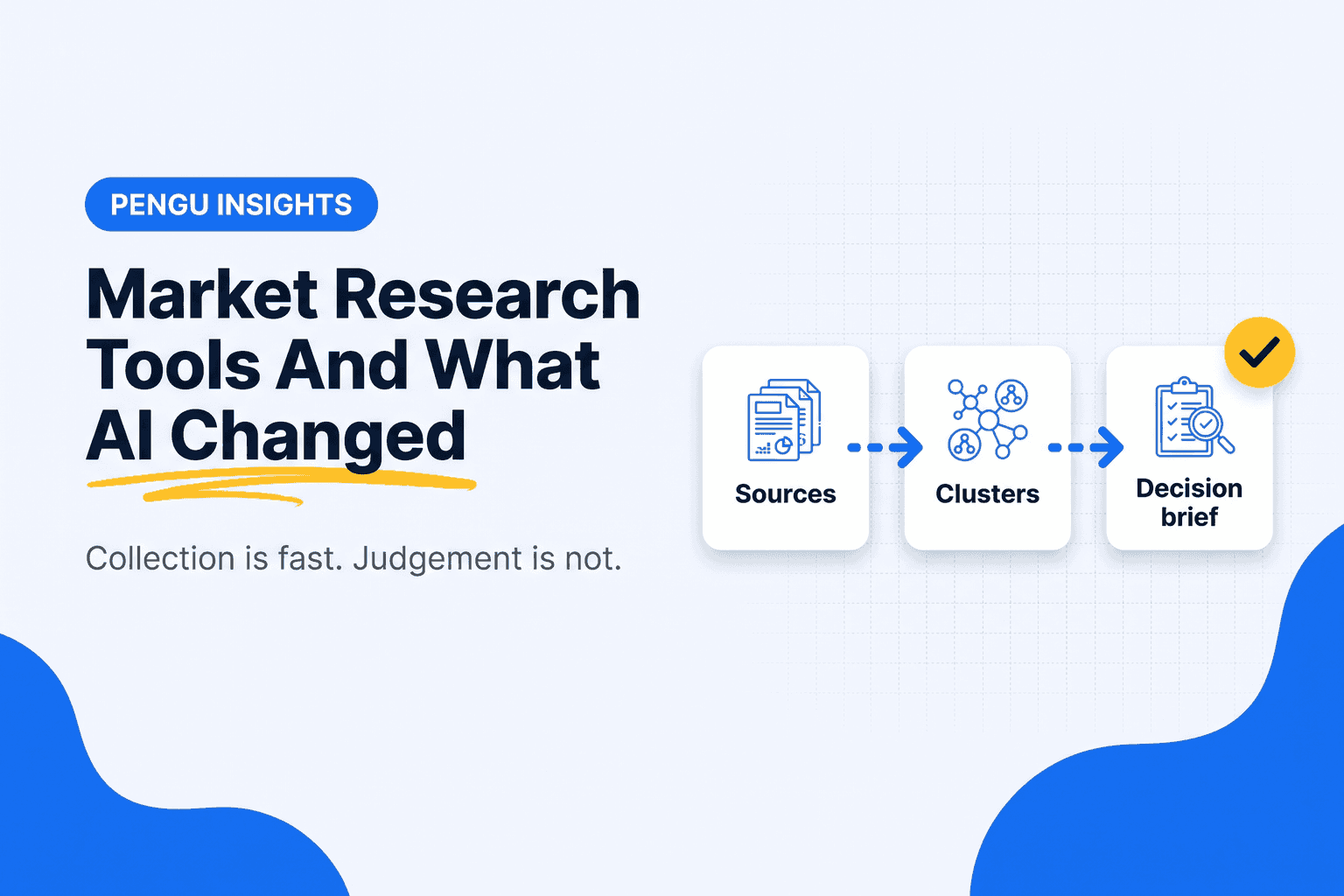
Market research used to mean six weeks and an invoice. AI compressed the collection half to an afternoon, which is genuinely useful, and made it trivially easy to produce a confident document full of statistics that never existed.
Both things are true at once. The difference is method.
Key takeaways
- AI handles collection and summarisation. It does not handle judgement.
- The most reliable market signals are the ones people pay or search for, not the ones they say in surveys.
- Every number in a research brief needs a source you opened yourself.
- Tool-based research is a subscription, not a project. Budget accordingly.
Video: five free market research methods that work before you buy a tool
Thirteen minutes of methods rather than software, which is the right order: the tool is only useful once you know what question it answers.
Three things worth taking from it:
- You do not want the total market. The total addressable market is everyone who could buy; the target is the segment you serve best and who will pay for it. Most failed messaging is a segment problem.
- Read book reviews in your category. Books take longer to write and edit than posts, so their reviews are a slower, more honest record of what customers care about and complain about.
- Match the message to the market. His central claim is that this one alignment makes every other marketing effort several times more effective, and that missing it is why businesses stall.
The tool comparison below is for the moment those questions are clear and you need data at scale.
What a market research tool actually is
The category is four different products wearing one label:
| Type | Answers | Typical cost |
|---|---|---|
| Survey platforms | What people say | $25 to $100/mo |
| Data panels | What large samples do | Quoted, annual |
| Competitive intelligence | What rivals publish, rank for and promote | From $39/mo |
| AI research assistants | What public sources already say | $0 to $20/mo |
Most teams asking for "a market research tool" want the third row and buy the first.
The five questions worth researching
Skip anything that does not answer one of these:
- Does demand exist? Search volume for the problem, not for your product name. Google Trends alternatives covers where to get the actual number rather than a 0-100 index.
- Who already serves it? Not who you think competes, who actually appears when a buyer searches. Our post on examples of competitors covers the difference.
- What do they charge, and for what? Pricing pages are public and reveal packaging logic.
- What are people angry about? Review sites and forums carry the objections your copy has to answer.
- What are competitors paying to say? An ad running for four months is a message that pays for itself, and the Meta Ad Library publishes every live creative for free.
Where AI is genuinely faster
Our roundup of AI marketing tools covers which model fits which job.
Clustering. Give a model 300 support tickets or 200 reviews and it will group them into themes in minutes. That job used to be a week of tagging and it is the single best use of AI in research.
Extraction. Pulling prices, features and claims out of twenty competitor pages into one table.
First-draft synthesis. Turning a folder of notes into a structured brief you then correct.
Translation of jargon. Turning what engineers call it into what buyers call it, which is where most keyword strategies quietly fail.
Where AI quietly breaks
Invented statistics. A model asked for "the market size of X" will often produce a number with a plausible source attached. If you did not open the source, do not publish the number.
Recency. Anything about pricing, funding or product features may be a year stale.
Small samples. With 40 responses, AI summarisation smooths away exactly the outlier that mattered.
Consensus bias. Models reproduce what the internet already agrees on. Research whose only value is contrarian insight will not come from a tool trained to average opinion.
A workflow that survives review
- Write the decision first. "Should we launch in the US or stay in Spain" produces different research than "tell me about the market".
- Collect signals with intent attached. Search demand, ad longevity, pricing, complaints. Skip anything based on stated preference.
- Cluster with AI, verify by hand. Let the model group; you open the top three sources per group.
- Write the brief with a source per claim. If a claim cannot carry a link, it is an opinion and should be labelled as one.
- End with a recommendation and a number you would bet on. Research that ends in "further study needed" cost you money and bought nothing.
Where a competitive intelligence platform fits
If your question is about a market that lives online, most of the evidence is already public and structured: what competitors rank for, what they publish, what they run as ads, whether AI assistants recommend them.
Pengu Insights covers that layer from $39 a month, including an AI market research tool that turns a niche and a competitor list into a brief, plus the raw data behind it so you can check the work. Pro at $69 adds AI visibility tracking, which answers a question no traditional research tool does yet: does ChatGPT name you when someone asks about your category.
Frequently asked questions
What is a market research tool?
Software that collects and structures evidence about a market: who competes, what customers search for and complain about, what things cost, how demand moves. The category spans survey platforms, data panels and competitive intelligence tools.
Can AI do market research?
It does collection and summarisation well and judgement badly. Used carelessly it also fabricates statistics that look exactly like real ones.
What is the best AI market research tool?
Perplexity and Claude for synthesising public sources with citations. A competitive intelligence platform when you need the underlying market signals rather than a summary of someone else's blog post.
How much does market research cost?
Panel studies run from thousands to tens of thousands per project. Tool-based research is a subscription: competitive intelligence from around $39 a month, survey tools $25 to $100.
How do I validate a market without a budget?
Use signals that carry intent: search volume for the problem, forum and support questions, ads competitors keep running for months, and complaints about existing solutions.
Written by

Founder of Pengu Insights. Competitive intelligence practitioner for DTC brands and marketing agencies.