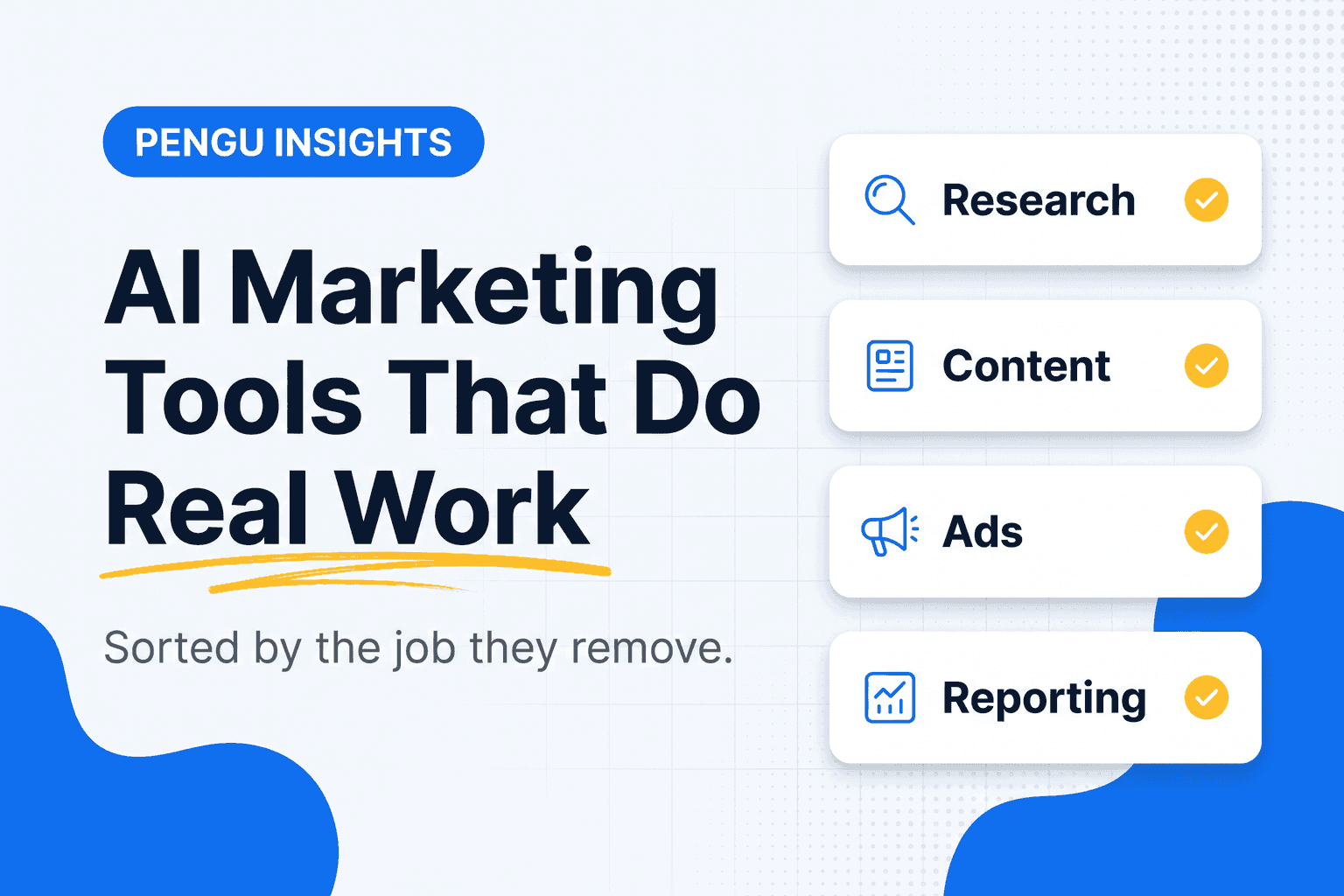
Most "best AI marketing tools" lists are affiliate pages sorted by commission. This one is sorted by the job each tool takes off your desk, which is the only ranking that survives contact with a real week.
Key takeaways
- AI is reliable at collection, summarisation and clustering. It is unreliable at taste.
- The tools worth paying for are priced below the labour they replace.
- Four common marketing jobs are still faster without AI. They are named at the end.
- Everything you publish needs a source and a human edit, or you are automating your own credibility problem.
Video: an AI marketing team built as commands, not as a tool
The most-watched video on this topic in the last year is not a tool review. It is someone assembling 15 marketing commands inside an AI coding assistant and running them on a real site.
Three things worth taking from it:
- The unit of work is a command, not a chat. "Audit this site", "write the email sequence", "scan these competitors" each run as a repeatable step with a defined output, which is how agencies actually bill.
- Parallel agents cut audit time to minutes. Five checks run at once and land in one PDF with a score and prioritised findings. The quality depends entirely on what each command is told to check.
- The report is the product. A scored audit with critical, high and medium findings is what clients pay agencies for, and it is now a template.
Our caveat: an audit is only as good as the data behind it. Connect the commands to live keyword, SERP and competitor data (the API and MCP in Pengu Insights exist for this) or the report is a well-formatted guess.
AI marketing tools, sorted by job rather than category
"AI marketing tool" is not a category, the same way "electric appliance" is not a category. The useful question is which of these five jobs you are trying to remove.
| Job | What it costs you weekly | Does AI actually help? |
|---|---|---|
| Research and competitor tracking | 3 to 6 hours | Yes, strongly |
| Content drafting | 4 to 10 hours | Partly, first drafts only |
| Ad creative and iteration | 2 to 5 hours | Partly |
| Analytics and reporting | 2 to 4 hours | Yes, strongly |
| Positioning and strategy | Untracked | No |
Research and competitor tracking
This is where AI earns its keep, because the work is collection and summarisation and the right answer is checkable.
1. Pengu Insights
Ours, so weigh it accordingly. From $39 a month it pulls competitor keywords, traffic, Instagram, TikTok and LinkedIn activity, and the Facebook ad library into one dataset, then answers questions about it in plain English. It also tracks whether ChatGPT and Google AI Overviews mention your brand, which no SEO tool under $100 currently does.
2. Perplexity
Free tier, around $20 a month for Pro. The best general research assistant because every claim comes with a link you can open. Use it to check what a market believes, then verify the sources yourself.
3. ChatGPT with web search
Around $20 a month. Strongest for turning a messy pile of notes into structure. Weakest when you ask it for facts without sources, which is where most bad marketing content comes from.
Content drafting
4. Claude
Around $20 a month. The best long-form drafter of the current generation, particularly for turning a real brief into prose that does not read like a template. Still needs an editor.
5. Jasper
From roughly $49 a month. Built for teams that want brand voice controls and workflow approval rather than a raw chat box. Worth it for a content team, overkill for one person.
6. Descript
From roughly $24 a month. Edits video and audio by editing the transcript. Not a language model gimmick, an actual production shortcut.
Ads and creative
7. Meta Advantage+ and Google Performance Max
Free with your ad account, funded by your budget. Both are AI systems already deciding where your money goes. Our post on broad match and smart bidding covers how to keep control of them.
8. AdCreative.ai
From roughly $39 a month. Generates ad variants at volume. Useful for testing quantity, dangerous if you skip the step of checking what competitors already run. Read the Facebook ad library guide before you generate anything.
Analytics and reporting
9. Looker Studio with the Gemini panel
Free. Connects to GA4 and Search Console and now summarises changes in plain language. The summaries are only as good as your data model.
10. Triple Whale
From roughly $129 a month. Ecommerce attribution with AI summaries. Justifiable above a certain revenue, indefensible below it.
Workflow glue
11. n8n
Free self-hosted, from roughly $24 a month cloud. The piece most lists forget: the thing that connects the tools so a result actually lands somewhere. We use it for the automations covered in our SEO automation guide.
12. Zapier
From roughly $19.99 a month. Easier than n8n, more expensive at volume, fewer escape hatches when a workflow needs real logic.
For ecommerce specifically, AI tools for ecommerce automation covers the stack in more depth, and on-page SEO with an n8n agent shows one of these workflows built end to end.
The four jobs where AI still loses
Say this part out loud in your next tool review:
- Deciding positioning. A model will happily generate five positioning statements. Choosing which one is true about your company is not a text problem.
- Judging whether a message lands. Models predict plausible text, not market reaction. Only a test does that.
- Small-number analysis. With 40 conversions, a spreadsheet and a person beat any AI summary, which will confidently describe noise as a trend.
- Anything you must defend. If a client will ask "where did this number come from", generate the number somewhere you can show your work.
How to evaluate one without wasting a month
- Name the task and time it. If you cannot say how many hours it takes today, you cannot tell whether the tool helped.
- Run it against last month. Give it a job you already did by hand and compare.
- Check what it does when it does not know. Tools that invent an answer under uncertainty will eventually invent one in a client report.
- Price against labour, not against competitors. The comparison that matters is tool cost versus hours saved times your rate.
- Cancel on a schedule. Put a reminder at 60 days. Unused subscriptions are how marketing budgets quietly die.
Start free in Pengu Insights and run the SEO, social and ads research tools on your own competitors. No card needed.
Frequently asked questions
What are AI marketing tools?
Software that uses machine learning or large language models to do a marketing task that used to need a person: drafting copy, clustering keywords, summarising competitor activity, generating a report. The useful ones remove a recurring task. The rest add a chat box to something you already had.
Which AI marketing tool should I start with?
The one covering the task that eats the most hours and has a clearly checkable answer. For most teams that is research and reporting, not creative.
Are AI marketing tools worth paying for?
Only when priced below the labour they replace. A $39 tool that saves four hours pays for itself. A $200 tool producing drafts you rewrite anyway does not.
Can AI replace a marketing team?
No. It removes the mechanical half: collection, summarisation, first drafts, formatting. It does not decide positioning or take responsibility for a number.
What is the risk of using AI marketing tools?
Fabricated facts published under your name, and generic output that reads like everyone else's. Both are avoidable with a source per claim and a human edit before anything ships.
Written by

Founder of Pengu Insights. Competitive intelligence practitioner for DTC brands and marketing agencies.