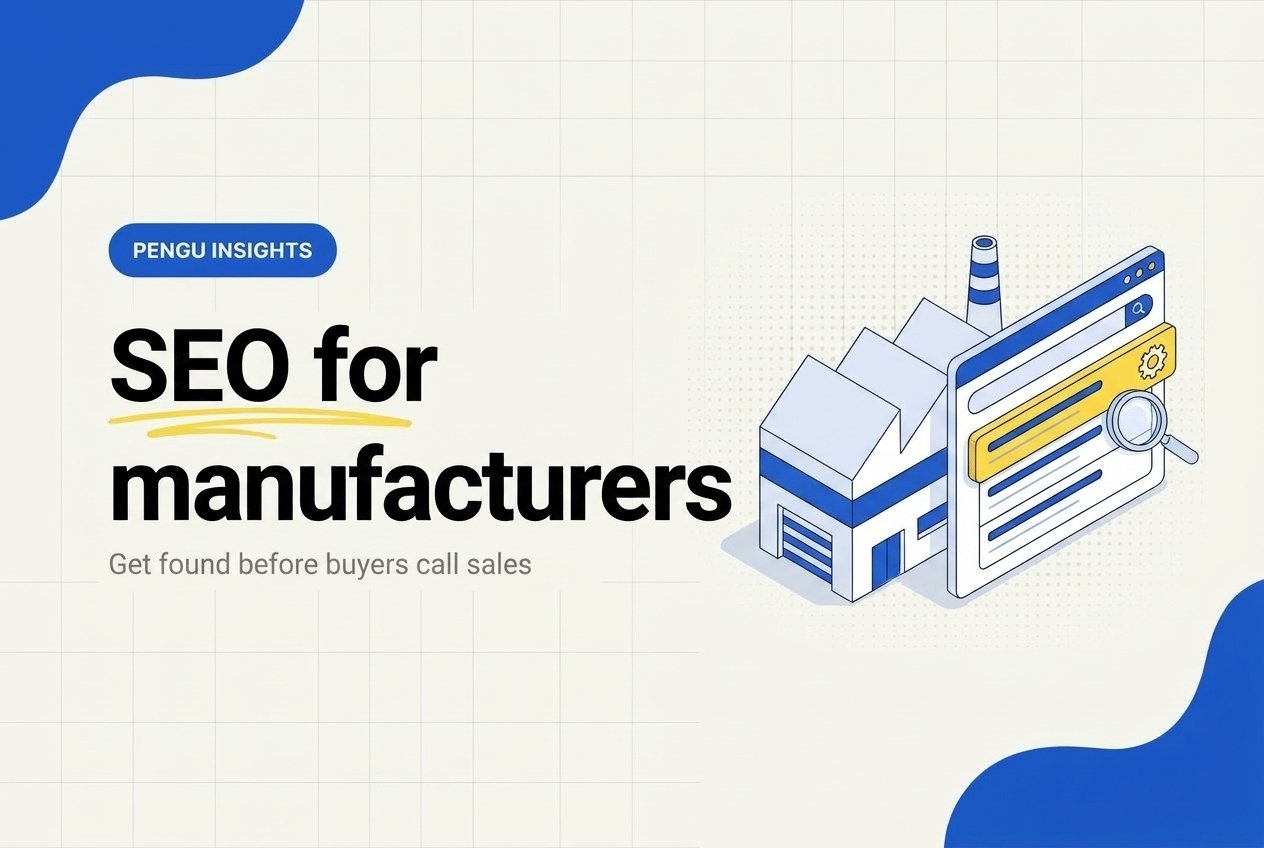
SEO for manufacturers is getting your capability pages found when an engineer or buyer searches a process, a material, a tolerance or a certification. Build one page per capability first, the blog second, and measure it in quote requests (RFQs) and quoted value, not sessions.
The buyer does most of the work before calling you. In the 2026 State of Marketing to Engineers research by TREW Marketing and GlobalSpec, 62% of the buying process happens before engineers contact sales (TREW Marketing, 2026). If your capabilities are not on a page they can find, you are not on the shortlist when they finally call.
Below: how industrial buyers search, what a capability page carries, a 90-day plan and how to trace RFQs to pages. Search brings new buyers; for the accounts that already bought and went quiet, see our B2B win-back campaign guide.
Key takeaways
- Buyers search the spec, not your name. Process, material, tolerance, certification and industry are the words in the query.
- One capability, one page. A single "Services" page cannot rank for CNC turning, wire EDM and anodizing at the same time.
- Put the data in text. Tolerances, materials, machine sizes and certifications belong on the page. The PDF is a download, not the content.
- Measure RFQs, quoted value and won value per landing page. Sessions count students, job seekers and competitors too.
- AI search reads the same pages. Google says AI Overviews and AI Mode need no special optimization, so good capability pages serve both.
Video: an SEO roadmap for a manufacturing website
Manan Gupta's 16-minute walkthrough is worth watching for the screen recording: he runs keyword research live on a packaging machine manufacturer instead of only describing it.
Three things worth taking from it:
- Start from what competitors already rank for. He opens a rival's site in a keyword tool, lists the organic keywords it ranks for, repeats that for a few more competitors, then widens the list with matching terms for the target country (from 2:34).
- Look at the results page before you write. His example: a query like "candy packaging" shows only images, so a blog post on it brings no traffic. Build the format Google already shows for that query (at 6:08).
- Your first links come from people you already work with. He suggests asking suppliers and customers to list you on their sites, and getting into industry directories even when those links are nofollow (at 8:44).
Where we differ: he also suggests paying publications for link insertions and making simple landing pages for each location. Google's spam policies list buying links for ranking purposes as link spam (unless the link carries rel="sponsored" or rel="nofollow"), and pages aimed at specific cities that funnel users to one page as doorway abuse, so we leave both out. He also judges SEO by rankings; this guide judges it by RFQs and quoted value.
How SEO for manufacturers differs from consumer SEO
Industrial search is small, specific and late in the journey. A query like "titanium 5-axis machining AS9100" gets a handful of searches a month, often from someone with a drawing ready. Consumer SEO chases volume. SEO for manufacturers chases fit.
Buyers build their queries from five parts. Your site needs a page that answers each one:
| What the buyer types | What they are checking | The page that answers it |
|---|---|---|
| Process: "wire EDM", "deep draw stamping" | Can you make it? | One capability page per process |
| Material: "PEEK machining", "316L tube bending" | Do you work this material? | A materials block on each capability page |
| Spec: "tight tolerance turning", "Ra 0.4 finish" | Can you hold it? | A tolerances and finishes table |
| Certification: "ISO 13485 contract manufacturer" | Will our quality team approve you? | A certifications block, plus one quality page |
| Industry or place: "aerospace sheet metal Florida" | Have you done this before, nearby? | Industry pages and a plant location page |
The queries in the left column are typical shapes, not measured keywords. Your real ones are in Search Console and in the RFQs you received last year (step 1 of the plan below).
So low volume is normal: do not drop a page because a tool shows 20 searches a month. And the words that matter are on your RFQs, not in your brochure.
Build capability pages before the blog
Capability pages answer "can you make this?" for a buyer ready to quote. A blog post answers "how does this work?" earlier in the journey. Both matter, in that order. What every capability page carries:
| Block | What goes in it | Why it matters for search |
|---|---|---|
| Heading and first paragraph | The process plus the main material or industry, in the buyer's words | Matches the query and tells Google what the page covers |
| Materials | Every material and grade you run, in text | Catches material searches |
| Tolerances and finishes | Standard and best achievable, in a table | Engineers search for specs |
| Equipment | Machine type, make, axes, work envelope, quantity | Proves capacity and adds detail no competitor can copy |
| Certifications | Standard, scope and site, with the certificate linked | Puts you in approved-supplier searches |
| Industries and example parts | Real parts you are allowed to show, with photos | Shows fit for the buyer's sector |
| RFQ button | At the top and at the end, with a form that accepts drawings | Turns the visit into a quote request |
Start with the processes that bring the most quoted value. Add a process plus material page only where you have real depth, such as a separate titanium page when titanium is a large share of your aerospace work.
Industry pages come after the capability pages. Many B2B guides call them solutions pages: an aerospace or medical page that groups the capabilities, certifications and example parts that sector asks for, and links to each capability page. They answer "aerospace sheet metal"; the capability pages answer "wire EDM".
Pages that only swap a material or a city name are what Google's spam policies call doorway pages. The same goes for asking an AI tool to write a page for every spec combination: the policies list using generative AI tools to generate many pages without adding value for users as scaled content abuse. Build fewer pages with more in them.
For the site around these pages, see our manufacturing website design checklist.
A worked example: from RFQs to one capability page
Advice like "one page per capability" is easy to agree with and harder to apply, so here is one page from start to finish. Take a hypothetical job shop whose RFQ export shows a cluster: titanium brackets and housings, mostly 5-axis work, mostly aerospace buyers, with AS9100 on every purchase order.
That cluster becomes one page:
- URL and heading:
/capabilities/5-axis-titanium-machining, headed "5-Axis Titanium Machining for Aerospace Parts". - First paragraph: the process, the grades you cut (such as Ti-6Al-4V), the part size range and the AS9100 scope, in two sentences.
- Tolerances and finishes: a table of standard and best achievable values, measured on your own parts.
- Equipment: each 5-axis machine by make, model and work envelope.
- Proof: two parts you are allowed to show, with photos and the industry they serve.
- RFQ: a button at the top and the bottom, linked to a form that takes STEP files.
The blog post that supports it then answers a question sales hears before those quotes, such as which titanium grade suits a bracket, and links back to the page.
Put specs and certifications in text, not only in PDFs
Google can index PDFs: the format is on its list of indexable file types. The problem is what happens next. A buyer who lands on a PDF has no menu, no related capabilities and no RFQ button. Put the key data on the page and offer the PDF as a download.
Certifications work the same way. A row of logos in the footer says little. A sentence that names the standard, the scope and the site ("AS9100 certified for CNC machining and assembly at our Tampa plant") answers the search a quality engineer runs before adding you to the approved list.
Add Organization structured data with your legal name, address and logo, so search engines tie every page to one company. Our free schema markup generator writes the JSON-LD for you.
Then the blog, written for engineers
The blog answers the questions sales hears before every quote: which process suits a part, how two materials compare, what tolerance is realistic at volume. Each post links to the capability page it supports. To see what competitors publish for the same processes, follow our guide to analyze a competitor website.
Our one public case is a promotional printing company, not a manufacturer: an SEO blog engine put 40 articles live in 4 days, and after 2.5 months the site averaged position 6.5 on Google with 385 clicks and about 200 writing hours saved (the case). The mechanism carries over; your numbers will differ.
A 90-day SEO plan for a manufacturer
- Export last year's RFQs and won orders from your CRM or ERP, and tag each one by process, material and industry (2 hours).
- Read your Search Console queries for the last 16 months and mark every query that names a process, a material or a certification (45 minutes).
- Ask sales for the 20 questions buyers ask before a quote, written down word for word (30 minutes).
- Rank your capabilities by quoted value and pick the first five pages to build or rewrite (1 hour).
- Check how three competitors cover the same processes with our free competitor keyword finder, and note the terms they rank for and you do not (30 minutes).
- Write the first capability page with an engineer checking every tolerance and material (4 to 6 hours per page).
- Run a technical check: mobile speed and Core Web Vitals on your top pages with our website health check, then indexing and the sitemap in Search Console (30 minutes).
- Claim the Google Business Profile for each plant, and ask five suppliers or customers to list you on their sites with a link (1 hour).
- Set up RFQ tracking as described in the next section (2 hours).
- Review the numbers every month: queries, RFQs and quoted value per page (30 minutes a month).
Five capability pages and working RFQ tracking by the end of the first month is a solid first milestone. If Search Console reports pages blocked by robots.txt, test the file with our free robots.txt checker.
How to measure SEO in RFQs and quoted value
Sessions are the wrong scoreboard: students, job seekers and competitors read your pages too. Measure what sales and the CEO care about:
| Metric | Where it comes from | What it tells you |
|---|---|---|
| Impressions and clicks on capability queries | Google Search Console | The early signal, well before RFQs arrive |
| RFQs from organic search, by landing page | The form submission as a key event in Google Analytics 4, plus the CRM | Which pages produce quote requests |
| Quoted value per landing page | Opportunity amounts in the CRM | The pipeline search opened |
| Won value per landing page | CRM or ERP | Revenue, the number the CEO asks about |
| Mentions in AI answers | Monthly manual checks or a tracking tool | Whether assistants name you for your processes |
Three settings make the table work:
- Capture the landing page. A hidden field in the RFQ form stores the first page the visitor saw and the traffic source, and the CRM receives it with the lead.
- Ask one question. A "How did you find us?" drop-down catches the buyer who searched, left, and came back by typing your name.
- Report by quarter. Industrial sales cycles are long. A monthly view of won value per page is mostly noise; a quarterly view shows the trend.
Nobody can promise positions. You control whether the right pages exist and whether you see what they produce.
What changes with AI search?
Less than people fear. Google says there are no additional requirements and no special optimizations needed to appear in AI Overviews or AI Mode (Google Search Central). The pages that rank are the pages it summarizes.
Engineers have noticed the summaries, and most keep reading past them. In the 2026 State of Marketing to Engineers research, 75% of respondents had noticed AI summaries at the top of search results, 69% of them read the summary and then kept going into the results, and only 6% said the summary is usually enough (TREW Marketing, 2026).
The summary is a filter, not the destination. Specs in text give it something precise to quote and give the engineer a reason to click.
ChatGPT works differently: it names suppliers. Ask it what your buyer would ask ("who makes deep drawn stainless parts in the Southeast") and see whether you appear. Our guide to AI visibility tracking shows how to check monthly.
Common mistakes in SEO for manufacturers
- One "Services" page for every process. It ranks for none of them. Fix: one page per process, linked from a capabilities hub.
- Specs only in PDFs. The buyer lands on a file with no way forward. Fix: the data in an HTML table, the PDF as a download.
- Brochure language. "Precision solutions for demanding industries" matches no query anyone types. Fix: use the words from your RFQs and your sales team's notes.
- Starting with the blog. Posts bring readers to a site with nowhere to ask for a quote. Fix: capability pages first, posts that link to them second.
- Measuring sessions. Traffic can rise while RFQs stay flat. Fix: track RFQs, quoted value and won value per landing page.
- Certifications as footer logos. Fix: name the standard, scope and site in text on every capability page it covers.
- Buying links or generating pages in bulk. Both are on Google's spam list. Fix: links from suppliers, customers and directories, and a page only where you have real data to put on it.
Frequently asked questions
Does SEO work for niche manufacturing companies?
Yes, and niches are where it works best. Search volumes are small, but each search tends to come from someone with a real part to make, and few competitors have pages that name the process, material and tolerance. A handful of well-built capability pages can cover the searches a niche gets. What SEO cannot do is create demand for a process nobody searches for.
Should manufacturers focus on blogs or service pages first?
Service pages first, which for a manufacturer means capability pages: one per process, with materials, tolerances, equipment and certifications in text and a quote button. These pages match buyers who are ready to ask for a price. Blog posts come second and work best when each one answers a question sales hears before a quote and links to the capability page it supports.
How long does SEO take for a manufacturer?
Nobody can promise a timeline or a position. Impressions in Search Console usually move before clicks, and clicks move before RFQs. Plan in quarters: build and fix the capability pages first, set up tracking for RFQs and quoted value, and judge the work on the trend over several quarters rather than on a single month.
What role do certifications play in manufacturing SEO?
Certifications are search terms. Buyers filter suppliers by standards such as ISO 9001, AS9100, ISO 13485 or IATF 16949, and they type them into the query. Name each certification in text on the capability pages it covers, with its scope and site, and link the certificate. A logo in the footer does not answer that search.
Does SEO help manufacturers who sell through distributors?
Yes. Engineers still research the maker before they ask a distributor for a price, so capability and product pages bring the specification to you. Add a clear where-to-buy page that lists distributors by region, and track which pages send buyers to it. That shows your distributors the demand your site creates in their territory.
What to do next
In short: SEO for manufacturers means capability pages first, measured in RFQs and quoted value. Build one page per process with the specs in text, then let the blog support those pages.
Start this week with step 1: export last year's RFQs and tag them by process and material. That list tells you which pages to build first.
If you want an outside view before you start, we record a free 60-second video of how a buyer sees your company on Google and in ChatGPT next to three competitors. Request it on our services page.
Prefer to talk it through? Book a 30-minute call.
Written by

Founder of Pengu Insights. Competitive intelligence practitioner for DTC brands and marketing agencies.