Answer engine optimization is not another buzzword pile. It is the beginner-friendly name for a real shift: AI systems answer first, then decide who deserves a mention. If you already know SEO, you are closer than you think. You still need crawlable pages, clear expertise, and topical depth. You just stop optimizing only for a ranked list.
In AEO education content popularized through courses like Ahrefs' beginner AEO tutorial, the urgency is concrete. As of December 2025, an AI Overview on Google can cut click-through rate for the number-one organic result by about 58%. ChatGPT alone has been reported near 900 million weekly users, handling roughly 12% of Google-scale search volume in those briefings. AI referral traffic to websites has also been described as growing nearly 10x year over year. This post is the how-to course path. For definitions and framing, read what is generative engine optimization (GEO).
Key takeaways
- AEO, GEO, and LLMO are the same family. Different labels. Same job: get cited inside AI answers.
- SEO is still the foundation. Real-time retrieval leans on pages that already rank and read cleanly.
- You compete for mentions, not positions. AI synthesizes dozens of sources and picks who to name.
- Brand mentions beat vanity metrics. Education data frames them as a stronger AI-visibility lever than domain rating alone.
- Measure citations and conversions. In one June 2025 example, AI search was 0.5% of traffic but 12.1% of signups (23x conversion vs organic).
What is answer engine optimization, and how is it different from SEO?
In 2026, AEO means making your content visible and useful to AI systems that deliver direct answers. Those systems include Google AI Overviews, ChatGPT, Perplexity, Gemini, and Copilot. Traditional SEO optimizes pages to rank in a list. AEO optimizes evidence so a model will mention or cite you while it synthesizes an answer.
You will also hear GEO and LLMO. Treat them as aliases. Industry beginner courses use AEO as the umbrella label because the user experience is an answer engine, not a classic ten-blue-link SERP. The finish line changes. The materials do not vanish.
| Dimension | Classic SEO | Answer engine optimization (AEO) |
|---|---|---|
| User sees | A ranked list of links | A synthesized answer |
| You compete for | Position | Mention / citation |
| Primary KPI | Rankings, clicks | Citations, brand share of answers |
| Content bias | Intent + keywords | Extractable answers, proof, freshness |
| Shared base | Technical health, authority | Same, plus quotable structure |
AEO does not replace SEO. It stacks on top. Ethan Smith's "zero-sum bias" framing (often referenced in AEO discussions) is useful here: mobile apps did not kill the web. AI search is growing fast, and organic search still processes enormous volume. Play both games.
How does AI search find and cite content?
In 2025 to 2026 AEO walkthroughs, the core mechanic is two information sources working together. First is training data: a large, relatively static snapshot of books, sites, transcripts, and more. Second is real-time retrieval (RAG): the model searches the live web, pulls candidate pages, then generates an answer from what it fetched.
That split creates two influence paths. Earn enough brand presence to show up in training patterns over time. Rank and structure pages so retrieval can find you today. Your existing SEO skills (authority, indexability, useful content) still decide whether you appear in that retrieval set. For a deeper operator workflow with live data, see how to dominate AI search results with Claude.
Query fan-out is the second mechanic beginners must understand. One prompt expands into many synthetic subqueries. Research from Seer Interactive and related AEO briefings is often cited for an average of 9 to 11 fan-out queries per prompt, with some climbing past 20, and extreme deep-research modes running hundreds of searches. Over 95% of those synthetic queries have zero classic search volume. Do not treat them as a new keyword list. Treat them as a map of subtopics the model thinks matter.
In our audits, the teams that win AEO stop writing "one keyword, one page" briefs. They cover the full question graph: definitions, comparisons, objections, pricing context, and adjacent how-tos the model will fan out into.
Freshness matters for the retrieval path. Training data lags. If you shipped a product last week, retrieval is how models learn you exist. Update dates, current stats, and clear changelogs help machines trust that a page is worth fetching now.
What beginner AEO roadmap should you follow?
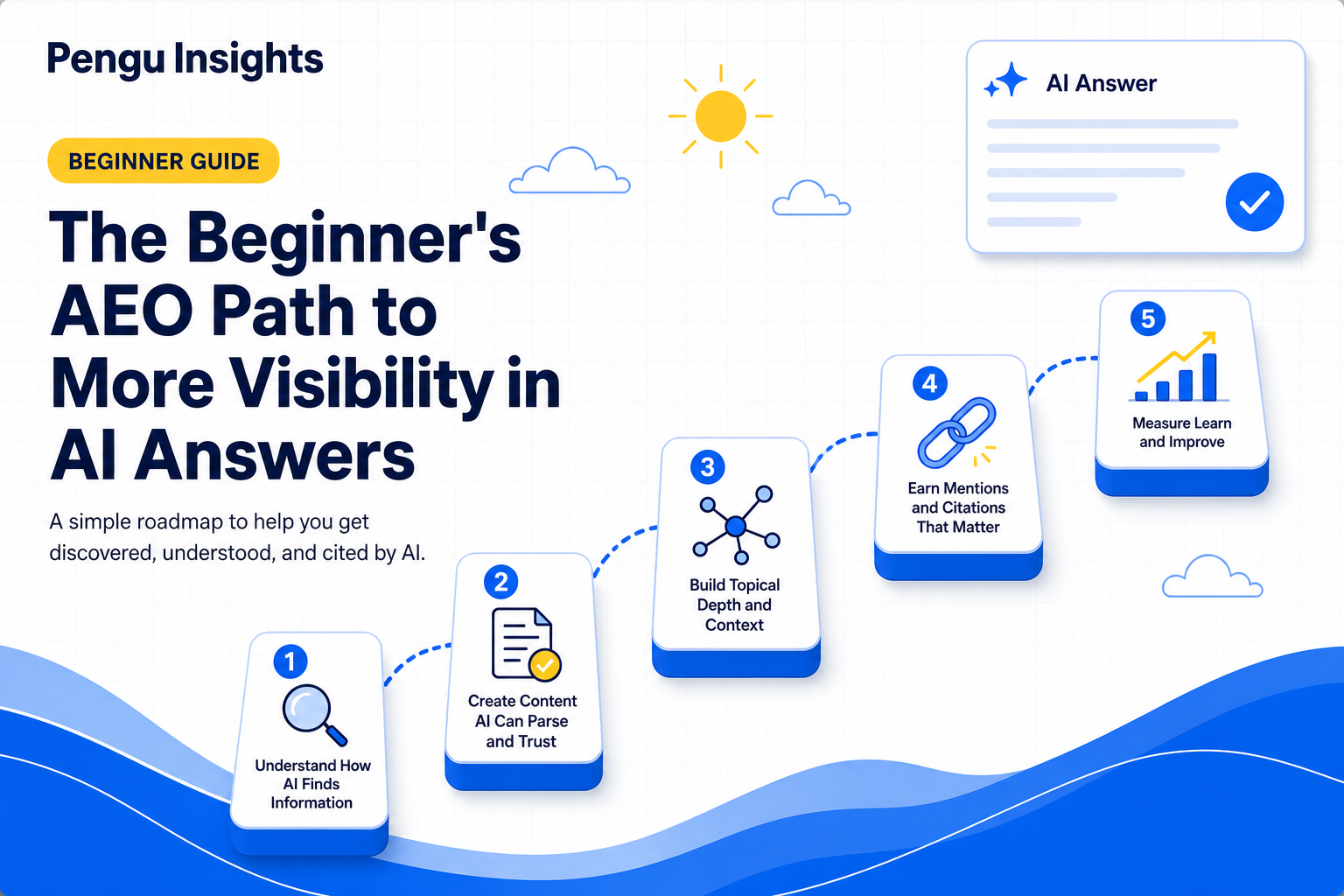
In 2026, a practical beginner roadmap mirrors the four-module structure used in leading AEO courses: understand mechanics, set strategy, execute, then measure. You do not need a new team on day one. You need a sequence.
Module 1: Mechanics (1 week)
Map where buyers ask questions: ChatGPT, Perplexity, Gemini, Copilot, and Google AI Overviews or AI Mode. Note which platforms cite links heavily versus which prefer brand-name mentions. Document two paths: training-data presence and retrieval eligibility.
Module 2: Strategy (1 to 2 weeks)
Prioritize brand mentions and prompt research. AEO education data often frames brand mentions as a stronger visibility lever than backlinks or domain rating alone. Build a prompt set of 20 to 40 category questions. Log who gets named. That is your AI share-of-voice baseline. Pair it with classic keyword research so you still win the retrieval SERP.
Module 3: Execution (ongoing)
Create content built for citation: answer-first openings, short paragraphs, comparison tables, FAQs, and explicit stats. Earn mentions on industry sites and YouTube. Keep technical access clean so crawlers and retrieval APIs can read you. If you want ops scale later, study an SEO automation system with AI agents, but do not automate judgment first.
Module 4: Measurement (monthly)
Track AI traffic in analytics, citation frequency for your prompt set, and conversion rate by channel. Soft-attributed industry examples show AI sessions converting many times harder than average organic. Treat volume and value as separate dashboards.
Time estimate for a first pass: about 4 weeks to ship a working plan, then a monthly cadence for prompts and refreshes.
How do you create content that AI systems actually cite?
In practitioner AEO guidance, citation-friendly pages share a pattern: they answer early, stay scannable, and make claims easy to lift. Soft-attributed findings often discuss correlations between clear, well-structured passages and citation likelihood, plus a freshness preference when retrieval is active. You do not need perfect prose. You need extractable truth.
Practical checklist (about 45 minutes per page refresh):
- Open with a 40 to 60 word direct answer and one dated fact.
- Use H2s that match real questions, including People Also Ask.
- Add one comparison table or numbered steps AI can quote.
- Include author identity, update date, and primary sources.
- Cover adjacent subtopics the model may fan out into.
- Keep sentences short enough that a model can lift one clean claim.
Also run a competitor pass. When you analyze a competitor website, ask which pages read like quotable answers. Those are usually the ones showing up in AI responses.
What is an example of answer engine optimization?
A concrete one from this site. The question "how much does Similarweb cost" is asked in Google, in ChatGPT and in Perplexity. Our pricing guide answers it in the first sentence of a paragraph that stands on its own:
The Web Intelligence Starter plan is about $199 a month on monthly billing, or roughly $125 a month billed annually.
That paragraph contains the subject, the number, the condition (monthly versus annual) and nothing that needs the rest of the article. It sits under an H2 that repeats the question, the same answer appears in a visible FAQ, and the page carries an author, a source and an update date. That is the whole of AEO for that query: a self-contained answer, placed where a system looking for one will find it, on a page that looks trustworthy enough to cite.
What it is not: a special file, a schema trick or a rewrite "for AI". Google's own guidance says as much. The work is the paragraph.
How should you measure whether AEO is worth it?
In June 2025 examples shared in AEO course material, AI search was only 0.5% of traffic yet drove 12.1% of signups, about 23x the conversion rate of classic organic. That is why "AI is not sending traffic" is the wrong dashboard. Ask whether AI-influenced buyers convert, and whether your brand appears in the answers that shape shortlists.
Minimum measurement stack:
- A fixed prompt library tested monthly across ChatGPT, Perplexity, and AI Overviews
- Screenshot or logged citation share vs named competitors
- Analytics segments for known AI referrers where available
- Conversion rate and assisted revenue for those segments
- A quarterly refresh list for pages that lost citations
Most businesses have not started intentional AEO yet. Solid SEO alone already produces organic mentions. Intentional optimization (knowing which platforms cite what, closing brand gaps, shipping citation-ready pages) is the unlock.
To score one of your pages for answer engines right now, run it through the AEO Audit in Pengu Insights. It returns a 0 to 100 score and the fixes in order. Free plan, no card.
Frequently asked questions
What is answer engine optimization (AEO)?
AEO is the practice of making your content visible and useful to AI systems that deliver direct answers. Platforms include Google AI Overviews, ChatGPT, Perplexity, Gemini, and Copilot. Success looks like mentions and citations inside the generated response.
Are AEO, GEO, and LLMO the same thing?
Yes for operating purposes. They sit in the same family. GEO emphasizes generative engines. LLMO emphasizes large language models. AEO emphasizes the answer-engine user experience. Pick one label and execute.
Does AEO replace traditional SEO?
No. Retrieval still leans on crawlable, authoritative pages. Abandoning Google and Bing usually weakens the source pool AI engines pull from. Keep SEO healthy. Add citation packaging on top.
What is query fan-out in AI search?
It is the expansion of one prompt into many synthetic subqueries. Averages around 9 to 11 are commonly cited in AEO education research summaries. Use fan-out as a topic-coverage checklist, not as a volume target list.
How should beginners start measuring AEO?
Start with a 20-prompt competitive log and AI referral conversion tracking. Compare citation share month over month. Volume can stay small while revenue impact stays outsized.
Can you give an example of AEO?
Answering a question in one self-contained paragraph under a heading that repeats the question, with the number, the condition and a source, then repeating it in a visible FAQ. A pricing answer such as "the Starter plan is about $199 a month" is AEO when it can be lifted out of the page and still be complete.
What should you do next?
Ship the four-module plan. Build the prompt set this week. Refresh one cornerstone page for extractability. Log competitor citations before you scale publishing. If you want a live walkthrough of how marketing teams combine AI search strategy with competitive intelligence, join us at penguinsights.io/webinar/marketing-ai.
AEO is future-proofing, not panic. Learn the mechanics, cover the topic graph, earn mentions, and measure value. The brands that treat AI answers as a competitive channel will own the shortlist before the click ever happens.
Written by

Founder of Pengu Insights. Competitive intelligence practitioner for DTC brands and marketing agencies.