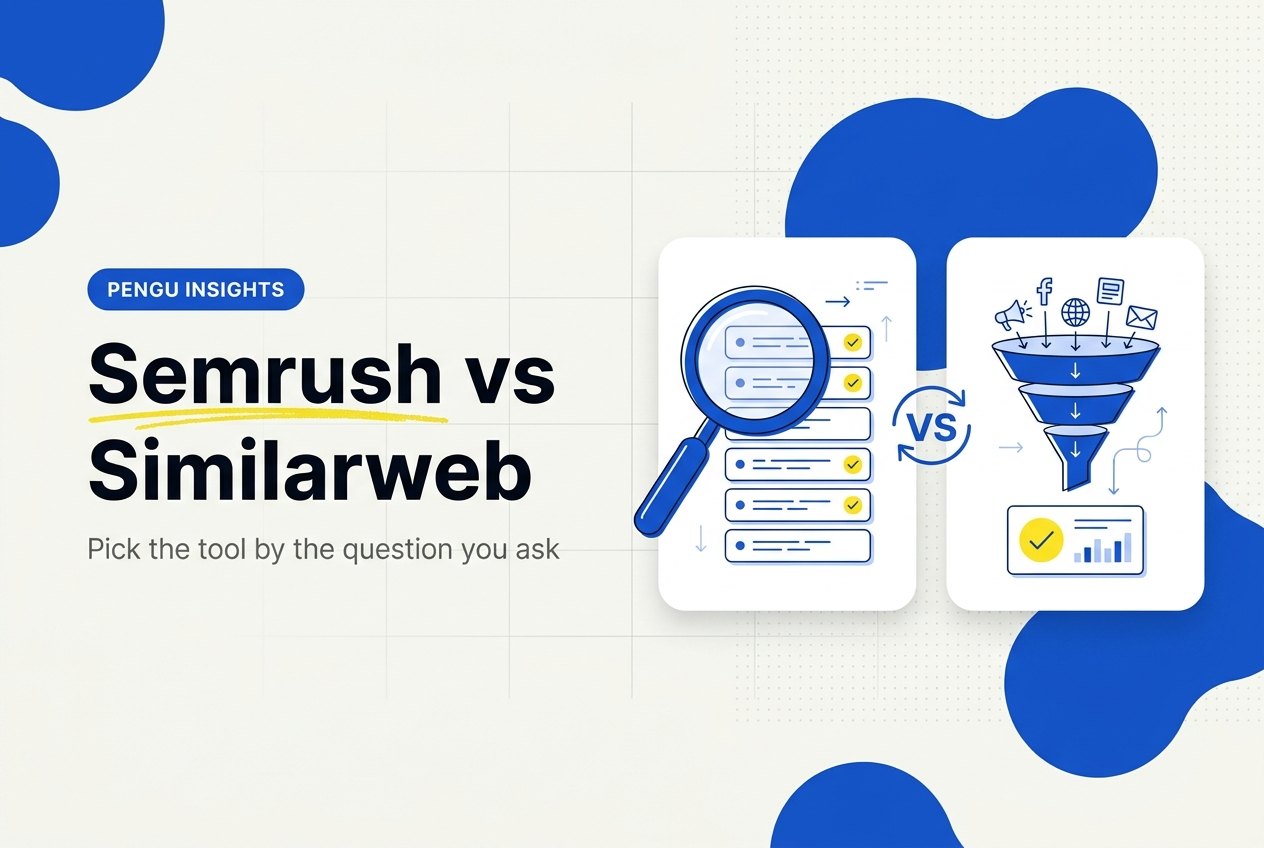
Semrush vs Similarweb is not a contest between two versions of the same tool. Semrush is built on search data: what people type into Google and who ranks. Similarweb is built on traffic data: how real visitors reach a site across every channel.
Pick by the question you need answered. Similarweb and Semrush prices below were checked on 1 November 2026 on each vendor's pricing page. The short version: Semrush's SEO plan starts at $139.95 a month and Similarweb's traffic plan at $199, but each vendor sells the other's core job as an add-on, and that add-on is where the comparison turns.
Key takeaways
- Different questions. Semrush answers "which searches bring traffic and who ranks". Similarweb answers "how much traffic a site gets, from which channels, and from whom".
- Different data. Semrush's core is a database of 28.8 billion keywords across 142 country databases. Similarweb blends a device panel, direct measurement, partners and public data.
- Each sells the other's job as an add-on. Semrush's traffic data is the Traffic & Market toolkit at $289 a month billed annually. Similarweb's SEO tools start in its $333 plan.
- For SEO work, Semrush is cheaper and deeper: $117.33 a month billed annually for 5 monitored websites, 500 tracked keywords and site audits.
- For channel mix and audience, Similarweb is the specialist, from $125 a month billed annually, with one user and worldwide data only.
Video: how Semrush and Similarweb get their data
Watch it for a plain-language explanation of the data split, plus the day-to-day differences a pricing page cannot show.
Three things worth taking from it:
- Library versus panel. Semrush works like a library of what people type into Google, built to show which page wins which search. Similarweb works like a panel of real people moving from social media or news links to sites, built for the big traffic picture.
- Setup speed differs. Semrush shows data for a domain in under a minute and a site audit fix list within 10 to 15 minutes. Similarweb asks for your competitors and industry before its deeper charts.
- Both cap the entry plans. One login on the basic plans; Semrush limits reports per day, while Similarweb limits history to the last 3 to 6 months.
Where we differ: the video says full API access needs a custom Similarweb plan, which is right, but Semrush also keeps API data integration on its custom-priced Advanced and Enterprise tiers (Starter does include MCP access). The creator uses affiliate links for both tools.
Semrush vs Similarweb: what each tool is built to answer
Semrush is built to tell you how to win search. Similarweb is built to tell you how a site wins traffic overall. The decision is about the job, not the brand, so start from the job:
| Your job | Pick | Why | Entry plan for that job (monthly, billed annually) |
|---|---|---|---|
| Find keywords to target | Semrush | Keyword database built from search results it collects | SEO plan: $139.95, $117.33 |
| Track your rankings daily | Semrush | 500 tracked keywords on the entry plan | SEO plan: $139.95, $117.33 |
| Audit your own site's technical SEO | Semrush | Site Audit on every paid plan | SEO plan: $139.95, $117.33 |
| See a competitor's total traffic and channel mix | Similarweb | Direct, referral, social and paid channels from the entry plan | Competitive Intelligence: $199, $125 |
| Understand a competitor's audience | Similarweb | Demographics, interests, overlap and loyalty on the entry plan | Competitive Intelligence: $199, $125 |
| See a competitor's top pages | Semrush | Top pages are in Traffic & Market; Similarweb's popular pages are business-only | Traffic & Market: $289 billed annually |
| Size a market or category | Semrush, if you need self-serve | Market Landscape is in Traffic & Market; Similarweb's market analysis is quoted | Traffic & Market: $289 billed annually |
| Research competitor ads | Depends on the channel | Semrush Advertising toolkit for Google search and Shopping, display and social on Pro; Similarweb ad spend in its top plan | Semrush: $99 or $220 billed annually; Similarweb: $649, $542 |
| Track AI visibility | Similarweb, on entry price | AEO Intelligence has 150 tracked prompts; Semrush Starter has 50 prompts tracked daily | Similarweb: $129, $99; Semrush: $199, $165.17 |
| API access | Neither self-serve | Semrush lists API on Advanced; Similarweb on business packages | Both quoted |
If your answers land mostly in the first three rows, you need Semrush. If they land in rows four and five, you need Similarweb. If they land in both, read the price section before you buy two subscriptions.
How do Semrush and Similarweb collect their data?
Semrush starts from search results. Similarweb starts from observed visits. That is why their traffic numbers for the same site rarely match, and why each is strongest where its method looks.
According to its data and metrics page, Semrush collects Google results pages for hundreds of millions of keywords through third-party providers, covering the top 100 positions, and holds 28.8 billion keywords across 142 geographic databases. Its Traffic & Market toolkit works differently: it estimates traffic from a clickstream panel of over 200 million anonymized users, processed together with Semrush's backlink and ranking data.
Similarweb's data methodology page lists four sources: direct measurement from website and app owners who connect their analytics, a contributors network of Similarweb products installed on millions of devices, public data, and partnerships with ISPs, measurement companies and other data firms. The blend is modeled into estimates for every channel, not only search.
What follows from the method:
- Search-shaped versus channel-shaped. An estimate built from rankings sees search well and sees direct, referral and email traffic poorly. A panel sees every channel, but only as well as its coverage of that site's visitors.
- Both are estimates. Neither replaces your own analytics. Compare competitors with each other inside one tool, and do not compare a tool's number with your Google Analytics. Our guide to checking website traffic covers how to read the gap.
- Their overlap is the Traffic & Market toolkit. When someone says Semrush "does what Similarweb does", they mean that toolkit, which is a separate purchase.
How much do Semrush and Similarweb cost in 2026?
Semrush is cheaper for search work, Similarweb is cheaper for traffic and audience work, and buying both jobs costs less on Similarweb for a single user. Semrush prices come from its pricing page, checked 1 November 2026; Semrush shows local currency outside the US, and these are its US dollar prices.
Similarweb prices come from its Web Intelligence and AI Search pricing pages on the same day. Every Semrush plan and add-on is broken down in our Semrush pricing guide.
The same for Similarweb, including the limits its plan cards skip and how its API credits work, is in our Similarweb pricing guide.
| Semrush | Similarweb | |
|---|---|---|
| Free | Free plan: 1 demo project, 10 reports a day, no card | Free sample on its site, extension and free tools; 7-day trial on paid plans |
| Entry plan | SEO: $139.95 a month, $117.33 billed annually | Competitive Intelligence: $199 a month, $125 billed annually |
| SEO plus AI visibility | Starter: $199, $165.17 billed annually, 50 prompts tracked daily | Competitive Intel & SEO & AEO: $399, $333 billed annually, 150 tracked prompts |
| Higher self-serve tier | Pro+: $299, $248.17 billed annually, 15 websites, 1,500 tracked keywords | Competitive Intel, SEO & AEO & Ads: $649, $542 billed annually |
| Traffic and channel data | Traffic & Market toolkit: $289 a month billed annually | Included from the entry plan |
| Extra users | From $45 a month each | Quoted |
| Country-level data | Keyword data by country database | Business packages only |
| History | Historical SEO data from Pro+ | 3 to 6 months self-serve, up to 37 months quoted |
| API | Advanced tier, custom price | Business packages or standalone, quoted and metered in credits |
What both jobs cost
If you need keyword work and channel-level traffic data, the two self-serve routes compare like this, billed annually:
- Semrush SEO plan plus Traffic & Market: $117.33 + $289 = $406.33 a month.
- Similarweb Competitive Intel & SEO & AEO: $333 a month, with AI prompt tracking included.
Similarweb is cheaper on paper for one person. Semrush is the better buy if you track more than one site, need keyword data for a specific country, or need a second seat, because Similarweb's self-serve plans are one user and worldwide only.
Which should you choose?
Choose by the job you do every week, then add the other tool's free version for the occasional question.
Semrush: best for SEO execution
Pros: the deeper keyword database, rank tracking and site audits on the entry plan, a free plan, extra seats from $45 a month, and toolkits you can add one at a time. Cons: total traffic and channel mix cost an extra $289 a month billed annually; API access sits on a custom-priced tier; the dashboard has a lot of tools to learn. Best for: SEO teams, content marketers and agencies running several client sites.
Similarweb: best for traffic and audience intelligence
Pros: channel mix, audience demographics and overlap from the $125 plan; the $99 AEO plan for AI visibility on its own; one bundle with SEO, AI tracking and ad data. Cons: one user per self-serve plan; worldwide data only; 3 to 6 months of history; no API, popular pages or subdomains without a quote. Best for: strategists, analysts and marketers who need to know how competitors get traffic outside search.
Pengu Insights: the social and ads layer both skip
Ours, so weigh the recommendation. Pengu Insights sits next to either tool rather than replacing them: Starter at $39 a month covers keywords, competitors and traffic estimates plus Instagram, TikTok, LinkedIn and the Meta Ad Library, and Pro at $69 adds keyword and backlink gaps and AI visibility tracking for Google AI Overviews and ChatGPT. It does not have Semrush's keyword depth or Similarweb's panel-based audience and channel data.
Best for: agencies whose competitor questions are half search and half social.
How to decide in 30 minutes
- Write the question (5 minutes). Is it about search, or about traffic and audience? Use the job table above.
- Run both free versions on one competitor (10 minutes). Semrush's free plan gives 10 reports a day; Similarweb's site shows a free sample. Our free website traffic checker gives a third estimate to compare.
- Price the job, not the plan (10 minutes). Add Traffic & Market to Semrush if you need channels; move to $333 on Similarweb if you need keywords.
- Count seats and countries (5 minutes). Two people or one-country data rules out Similarweb's self-serve plans.
How we compared them
We read both vendors' pricing pages on 1 November 2026, expanded Similarweb's full feature table, and read each vendor's own description of its data sources. Semrush localizes prices by visitor location, so we took the US dollar figures from the page's own price list and confirmed the add-on prices from a US connection.
We did not run a traffic accuracy test for this comparison, so we make no claim about which estimate is closer for any given site; the data section explains why they differ. The video was chosen for relevance and explains its affiliate links. Pengu Insights is our product, which is why it appears once, with what it does not do.
Common mistakes when choosing between Semrush and Similarweb
- Comparing entry prices across different jobs. $139.95 buys SEO tools; $199 buys traffic data. Compare the plans that do your job.
- Reading Semrush's organic traffic as total traffic. Without the Traffic & Market toolkit, the estimate is search-shaped.
- Buying Similarweb for country-level SEO. Self-serve plans are worldwide only.
- Forgetting seats. Similarweb self-serve is one login; Semrush adds users from $45 a month each.
- Paying for both before using one for a month. Most teams need one daily tool and one occasional lookup, and free versions cover the occasional one.
Frequently asked questions
Is Similarweb better than Semrush?
Neither is better overall. Semrush wins on keyword research, rank tracking and site audits; Similarweb wins on total traffic, channel mix and audience.
Which is more accurate, Semrush or Similarweb?
Neither gives ground truth. Semrush is strongest on search data it collects; Similarweb models every channel from a panel, direct measurement, partners and public data.
Can Semrush show competitor traffic?
Yes. SEO plans estimate organic traffic, and the Traffic & Market toolkit at $289 a month billed annually covers total traffic and channels from a clickstream panel.
Does Similarweb do SEO?
Yes, from the $333 plan billed annually: keyword research, rank tracking, site audit and backlinks, for one user with worldwide data.
Is there a cheaper alternative to Semrush and Similarweb?
Both have free versions for quick checks. Pengu Insights (ours) starts free, with paid plans from $39 a month for keywords, traffic estimates and social and ad research.
What to do next
In short: pick Semrush if your week is keywords, rankings and audits; pick Similarweb if your week is competitor traffic, channels and audiences; and price the other job as an add-on before buying both. Start by running one competitor through the competitor keyword finder and the free traffic checker to see which question your data gap really is.
If the gap turns out to be social and ads rather than search or traffic, start free in Pengu Insights with 80 credits at sign-up and no card.
Written by

Founder of Pengu Insights. Competitive intelligence practitioner for DTC brands and marketing agencies.