Agencies still sell SEO retainers in the $2,000 to $5,000 per month band for many mid-market brands. That fee buys research, briefs, drafts, edits, and publishing cadence. In 2026, 75% of content marketers already use AI tools in their standard content creation workflow (Clutch and Conductor, 2026). The question is no longer whether to automate. It is how to automate without flooding Google with forgettable pages.
This guide is a practical SEO automation framework for marketing teams and agencies. You will see a stage-based pipeline: planning agents, draft HTML with internal links, titles and slugs, image generation, and CMS publish. You will also see where humans must stay in control. Automation accelerates ops. It does not replace strategy, and it does not guarantee #1 rankings.
Key takeaways
- Automate the pipeline, not the strategy. Agents handle volume. Humans own keywords, angles, and publish gates.
- 75% of marketers already use AI in content workflows (Clutch and Conductor, 2026). Governance is the differentiator.
- Feed competitive intelligence into the queue. Without rival context, automated posts become SERP noise.
- Start at 1 to 2 posts per week with review. Scale cadence only after quality holds for a full month.
What is an SEO automation system with AI agents?
In 2026, an SEO automation system is a connected set of agents and workflows that move a topic from queue to published page with minimal manual copy-paste. More than 55% of content marketers expect to increase content output in 2026 (Clutch and Conductor, 2026). The system answers that volume pressure. A good build still keeps humans on brief approval, fact checks, and final publish.
Think of agents as specialized roles, not one magic chatbot. One agent clusters keywords. Another drafts HTML and suggests internal links. Another writes titles, slugs, and summaries. Another generates images. A final step pushes to WordPress or your headless CMS. Orchestration tools such as n8n glue the stages together. A Google Sheet or Airtable table often acts as the topic queue.
Automated SEO content without competitor context is noise. The SERP already contains ten pages answering the same question. Your edge is what rivals miss: angles, proof, and fresh primary research. For AI answer surfaces, pair this with generative engine optimization (GEO).
Why do marketing teams automate SEO content ops?
Teams automate because retainer economics and headcount collide. In our experience, many agencies still price ongoing SEO content between roughly $2,000 and $5,000 per month, depending on niche and deliverables. That budget rarely covers unlimited original reporting. Automation reduces repetitive assembly work so strategists spend time on clusters, competitive gaps, and editorial standards.
87% of content marketers plan to increase content marketing budgets in 2026 (Clutch and Conductor, 2026). Budget up does not mean quality down. It means leadership expects more pages, more formats, and more AI-search readiness. Automation is how ops teams meet that demand without doubling headcount overnight.
The honest trade-off: speed is easy to buy. Differentiation is not. Generic AI drafts converge on the same SERP consensus. Treat competitive inputs as required, not optional polish.
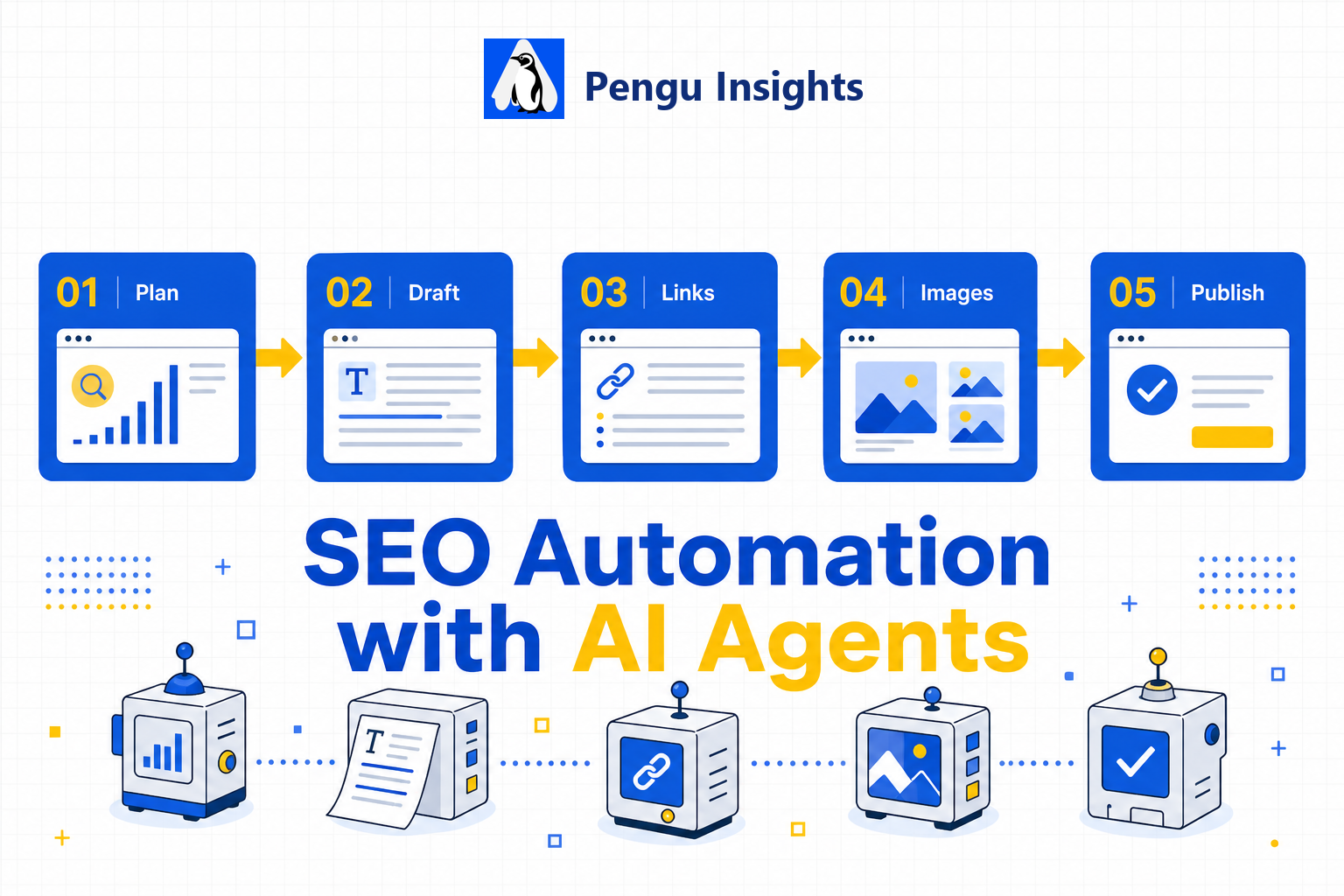
How does a five-stage SEO automation pipeline work?
A reliable pipeline has five stages. In 2026, nearly one in four marketers say LLMs are now the primary audience for a majority of their content (Clutch and Conductor, 2026). That shift rewards structured pages with clear answers, not thin keyword stuffing. Design each stage so answer-first writing and internal links survive automation.
Stage 1: Planning with multi-agent research (45 to 90 minutes setup, then minutes per topic)
Feed the queue with keyword research and topic clusters first. Agents can expand seed terms, group by intent, and draft outlines. Humans approve the cluster map and reject cannibalizing titles. Store approved topics in Google Sheets with columns for primary keyword, cluster, search intent, competitor URLs, status, and owner.
Stage 2: HTML draft plus internal links (agent runtime)
The drafting agent produces structured HTML or Markdown with H2 questions, short paragraphs, and suggested internal links. Constrain word count and require a Key Takeaways block. Ban empty claims. Pass a link inventory so the agent does not invent URLs.
Stage 3: Titles, slugs, and summaries (5 to 10 minutes review)
A metadata agent proposes three titles, one slug, one meta description under 160 characters, and a short excerpt. A human picks the winner. This stage prevents duplicate titles and soft keyword stuffing.
Stage 4: Image generation (optional automation)
Generate a hero and one in-article visual from a locked brand prompt. Reject placeholder art. If the image looks generic, regenerate or commission a real chart instead.
Stage 5: CMS publish with a human gate (5 to 15 minutes)
Push as draft to WordPress or your CMS API. Never auto-publish on day one. After a month of clean drafts, you may allow auto-publish for low-risk templates only. Keep YMYL and competitive comparison posts on manual approve forever.
A realistic cadence for most teams is two posts per week once the pipeline is stable. That pace matches many retainer scopes without drowning editors.
Why must competitive intelligence feed the topic queue?
Because 76% of AI Overview citation sources come from pages already ranking in Google's top 10 organic results (Ahrefs, July 2025). If your automation only rewrites the average of those ten pages, you add another near-duplicate. Competitive intelligence breaks the loop. You document what rivals cover, what they ignore, and where their proof is weak.
Before a topic enters the queue, attach three competitor inputs:
- Top ranking URLs and their H2 outlines
- Gaps in examples, pricing tables, or methodology
- Social and ad angles rivals push that organic pages ignore
Run a structured competitor website analysis before you unlock high-volume topics. When we build content systems for agencies, the highest failure mode is the same: agents write fluent copy that says nothing new. The fix is boring and effective. Force every brief to include a "what competitors miss" field. If that field is empty, the topic stays blocked.
Competitive research is not a vanity PDF. It is fuel for the automation queue. Without it, you scale sameness.
How do you keep brand voice and governance intact?
Governance is the operating system. In 2026 surveys, 53% of content leaders report concern about AI content quality control (Digital Applied content marketing statistics compilation, 2026). Concern is rational. Automation without rules produces on-brand sentences and off-brand claims.
Build four non-negotiable controls:
- Voice pack: tone rules, banned phrases, product naming, and CTA style loaded into every agent prompt
- Source rules: every statistic needs a named source and year; invent nothing
- Review SLA: editor checks facts, links, and positioning before publish (15 to 30 minutes per post)
- Kill switch: any stage can fail closed if quality scores drop or plagiarism flags fire
Also measure what matters. Only 19% of content marketing teams track AI-specific KPIs (Content Marketing Institute via Digital Applied, 2026). If you automate output without tracking assisted vs fully human performance, you will confuse volume with results. Track indexation, rankings for target clusters, assisted conversions, and revision rate after publish. For citation-ready structure in assistants, see our guide on AI search visibility.
When should you not fully automate SEO content?
You should not fully automate when the cost of being wrong exceeds the cost of being slow. Purely AI-generated content has shown weaker long-term ranking durability in multiple industry analyses, including compilations that cite roughly a 23% ranking performance drop after 12 months for unedited AI pages versus stronger results for AI-assisted, human-edited work (Digital Applied, 2026). Treat that as a caution signal, not a universal law. Still, it matches what we see in audits: thin automated posts decay fast.
Do not full-auto these assets:
- Medical, financial, or legal advice pages
- Original research and survey reports
- Named competitor comparisons and battlecards
- Founder essays and category-defining positioning
- Pages that carry pricing promises or contractual claims
Automate these first:
- Formatting, metadata drafts, and internal link suggestions
- Cluster expansion and outline scaffolding
- Image variants from approved brand templates
- Republishing refreshes when a human already validated the core argument
Quality still matters more than cadence. Two strong posts per week beat ten interchangeable ones. Google and AI answer engines both reward useful specificity.
How do you implement the system in 30 days?
Start small. Week one: build the Sheet queue and voice pack. Week two: wire planning and draft agents in n8n or your preferred orchestrator. Week three: add metadata and image stages with draft-only CMS push. Week four: publish two reviewed posts and measure revision minutes.
Checklist for day 30:
- One approved topic cluster with competitive gap notes
- One end-to-end draft that required under 30 minutes of human edit
- Zero invented statistics in the sample posts
- A documented reject reason log for failed drafts
- A decision on which templates may later auto-publish
If edit time stays above 45 minutes per post after a month, pause scaling. Fix prompts, examples, and competitive inputs before you add volume.
Pengu Insights exposes the same SEO tools to AI agents through an API and an MCP server (beta), so an agent can run the research steps on live data. Start free, then create a key under Settings.
Frequently asked questions
What is an SEO automation system with AI agents?
It is a multi-stage workflow that turns a keyword or topic into a draft, metadata, images, and CMS-ready pages using AI agents plus orchestration tools. Humans still own strategy, brand voice, and publish approval. Automation accelerates ops. It does not replace editorial judgment.
Can SEO automation guarantee #1 Google rankings?
No. Rankings depend on competition, authority, intent match, technical health, and continuous updates. Automation can increase output and consistency. It cannot promise position one. Treat any #1 claim as marketing, not an operating plan.
How much do agencies charge for SEO content retainers?
In 2026, many SEO and content retainers for growing brands land roughly in the $2,000 to $5,000 per month range for ongoing strategy, writing, and publishing support. Exact fees vary by niche, volume, and whether research and link work are included. Always get a scoped proposal.
When should you not fully automate SEO content?
Do not fully automate YMYL topics, thought leadership, original research, comparison pages against named rivals, or anything that needs legal review. Keep a human in the loop for brand voice, factual claims, and competitive positioning. Automate formatting and drafts first.
Why does competitive intelligence matter for SEO automation?
Automated content without competitor context often repeats generic SERP consensus. Competitive research feeds topic gaps, angle differentiation, and internal link priorities. Teams that skip this step publish more pages and still lose the intent battle. Start with a structured competitor website analysis before you scale the queue.
What should you do next?
Build the queue and the gates before you build the agents. Load competitive gaps into every brief. Automate assembly, not judgment. Measure assisted outcomes, not just post count. If you want a live walkthrough of how marketing teams combine AI workflows with competitive research, join our session at penguinsights.io/webinar/marketing-ai.
SEO automation is an ops advantage. Strategy, brand voice, and competitor context remain human work. Keep that split clear, and the system helps you ship more useful pages without flooding the SERP with noise.
Written by

Founder of Pengu Insights. Competitive intelligence practitioner for DTC brands and marketing agencies.