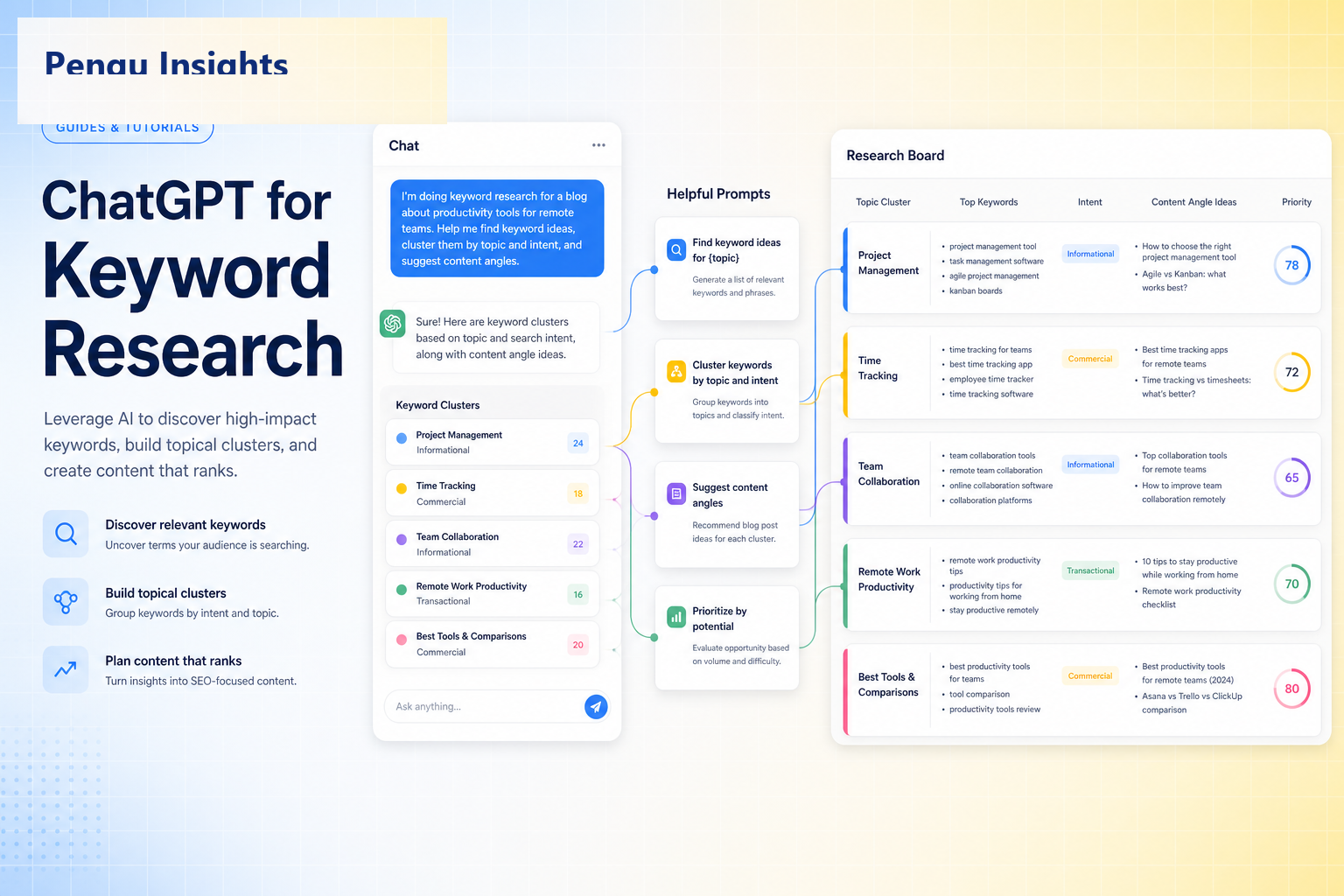
Think of ChatGPT as a brainstorming partner who never gets tired, but sometimes makes up facts. That is the whole promise and the whole risk of ChatGPT keyword research.
ChatGPT is fast at language. It is unreliable at metrics. Used correctly, it accelerates keyword research. Used lazily, it fills spreadsheets with fake volume and random clusters.
Search Engine Journal and similar outlets have popularized AI-assisted research workflows. This guide strips the hype: prompts that work, validation steps you cannot skip, and handoff to content or ads without duplicating ChatGPT SEO content production mistakes.
Key takeaways
- ChatGPT brainstorms and clusters. It does not replace Ahrefs, Semrush, or Keyword Planner.
- Never trust AI-generated search volume. Validate every priority term externally.
- Intent labels from ChatGPT are hypotheses. SERP-check before assigning URLs.
- Question variants are ChatGPT's superpower. Mine PAA-style phrasing fast.
- Human editor merges clusters. Models over-split or under-split without business context.
Video: five prompts that turn a niche into a keyword list
A 15-minute session building a keyword sheet from five prompts, which is a good template for the first hour of any research.
Three things worth taking from it:
- Go two levels down. "20 subtopics of PPC advertising", then "20 subtopics of landing pages". The second level is where the specific keywords live.
- Separate blog keywords from video keywords. The same subtopic yields different phrases for a post and for a video, and he asks for them separately.
- The spreadsheet is the product. Every answer goes into a sheet by topic before anyone writes anything.
What the video does not do, and what the rest of this guide covers: check any of those keywords against real volume, difficulty or the SERP. The list is a set of hypotheses until a data tool confirms them.
Where ChatGPT fits in the keyword stack
Here is what ChatGPT does well and what it does poorly:
Idea generation: ChatGPT is strong. Your SEO tool is strong too.
Search volume: ChatGPT is unreliable (often makes up numbers). Your SEO tool is strong.
Keyword difficulty: ChatGPT is unreliable. Your SEO tool is strong.
SERP analysis: ChatGPT is weak (no live SERP access). Your SEO tool is strong.
Intent labeling draft: ChatGPT is moderate. Your SEO tool is moderate, and you still need to SERP-check.
Cluster naming: ChatGPT is strong. Most SEO tools do not do this.
Negative keyword ideas for PPC: ChatGPT is strong. Most SEO tools are moderate here.
Treat ChatGPT as draft zero of the research doc.
Prompt 1: Seed list from business context
This prompt helps you generate a starting list of keyword ideas when you know your product and audience.
Time estimate: 15 minutes.
You are an SEO strategist. Product: [describe in 2 sentences].
Audience: [role, geo, budget if relevant].
Competitors: [3 names].

Generate 40 keyword ideas grouped by informational, commercial, and transactional intent.
Include question phrasing (how/what/best).
Do NOT invent search volume or difficulty scores.
Output as a markdown table: keyword | intent | suggested page type.
What this prompt does: It forces ChatGPT to think about your specific context, not generic SEO advice. The instruction not to invent volume stops the model from hallucinating fake numbers.
Review output. Delete branded competitor terms you will not target. Add gaps from customer support tickets.
Prompt 2: Long-tail expansion from one pillar
Use this when you already know one main topic and want to expand into related long-tail phrases.
Time estimate: 10 minutes.
Pillar topic: [head term].
Audience pain points: [bullets].

List 25 long-tail variants including:
- comparison queries
- problem-solution queries
- pricing and alternative queries
Mark each as topical (own URL) or supporting (section inside pillar).
No volume numbers.
What this prompt does: It expands one core keyword into variations people actually search. The "topical vs supporting" instruction helps you decide which terms need their own page.
Cross-check with long-tail vs short-tail strategy.
Prompt 3: Cluster merge pass
When you have a messy export from a keyword tool with 200 random terms, use this to organize them.
Time estimate: 15 minutes.
Paste a messy CSV export (keyword column only, max 200 rows):
Group these keywords into 5 to 8 topic clusters.
Name each cluster.
Pick a pillar keyword per cluster.
Flag duplicates and near-duplicates to merge.
Output: cluster name | pillar keyword | member keywords | intent | page type.
What this prompt does: It sorts chaos into usable groups. The model looks for semantic patterns better than most people can do by hand.
Human step: collapse clusters that SERP treats as one intent. ChatGPT does not know what Google actually shows for each query.
Prompt 4: PPC negatives and match type hints
Use this to generate a list of negative keywords and match type ideas for a paid search campaign.
Time estimate: 10 minutes.
Campaign theme: [service/product].
Target geo: [location].
List 30 potential negative keywords to block irrelevant traffic.
List 15 exact-match candidates for high-intent terms.
List 10 broad-match discovery seeds (we use Smart Bidding).
No CPC estimates.
What this prompt does: It identifies junk queries you should block and high-value terms you should protect with exact match. Negatives are often forgotten in keyword research. This surfaces them early.
Feed negatives into shared account lists. See Google Ads match types.
Prompt 5: SERP content angle
After YOU manually SERP-check five keywords, use this to brainstorm differentiation angles.
Time estimate: 10 minutes.
Keyword: [term].
Page-one formats I see: [list blog/product/video/forum].
Suggest a differentiated angle for our brand that is not generic.
Include H2 outline and 4 FAQ questions.
Do not claim statistics without sources.
What this prompt does: It suggests how to stand out from what already ranks. The instruction about not claiming statistics stops hallucinated facts from sneaking into your brief.
Use this to brief writers, not to publish raw.
Validation workflow (non-negotiable)
You cannot skip this part. ChatGPT ideas must pass through real tools and real SERPs before you build anything.
- Export top 30 ChatGPT ideas to your keyword tool (Ahrefs, Semrush, Keyword Planner).
- Drop zero-volume or wrong-geo terms. If the tool shows zero searches or the wrong country, delete it.
- SERP-check top 10 by business priority. Open incognito, set your target country, and look at what actually ranks.
- Assign URL type from real SERP, not model guess. Does Google show blogs? Videos? Product pages? Match that.
- Log decisions in content calendar or ads build sheet.
Time estimate: 30 minutes validation per cluster. Skipping this is how AI research fails.
ChatGPT keyword research mistakes
Asking for volume and KD. The model will invent plausible numbers. They are fiction.
One-shot 500 keywords. Quality collapses. Iterate in batches of 25 to 40.
No competitor context. Generic lists read like textbook SEO. Add real competitor names to prompts.
Publishing clusters without internal link plan. Research ends at the spreadsheet. Connect pages.
Ignoring brand guidelines. AI suggests angles you cannot credibly claim. Filter for what your business can actually deliver.
Pairing ChatGPT with competitive intelligence
Before prompting, pull:
- Competitor top pages from an SEO tool
- Sales call objections (language gold)
- Support ticket themes
Paste summarized bullets into prompts. For site-level gaps, run competitor website analysis first.
When not to use ChatGPT for keywords
- Highly regulated industries requiring legal review of every claim
- Markets where you lack language fluency (native editor required)
- Tiny niches with no training data (tools plus expert interviews beat AI)
Handoff to content and ads
Export final clusters with:
- Primary keyword
- Intent (SERP-validated)
- Target URL (new or existing)
- Priority P1 to P3
- Owner and deadline
SEO teams write briefs from this row. PPC teams build ad groups from transactional rows. Same source doc prevents channel drift.
What to do next
Run Prompt 1 for one product line today. Validate the top 15 terms in your SEO tool. SERP-check the top 5. Kill bad ideas fast. ChatGPT saves hours on language. Your tool subscription saves you from ranking for fiction.
ChatGPT gives you ideas, not volumes. To check how often those keywords are searched inside AI assistants and in Google, use AI Keyword Volume in Pengu Insights. Free plan, no card.
FAQs
Can ChatGPT replace keyword research tools?
No. ChatGPT generates ideas, clusters, and intent hypotheses quickly. It does not provide reliable search volume, difficulty, or SERP data. Always validate in Ahrefs, Semrush, or Keyword Planner before building a content plan.
What is the best ChatGPT prompt for keyword research?
Give context: product, audience, geo, and competitors. Ask for grouped keyword ideas by intent, question variants, and negative keywords for paid. Request a table format and tell the model not to invent search volume numbers.
How do I cluster keywords with ChatGPT?
Paste a raw keyword export or brainstorm list. Prompt ChatGPT to group by topic pillar, intent, and recommended page type. Human editor merges overlapping clusters and checks SERP reality for each pillar.
Is ChatGPT keyword data accurate?
Volume and difficulty figures from ChatGPT are often hallucinated. Use AI for language patterns, angles, and question phrasing. Pull metrics from dedicated SEO platforms.
How long should a ChatGPT keyword research session take?
30 to 60 minutes for a focused cluster if you already know the product. Add 30 minutes to validate top terms in an SEO tool and SERP-check five priority keywords.
Written by

Founder of Pengu Insights. Competitive intelligence practitioner for DTC brands and marketing agencies.