Think of keywords as fishing nets.
Short-tail keywords are wide nets cast in the open ocean. You catch a lot, but most of what you haul in is not what you wanted. Long-tail keywords are smaller, targeted nets in a specific cove where you know the right fish gather. Fewer total fish, but nearly every catch is exactly what you need.
Head terms get the board meeting slides. Long-tail terms pay the invoices. This is not a morality play. It is a portfolio decision about volume, competition, and intent clarity.
Ahrefs and similar SEO research libraries show that most keywords in large datasets are long-tail by count, even when head terms absorb a visible share of total volume.
Key takeaways
- Short-tail means broad, high volume, high competition, vague intent.
- Long-tail means specific, lower volume per term, often higher conversion rate.
- Topical long-tail clusters beat one-off random posts.
- Supporting long-tail pages strengthen pillar rankings through internal links and coverage.
- Paid search uses long-tail for control, short-tail for scale with guardrails.
Video: long-tail is about specificity, not word count
Twenty minutes that clear up the most common confusion first: a three-word query can be short-tail and a three-word query can be long-tail.
Three things worth taking from it:
- Classify by intent, not by length. "Best budget laptops" is mid-tail because the category is huge; "best gaming laptops" is long-tail because it names a niche. The word count is the same.
- Volume falls as intent rises. The walk from "dog" to "dog food" to "healthy dog food" to a specific grain-free product shows searches dropping and purchase intent climbing at each step.
- Long-tail terms are where a new site gets its first traffic. They are winnable, they convert, and they add up.
Our addition: your own Search Console is the best long-tail source you have. The queries you already get impressions for at position 15 are the long tail that is closest to paying. Paste ten of them into the free keyword volume checker to see which ones have volume and which are too small to show.
What are short-tail keywords?
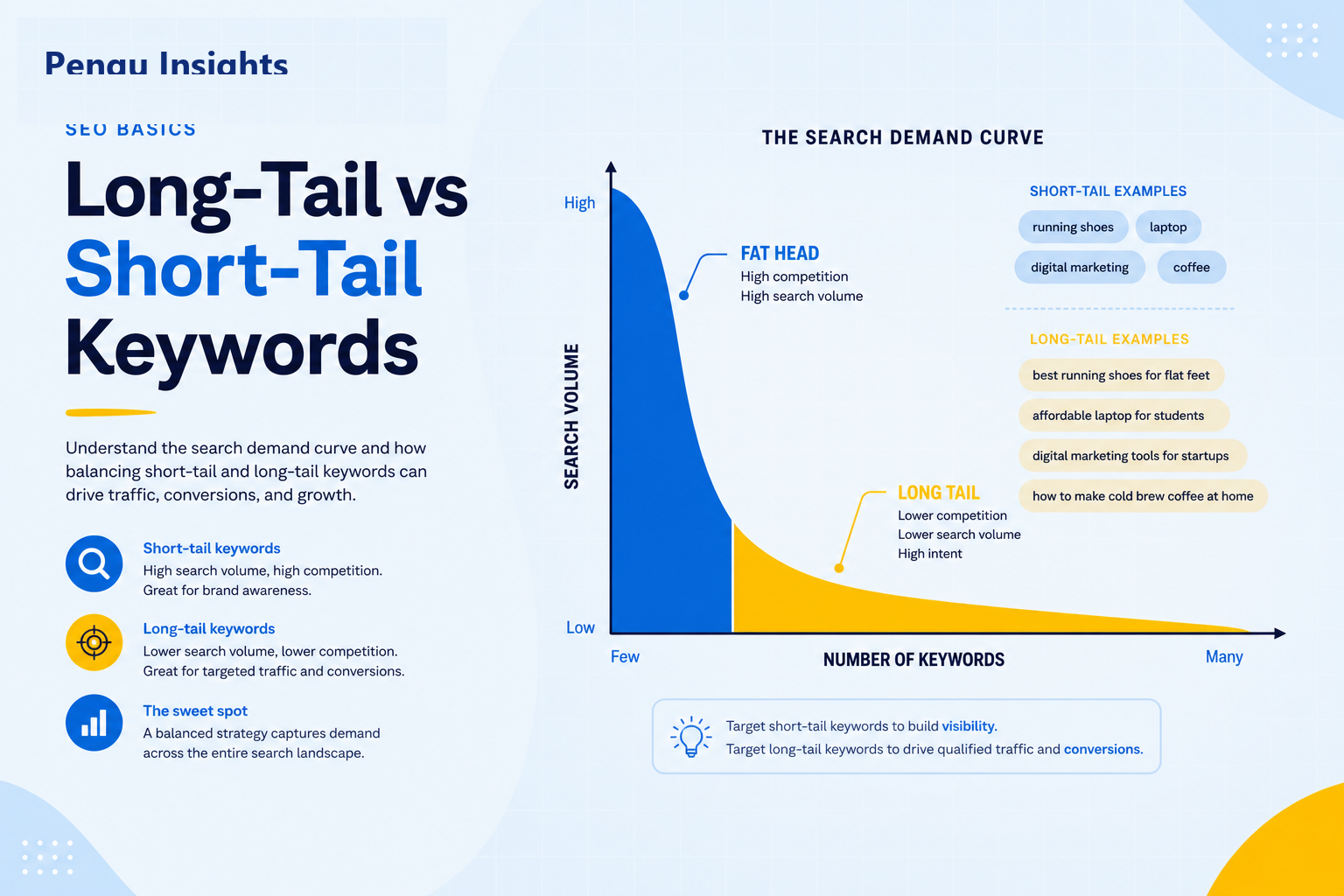
Short-tail keywords are broad queries, typically one to two words:
- "insurance"
- "CRM"
- "yoga"
What makes them short-tail:
- High monthly search volume compared to the category average
- Heavy SERP competition from brands, Wikipedia, marketplaces
- Mixed or ambiguous intent (research? comparison? purchase?)
- Expensive in paid search for commercial categories
Head terms define markets. They are poor solo KPIs for young domains.
What are long-tail keywords?
Long-tail keywords are longer, specific phrases:
- "CRM for independent insurance brokers"
- "beginner yoga routine for lower back pain"
- "how to export Google Ads search terms to CSV"
What makes them long-tail:
- Lower volume per keyword
- Clearer intent and audience
- Often less competition
- Cumulative traffic from many terms can exceed one head term
Long-tail is a distribution, not a strict word count rule. Three words can be long-tail if specific ("best CRM for solopreneurs").
Short-tail vs long-tail: side by side
Here is how they compare in practice:
Example short-tail: "project management"
Example long-tail: "project management template for client work"
Volume: Short-tail has high volume. Long-tail has low volume per individual term.
Competition: Short-tail faces heavy competition. Long-tail usually sees less.
Intent: Short-tail intent is mixed. Long-tail intent is specific.
Content type: Short-tail fits pillar pages and category pages. Long-tail fits guides, templates, FAQs.
Paid CPC: Short-tail often costs more per click. Long-tail often costs less.
Time to rank: Short-tail takes longer. Long-tail is usually faster, though not instant.
Topical vs supporting long-tail
Ahrefs-style cluster strategy splits long-tail into two jobs:
Topical long-tail: Subtopics that deserve their own URL because search demand exists and intent is distinct.
Example: "Kanban vs Scrum for marketing teams."
Supporting long-tail: Narrow questions answered inside a broader guide or FAQ section.
Example: "how many columns on a Kanban board" inside a Kanban primer.
Do not create separate URLs for every supporting question. That breeds thin content. Do create URLs when SERP shows standalone intent deserving a dedicated page.
Time estimate: 60 minutes to map one pillar topic into topical vs supporting long-tail in a spreadsheet.
How to build a long-tail cluster for SEO
- Pick a head term that matches your offer ("competitive intelligence software" not "marketing").
- Pull long-tail variants from tools, PAA boxes, forums, sales call notes.
- Group by intent: informational, commercial, transactional.
- Assign one pillar URL for the head topic.
- Build topical long-tail pages linking up to the pillar.
- Use supporting long-tail as H2/H3 sections or FAQ schema on pillar pages.
Internal links flow up to the pillar and sideways among related long-tail pages. See search intent keyword types when grouping.
When short-tail keywords are worth chasing
Pursue head terms when:
- Domain authority and backlinks can compete on page one
- You can ship a superior page format (tools, data, original research)
- Brand searches and PR amplify click-through rate
- Paid supports organic while rankings mature
Skip head terms when page one is all giants and your page adds nothing new. Patience is not a strategy if the SERP requires assets you will not build.
Long-tail and short-tail in Google Ads
Short-tail in paid search: Use for scale with Smart Bidding, strong negatives, and frequent search term reviews. Expect higher CPC.
Long-tail in paid search: Exact and phrase match protect budget. Ideal for niche SKUs, local modifiers, and high-intent questions.
Discovery loop: Broad match finds new long-tail queries converting at acceptable CPA. Promote winners to exact match ad groups.
Read Google Ads keyword match types before expanding broad.
Measuring success beyond single keywords
Track clusters, not vanity head rankings alone:
- Pillar visibility for head term and variants
- Long-tail URL count ranking top 20
- Assisted conversions from informational long-tail to money pages
- Paid search term reports: which long-tail queries hit CPA targets
Google Analytics 4 path explorations help show cluster assist paths.
Common long-tail mistakes
Publishing 200 thin pages with one paragraph each. Google consolidates or ignores them.
Ignoring head term context. Random long-tail without pillar connection wastes crawl budget.
Choosing long-tail with zero volume because tools show "easy." No demand means no ROI.
Duplicate long-tail across locales without translation of intent.
AI search and long-tail acceleration
Conversational queries are long-tail by nature. Users ask full questions in AI Mode and chat tools. Structured FAQs, tables, and clear definitions on long-tail pages improve citability.
Pair SEO clusters with ChatGPT keyword research to brainstorm question variants, then validate in a real keyword tool.
What to do next
Pick one product line or service. List the head term and 30 long-tail variants from sales and support language. Classify topical vs supporting. Publish or upgrade three topical long-tail pages this month linking to one pillar. Measure cluster traffic, not single keyword ego metrics.
To pull long-tail variations with real volume and difficulty for any seed keyword, use the Keyword Explorer in Pengu Insights. Free plan, no card.
FAQs
What is the difference between long-tail and short-tail keywords?
Short-tail keywords are broad, usually one to two words with high search volume and competition. Long-tail keywords are longer, specific phrases with lower individual volume but often stronger intent and conversion rates.
Are long-tail keywords easier to rank for?
Often yes, because competition is lower and content can match intent precisely. Easy is not automatic. Weak pages on obscure terms still fail if SERP quality is high or intent is wrong.
What percentage of searches are long-tail?
Estimates vary, but many SEO studies suggest a large share of all queries are low-volume, specific phrases. Ahrefs and similar tools show that most keywords in databases are long-tail by volume distribution.
Should I target short-tail or long-tail keywords first?
New sites usually win faster with long-tail clusters that support a pillar topic. Established brands can compete for short-tail head terms while using long-tail to capture niche demand and feed internal links.
Do long-tail keywords work for Google Ads?
Yes. Exact and phrase match on long-tail terms control costs. Broad match can discover new long-tail variants when paired with Smart Bidding and negative keywords.
Written by

Founder of Pengu Insights. Competitive intelligence practitioner for DTC brands and marketing agencies.