Almost every competitor tracking setup dies the same way. Someone turns on alerts for five rivals, the alerts fire twelve times a day, and within a month the whole thing is filtered into a folder nobody opens.
The fix is not a better tool. It is watching fewer things.
Key takeaways
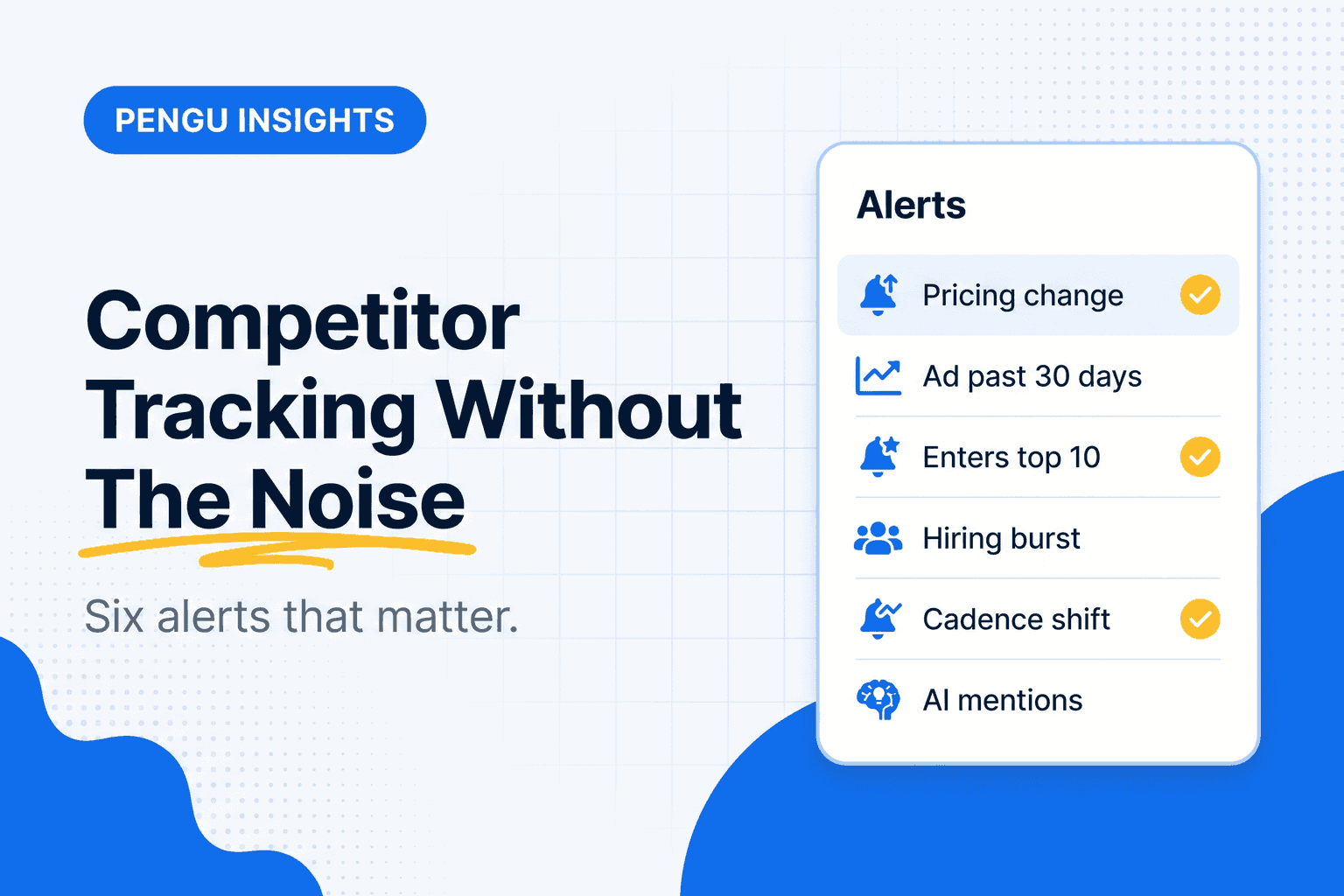
- Six changes predict a move. Most alerts track the other twenty.
- Five to eight competitors is the working range. More and nobody reads it.
- Cadence: ads and social weekly, content and rankings monthly, pricing quarterly.
- Tracking that does not end in an owner and a date is a newsletter.
Video: the mistakes that make competitor tracking backfire
Ten minutes on how tracking competitors goes wrong, from an agency owner who has watched clients copy rivals into losses.
Three things worth taking from it:
- Visible success is not measured success. More followers, more ads, growing organic traffic: none of it tells you whether their marketing is profitable. He gives the case of a course "sold 10,000 times" that turned out to be $5 sales on a marketplace.
- You can see what they do, not what works. Unless you have inside information, tracking shows activity. Treat every tactic you see as a test to run, not a result to copy.
- Audit your audience's attention, not the competitor. His alternative: find what your customers are exposed to every day, then say something that stands apart from it.
That last point is why the alerts in this guide are about changes, not activity. A competitor changing their pricing page is a signal; a competitor posting daily is noise. The one activity worth a monthly look is their keyword list, because a new page that ranks is a decision they made: the free competitor keyword finder shows the twenty that carry their traffic.
The six changes worth an alert
1. A pricing or packaging change
The highest-signal event in the entire category. Pricing pages change quietly, and a repackaging usually precedes a positioning shift by a month or two. Check quarterly, or set a change detector on the pricing URL.
2. A new ad that survives 30 days
Anyone can launch an ad. Surviving a month means it passed a budget review. The Facebook ad library shows the start date free, so run duration is the metric to watch, not creative volume.
3. A page that enters the top 10 for a keyword you want
Not any ranking movement, which is mostly noise. A competitor breaking into the top 10 for a term you care about is a direct threat with a direct response.
4. A hiring pattern
Three job posts for the same role tell you where the budget went. Two performance marketers and a lifecycle hire says paid is scaling. A first enterprise AE says they are moving upmarket, which usually means the low end opens up.
5. A sudden change in publishing rhythm
A brand that posted twice a week for a year and now posts daily has decided something. So has one that went silent for six weeks.
6. Whether AI assistants started recommending them
New, and most teams do not watch it at all. If ChatGPT names a competitor when someone asks about your category and never names you, that is a distribution channel you are losing without a single ranking changing.
Watch it in a social media dashboard alongside the rest, rather than as a separate alert nobody opens.
The twenty changes that are not worth an alert
Anything on this list, check on a cycle instead of alerting:
- Follower count movements
- Individual social posts
- Blog posts that are not ranking
- Minor copy edits
- Rankings moving between positions 30 and 70
- Press mentions with no product news attached
- Conference appearances
- Small design changes
- Any mention of them in a listicle
- Their newsletter, unless it announces something
None of these predict a move. They tell you a company exists.
Choosing the set
Five to eight, split in two:
Two or three direct rivals. Same buyer, same problem, appear against you in deals or in the SERP. Watch these closely.
Three to five adjacent players. Serve a neighbouring problem or a neighbouring segment. Check quarterly. These are where disruption usually arrives from, and they are the ones most lists forget. Our post on examples of competitors covers how to build the list properly.
How to set up competitor tracking
The free version. Google Alerts for brand mentions, a change-detection service on their pricing and homepage, a monthly calendar block to open the ad library and check the top pages by hand. Costs nothing, takes an hour a month, and beats most paid setups that nobody reads.
The tooled version. A platform that diffs everything on a schedule and shows the delta. Pengu Insights tracks competitor keywords, traffic, Instagram, TikTok and LinkedIn activity, the ad library and AI visibility from $39 a month, which is the point at which doing it by hand stops being cheaper than paying for it.
Turning tracking into decisions
The step that separates useful tracking from an expensive newsletter:
- One page a month. What changed, what it implies, what we do, who owns it.
- Three bullets maximum per competitor. If everything is worth reporting, nothing is.
- Close the loop. Next cycle, open last month's actions first. Anything not done gets dropped or reassigned, never silently carried.
Frequently asked questions
What is competitor tracking?
Monitoring a defined set of rivals for meaningful changes over time: new pages and rankings, pricing edits, new ad creatives, hiring, launches and shifts in social output.
How do I track competitors automatically?
Point a tool at a fixed list and let it diff each cycle. Google Alerts and change-detection services cover the free version; a competitive intelligence platform covers rankings, content, ads and social in one place.
How many competitors should I track?
Five to eight, split into two or three direct rivals watched closely and a wider set checked quarterly.
What is the difference between competitor tracking and competitive intelligence?
Tracking is the collection layer. Competitive intelligence is the whole practice, including deciding what a change means and acting on it.
How often should competitor tracking run?
Ads and social weekly, rankings and content monthly, pricing and positioning quarterly.
Written by

Founder of Pengu Insights. Competitive intelligence practitioner for DTC brands and marketing agencies.