Ask ten marketers "what is competitive intelligence" and you get ten answers, most of which describe a spreadsheet somebody abandoned in March.
Here is a working definition: competitive intelligence is the repeatable collection of public signals about your market, analysed to the point where it changes a decision. If it does not change a decision, it is trivia.
Key takeaways
- It uses public information. The legal line is how you obtained it, not how valuable it is.
- Four signals carry most of the value: search, social, ads and pricing.
- The output is a decision, not a document.
- Monthly is the right cadence for content and ads. Faster is noise.
Video: competitive intelligence in five steps
Five minutes from a product marketing community that walks the whole loop, which makes it a good companion to the definition above.
Three things worth taking from it:
- Sort competitors into direct and indirect. Direct sells what you sell; indirect solves the same need differently and could become direct with one product decision. Keep both lists.
- Benchmark on their history, not just their present. Founding date, funding, headcount at the age your company is now. It reframes "they are bigger" as "they were here two years ago".
- A survey is a cheap market-share proxy. Ask a large sample of prospects what they use today. The names that keep coming up are your share data, without a research budget.
Step five in the video, scrutinising pricing, distribution and positioning, is where the tools in our comparison earn their keep; the first four steps are mostly reading and asking.
What is competitive intelligence, and what it is not
It is not espionage. Nothing in a competent CI process requires deception. Pretending to be a customer to extract confidential information is not clever, it is a legal problem.
It is not a competitor list. A list of rivals with logos is a slide, not intelligence.
It is not monitoring for its own sake. Alerts nobody reads are a subscription, not a practice.
It is not the same as market research. Research studies demand. Intelligence studies supply. Our post on market research tools covers the other half.
The legal and ethical line
The rule is simple: intelligence comes from information that was public, or that you obtained lawfully and honestly.
Fair game: websites, pricing pages, ad libraries, job postings, patents and filings, reviews, conference talks, public social accounts, search data, app store listings.
Not fair game: misrepresenting who you are to get information, trade secrets, anything obtained by accessing systems you were not authorised to access, and inducing an employee to breach an NDA.
Most professional CI codes, including SCIP's, draw the line at exactly that point. If explaining how you got a fact would embarrass you, you are on the wrong side of it.
The four signals worth collecting
1. Search: what they rank for and you do not
The clearest statement of what a competitor believes the market wants. Keyword gaps are also the most directly actionable finding CI produces, because a gap converts straight into a content plan.
2. Social: what they publish and what it earns
Volume tells you their bet. Engagement tells you which of their bets worked. The interesting number is not their follower count, it is which three posts carried the quarter. Our comparison of social media monitoring tools covers how to collect this.
3. Ads: what they pay to keep saying
The strongest signal available for free. An ad running for four months has survived a budget review, which is more evidence than any organic post can offer. Start with the Facebook ad library, which Meta publishes publicly.
4. Pricing and packaging
How they slice the product tells you which customer they are optimising for, and where they left a segment unserved. Pricing pages change quietly and rarely get announced.
The loop
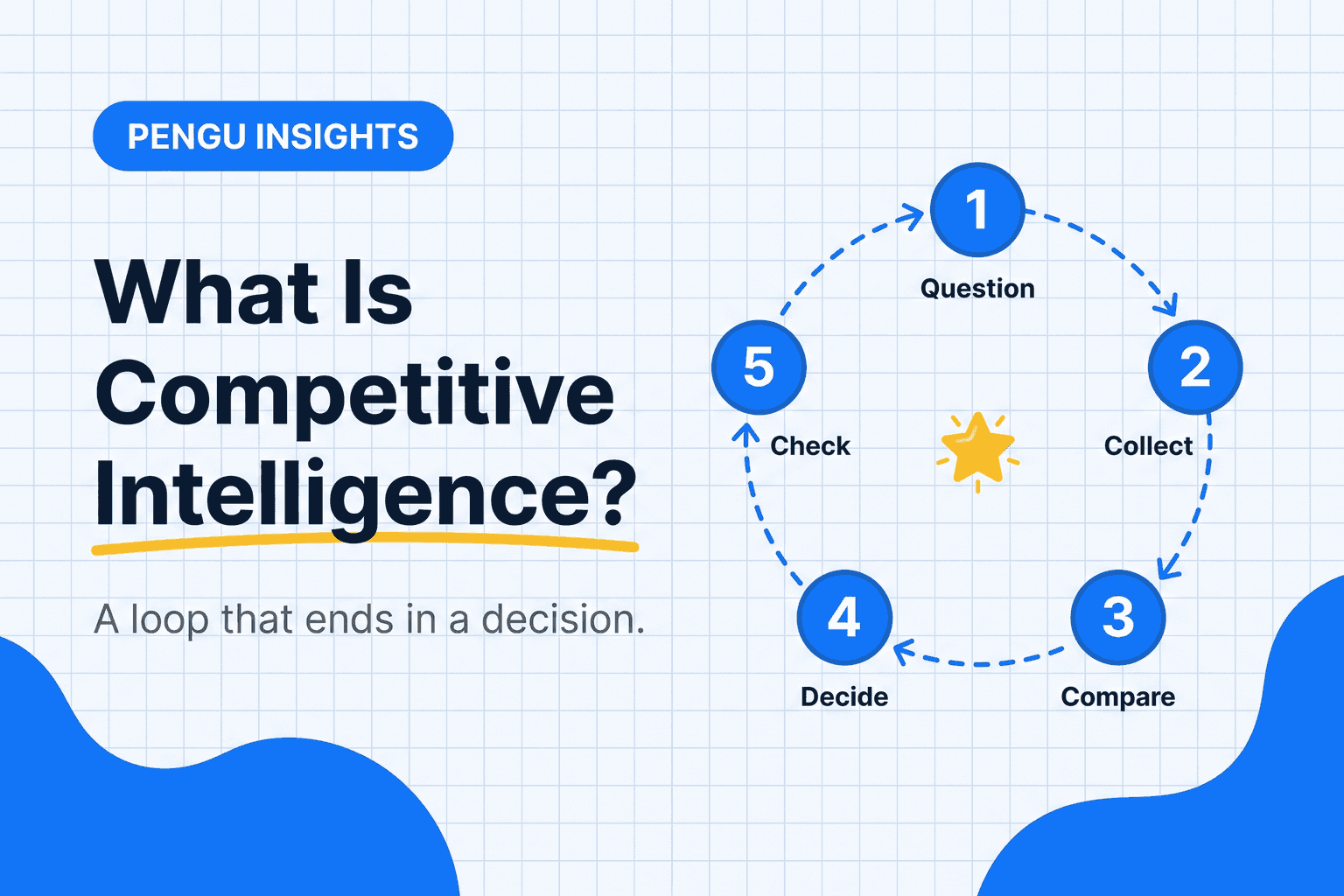
Intelligence is a loop, not a project:
- Question. "Why are we losing deals to X" beats "monitor X".
- Collect. The four signals above, on a schedule, into one place.
- Compare. Against your own numbers, not in isolation.
- Decide. Write the action and the owner.
- Check. Next cycle, did the action move anything?
The step teams skip is the last one, which is why so many CI programmes quietly become newsletters.
What good output looks like
One page, monthly, per competitor set:
- What changed since last month, three bullets maximum
- What it implies for our plan, one paragraph
- What we will do, with an owner and a date
- What we are watching next cycle
If it takes longer than ten minutes to read, nobody will read it twice.
Doing it without a research team
Most of this can run on a subscription rather than a headcount. Pengu Insights pulls the four signals into one workspace from $39 a month: competitor keywords and traffic, Instagram, TikTok and LinkedIn activity, the Facebook ad library, and AI visibility so you also know whether ChatGPT recommends them instead of you. Agency plans export it white label, which is what turns intelligence into something you can bill for. Our post on white label reports covers how agencies package that.
For the manual version, our competitor website analysis workflow is a 90-minute process that needs no tools beyond a browser.
Once the definition is clear, the buying decision is a separate question: see the competitive intelligence tools comparison.
Frequently asked questions
What is competitive intelligence?
The practice of collecting and analysing public information about competitors and a market, then turning it into decisions: what rivals publish, rank for, charge, promote and ship.
Is competitive intelligence legal?
Yes, when it uses public or lawfully obtained information. It becomes illegal or unethical with misrepresentation, trade secrets, hacking, or inducing a breach of confidentiality. The line is how you obtained it.
What is the difference between competitive intelligence and market research?
Research studies demand, intelligence studies supply. A real decision usually needs both.
What signals should I actually track?
Search rankings, social content and its performance, paid ads, and pricing and packaging. Everything else is usually noise or lagging.
How often should I run competitive intelligence?
Monthly for content and ads, quarterly for pricing and positioning.
Written by

Founder of Pengu Insights. Competitive intelligence practitioner for DTC brands and marketing agencies.