Imagine walking into a library where the librarian reads the book for you and hands you a summary. You only open the book if you need something deeper. That is the future of search, and it is already here.
That is search in 2026.
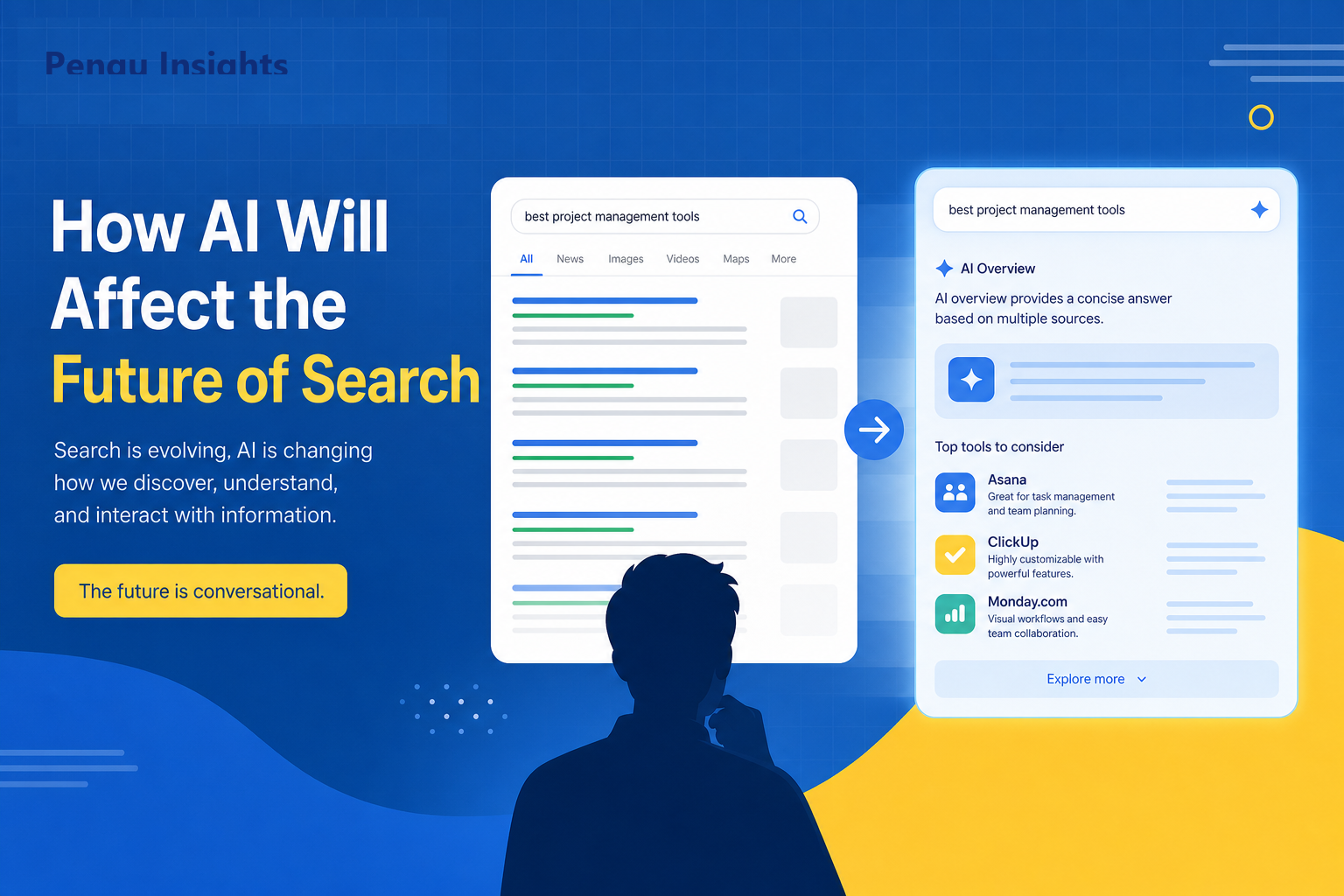
Search is splitting in two. Users still click links for high-stakes decisions. They accept AI summaries for quick answers. AI Overviews, chat tools, and zero-click SERPs already changed how marketers plan content and measure success.
Search Engine Land and peer outlets have tracked this shift since Google expanded AI-generated answers in results. Gartner predicted traditional search volume could fall 25% by 2026 as AI absorbs demand (Gartner, February 2024). This post maps practical adaptations for 2026 and beyond without panic or denial.
Key takeaways
- AI answers compress informational clicks first. Transactional and local intent still drive site visits.
- Zero-click is not new. AI accelerated a trend SparkToro documented for years.
- Citations become a KPI. Visibility inside answers matters alongside blue-link rank.
- Brand and product data feed AI matching for organic and paid surfaces.
- Measurement must include assisted conversions and SERP feature presence.
Video: Google's CEO on where search is going
The most useful primary source on this question is the person running the company. This 40-minute interview, recorded after Google I/O, covers AI Mode, AI Overviews and agents directly.
Three things worth taking from it:
- Google calls this a platform shift, not a feature. The framing is that AI changes the interface to computing itself, the way mobile did, and search is the first product to show it.
- AI Mode is the direction, AI Overviews are the bridge. Overviews sit on top of the classic results page; AI Mode is a separate, conversational experience that Google is rolling out to more users.
- The open question is the web's share of the visit. The interviewer presses on what happens to sites when answers are synthesised; the answer leans on sending "quality traffic". Publishers should read that as the metric to watch.
The rest of this guide works from the same premise: citations replace clicks as the unit, and the pages that get cited are the ones with something specific to say.
What changed in search interfaces
Three layers overlap in 2026:
Classic blue links. Still core for many commercial SERPs.
AI Overviews and AI Mode-style experiences. Synthesized answers with source links.
Off-platform chat (ChatGPT, Perplexity, Copilot). Discovery without a traditional SERP.
Google expanded AI Overviews to more queries and locales through 2024 and 2025. OpenAI and others scaled chat usage globally. Users learn that search can mean "ask" not "ten blue links."
For organic plus paid interplay, read Google organic and paid search in 2026.
Zero-click search in an AI world
SparkToro and Similarweb research has reported that a majority of Google searches end without a click to the open web in many datasets (methodology varies by definition of zero-click). AI Overviews extend that pattern for definitional and how-to queries answered inline.
Implications:
- Traffic dashboards on informational content may flatten even if "visibility" grows
- Brand recall matters when users never visit until purchase moment
- SERP real estate splits among ads, AI blocks, packs, and fewer organic slots
Do not interpret zero-click as "SEO is dead." Interpret it as KPI diversification.
How AI Overviews choose sources
Google states AI Overviews draw from its search index and ranking systems. Third-party studies, including Ahrefs research on AI Overview citations, found strong overlap with top organic results, especially pages already in the top 10 (Ahrefs, 2025).
Practical requirements for citability:
- Clear, quotable sentences under descriptive H2s
- Original stats with named sources and dates
- Tables and lists models can parse
- Expert bylines and About pages with real credentials
- Fast, crawlable HTML (not everything hidden in JS tabs)
Pair technical structure with answer engine optimization basics.
Content strategy for the future of search
1. Intent-tiered portfolio
Informational content: Aim for citation, newsletter, and brand trust. Accept lower click volume.
Commercial content: Comparison depth, methodology, pricing verification dates. Win clicks and citations.
Transactional content: Speed, clarity, schema, feeds. Protect revenue paths.
2. First-party data and lived experience
AI summaries commoditize generic definitions. Original surveys, screenshots, workflow videos, and practitioner notes differentiate. That aligns with Google's helpful content emphasis on experience.
3. Structured FAQ and entity clarity
FAQ sections with honest answers map to PAA and AI follow-ups. Organization schema, author schema, and product schema reduce ambiguity about who you are.
4. Multimedia where SERPs demand it
Some queries surface video or forums heavily. Text-only SEO plans miss those surfaces.
Time estimate: 90 minutes to add FAQ blocks and author bios to your top 10 money pages.
Paid search in an AI-shaped SERP
Ads appear in and around AI experiences in tested layouts. Performance Max and search campaigns with strong conversion signals compete for new inventory as it rolls out market by market.
Ops moves:
- Clean product feeds and business data
- Value-based bidding with offline imports
- Separate reporting for brand vs non-brand in a zero-click world
- Creative that states differentiated facts, not generic claims AI can paraphrase from anyone
Measurement beyond rankings
Add dashboard rows:
AI Overview presence (tools or manual tracking): Track visibility when clicks drop.
Branded search volume: Delayed demand signal that shows brand awareness even without visits.
Assisted conversions in GA4: Long paths through AI touchpoints before purchase.
Share of voice on commercial SERPs: Clicks plus ad impression share combined.
Lead quality scores: Volume lies when funnel top shifts to AI answers.
Rank tracking alone underreports success and failure in 2026.
Risks marketers underestimate
Thin content acceleration. AI lets teams publish more fluff faster. Flooded SERPs hurt everyone.
Copyright and attribution disputes. Models and platforms evolve policies. Monitor how your content appears in answers.
Overfitting to one platform. Google AI Overviews, ChatGPT, and Perplexity cite differently. Diversify visibility tactics.
Neglecting technical SEO. Crawl errors still block citations.
What will not change soon
- Businesses still need demand capture on high-intent queries
- Trusted brands still win comparisons
- Product data still powers shopping and local surfaces
- Measurement still separates profitable teams from vanity metrics
SEO job titles may change. Search demand does not vanish.
For a broader playbook, see AI search strategy and GEO.
90-day adaptation plan
Days 1 to 30: Audit top 50 URLs by intent tier. Add FAQs, author bios, and citation-friendly summaries.
Days 31 to 60: Implement schema where missing. Improve Core Web Vitals on money pages.
Days 61 to 90: Launch tracking for branded search, AI Overview spot checks on priority keywords, and assisted conversion reports.
Assign owners across SEO, content, and paid. AI search reward loops cross teams.
What to do next
List your top 20 informational keywords. Manually check AI Overviews this week. Note who gets cited and why. Upgrade two pages with clearer structure and original proof. Update leadership dashboards with visibility metrics, not traffic alone. The future of search is already here on half your SERPs.
To check today whether Google shows an AI Overview for your keywords and which sites it cites, use the AI Overview Tracker in Pengu Insights. Free plan, no card.
FAQs
How is AI changing search engines?
Search engines embed generative answers directly in results (AI Overviews), expand conversational interfaces, and synthesize sources instead of only ranking links. Users get faster answers; publishers compete for citations as well as clicks.
Will AI kill SEO?
SEO evolves rather than dies. Technical crawlability, authority, structured content, and brand signals still matter. Traffic mixes shift toward high-intent queries, direct brand searches, and visibility in AI answers.
What is zero-click search?
Zero-click searches end on the SERP without a visit to a website. Featured snippets, knowledge panels, and AI Overviews contribute. SparkToro and similar research has long shown a large share of searches produce no click.
How should content strategy adapt to AI search?
Publish citation-ready passages with clear headings, original data, expert attribution, and FAQ schema. Own transactional and branded intent. Track visibility in AI surfaces, not rankings alone.
Do AI Overviews reduce website traffic?
Early studies show mixed impact by query type. Informational queries lose clicks first. Commercial and transactional queries still send traffic. Measure your categories separately instead of assuming uniform loss.
Written by

Founder of Pengu Insights. Competitive intelligence practitioner for DTC brands and marketing agencies.