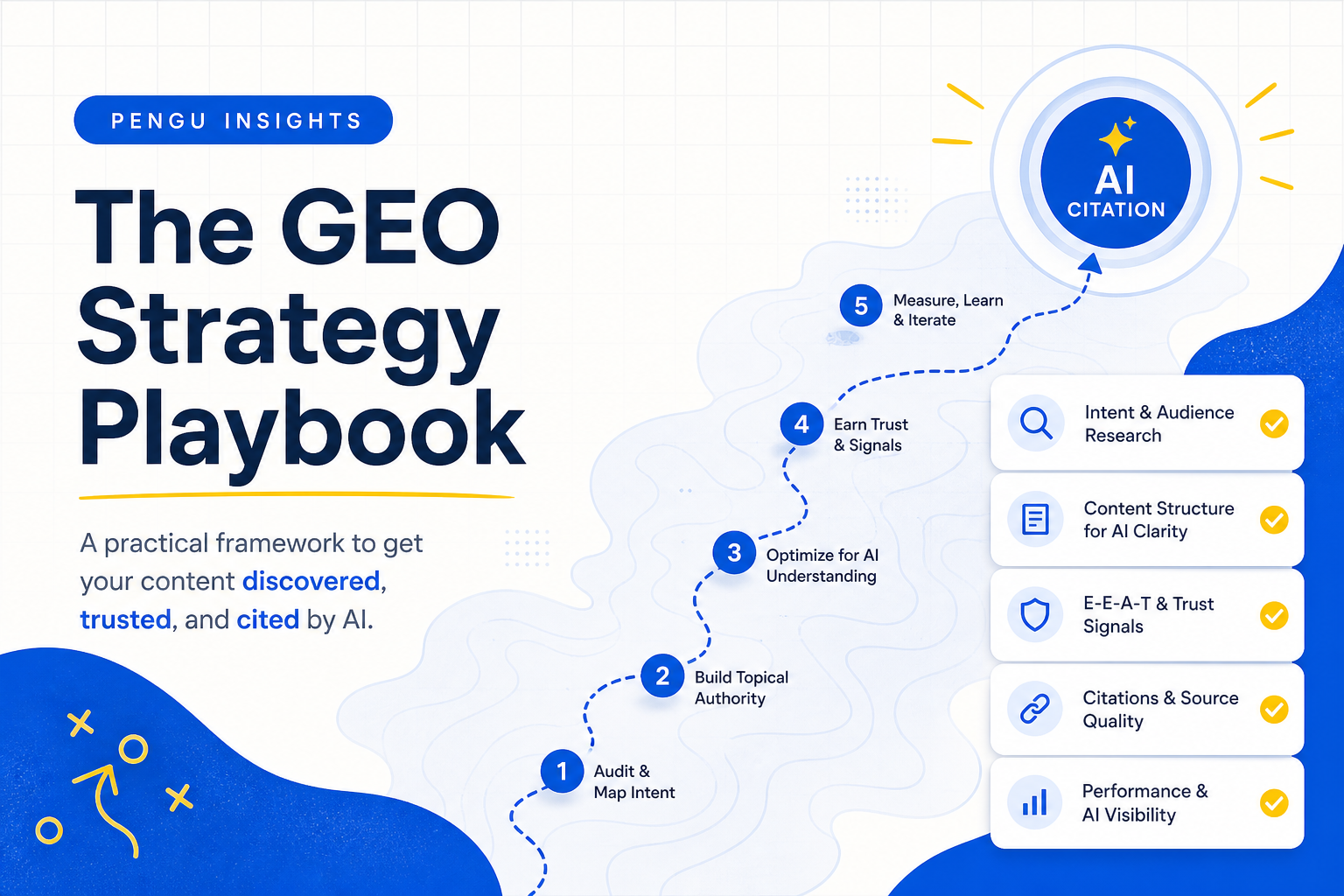
Knowing what generative engine optimization is is table stakes. Shipping an AI search strategy that earns citations is the hard part. This playbook turns expert tactics into a weekly operating rhythm you can run without waiting for perfect consensus on "how AI search works."
In Ahrefs' study of roughly 75,000 brands, YouTube mentions showed the strongest correlation with AI visibility across ChatGPT, AI Mode, and AI Overviews, around 0.737, ahead of branded web mentions, domain rating, and backlinks (Ahrefs, 2025). That is the strategic clue: AI search rewards how the web (and video) talks about you, not only how you write homepage copy. Below is the execution layer, synthesized from practitioners actively testing GEO tactics, including the expert roundup in Top SEO Experts Build Me an AI Search Strategy (GEO).
Key takeaways
- Mine prompts from real conversations, not only keyword tools. Prompts run about five times longer than classic search queries.
- YouTube mentions lead AI visibility correlates in Ahrefs' 75k-brand research (~0.737) (Ahrefs, 2025).
- Ship niche comparisons and listicles that match ICP contexts AI already knows about the user.
- Stay fresh. AI-cited pages skew newer than classic SERP winners. Refresh on a calendar.
- Deserve the citation. Tactics amplify a trustworthy product and clear evidence. They do not replace it.
Why do you need a GEO playbook, not just a definition?
In 2025, Ahrefs found that 76% of AI Overview citation sources already ranked in the organic top 10 for the query (Ahrefs, July 2025). Definitions tell you the finish line is citation. A playbook tells you what to do every week so you become one of those sources. Teams that only read "what is GEO" stall at awareness. Teams with a system ship pages, earn mentions, and track share of AI answers.
Gartner predicted traditional search volume could fall 25% by 2026 as buyers shift toward AI-assisted answers (Gartner, February 2024). Direction matters more than the exact percentage. Fewer clicks per query means recommendation moments move inside the answer. Your competitors are already testing listicles, YouTube collabs, and comparison pages. Waiting for a perfect GEO textbook is how you lose the shortlist.
A definition answers "what changed." A playbook answers "what do we ship this sprint?" If your GEO work has no owner, no prompt set, and no monthly citation log, you do not have a strategy yet.
For the concept layer, keep What Is Generative Engine Optimization (GEO)? bookmarked. For live research workflows with assistants and SEO data, see how to dominate AI search results with Claude. This article is the operating system between those two.
How do you research prompts instead of only keywords?
Practitioners testing GEO report that prompts run about five times longer than classic keywords because people explain context, constraints, and goals in natural language (Ahrefs expert roundup, 2025). Keyword tools still matter for demand signals. They miss the sentence-level fears, objections, and use cases that show up in sales calls, support tickets, Reddit threads, and live chat.
Step 1: Collect conversation corpus (45 minutes)
Pull the last 30 to 90 days of sales call transcripts, support emails, chat logs, and high-intent Reddit threads where your ICP already talks. Strip personal data. Keep product language intact. This is prompt research, not vanity analytics.
Step 2: Extract themes with an LLM (30 minutes)
Upload the corpus and ask marketing research questions: What do buyers care about? What are their fears, uncertainties, and doubts? Which comparisons keep coming up? Which jobs-to-be-done never appear in your keyword sheet? The output should be a prompt bank, not a blog idea dump.
Step 3: Map prompts to citable assets (60 minutes)
Group prompts into definition, comparison, how-to, pricing, and "best for [ICP]" buckets. Assign each cluster an owner and a page type. If you already analyze competitor websites, add one column: which rival pages already answer this prompt in a quotable way?
Classic SEO asks "what keyword do we rank for?" GEO research asks "what situation is the buyer describing to the model?" Those two questions produce different briefs, even when the commercial intent is the same.
How do YouTube mentions fit an AI search strategy?
In Ahrefs' 75,000-brand analysis, YouTube mentions were the strongest correlate of AI visibility (~0.737), slightly ahead of YouTube mention impressions (~0.717) (Ahrefs, 2025). That aligns with reporting that OpenAI trained GPT-4-class models on over a million hours of YouTube transcriptions (Ahrefs summarizing NYT reporting). YouTube is both training fuel and a frequently cited domain in AI Mode and AI Overviews.
Practical YouTube GEO moves (2 to 4 weeks)
- Audit mentions (60 minutes): Who already says your brand name in titles, descriptions, or transcripts? Who says your competitors?
- Sponsor or collaborate (ongoing): Prioritize creators whose audiences match your ICP, not vanity subscriber counts.
- Publish for transcript clarity (per video, +30 minutes): Chapters, spoken definitions, and on-screen claim captions make extraction easier.
- Piggyback category videos: If you cannot own the channel yet, earn a fair mention inside comparison and "best tools" videos that already rank.
Organic search presence still matters. Mentions across publishers, review sites, Reddit, and your own answer-first content give models something solid to lean on. YouTube is the amplifier many teams ignore until competitors own the narrative.
What content formats should your GEO playbook ship first?
Across AI Overviews research, citation patterns keep rewarding pages that already earn attention in organic search, while third-party domains like YouTube, Wikipedia, and Reddit punch above their weight in many studies (Pew Research and industry AIO roundups, 2024-2026). For owned content, practitioners report the fastest wins from SaaS-style comparisons, ICP-niche listicles, and fresh, updated pages.
Niche comparisons beat generic "A vs B"
Generic "Brand A vs Brand B" pages still get visibility. The upgrade is comparisons that speak to a user type the model already knows about. Example shape: "QuickBooks alternative for graphic designers" instead of only "QuickBooks alternative." You help the model finish a reasoning path: this persona values X, this product delivers X, here is the shortlist.
Listicles still move mentions (for now)
Experts actively testing GEO still call listicle placements important. There is spam in the channel. Simple outreach still works. Will it last forever? Unclear. So use listicles as a bridge: get associated with known entities, then backfill with owned evidence pages that deserve the citation.
Freshness is a scheduling problem
Analyses of large citation sets have found AI-cited content roughly 26% fresher than classic SERP winners (Ryan Lord / 17M citation work, cited in practitioner roundups). Treat refresh as a calendar item: update stats, examples, and FAQs on your money pages every 30 to 90 days.
| Play | Primary goal | Time to first draft | Best for |
|---|---|---|---|
| Prompt bank from sales/support | Discover real buyer language | 2 to 3 hours | Any team with call or ticket data |
| ICP niche comparison pages | Mentions + citations | 4 to 8 hours | SaaS, agencies, tool vendors |
| Listicle / three-way roundups | Brand association | 1 to 3 weeks outreach | Newer brands next to giants |
| YouTube mention program | AI visibility correlate | 2 to 6 weeks | Categories with creator coverage |
| Monthly citation scorecard | Measurement | 90 minutes / month | Every serious GEO program |
Want a research stack for gaps and clusters? Pair this playbook with dominate AI search results with Claude + live SEO data. For automation of production after strategy is set, see SEO automation with AI agents.
How do you close mention gaps against competitors?
In our experience, the fastest diagnostic is a mention gap, not another keyword export. Ask: for the prompts that matter, which topics associate rivals with the category while you stay invisible? Ahrefs-style Brand Radar workflows and manual ChatGPT / Perplexity checks both work if you keep a fixed prompt list.
Weekly competitive GEO loop (90 minutes)
- Run your top 20 prompts in ChatGPT, Perplexity, Gemini, and AI Overviews.
- Screenshot who gets named and which domains get cited.
- Check Reddit threads that already rank for those topics. Participate where you can add real value.
- Note listicles and comparison pages you are missing.
- Assign one content fix and one outreach fix per week.
If you need help defining who counts as a rival, start with examples of competitors. Then reverse-engineer their product positioning and the pages AI keeps citing.
Before you chase a tactic, ask: would it look weird if we were cited here? If the answer is yes, fix product proof, case studies, and clarity first. Long-term GEO rewards brands people already trust.
What does a 30-day GEO playbook look like?
McKinsey's State of AI research continues to show that most organizations use AI in at least one function, while fewer redesign workflows end to end (McKinsey, 2025). GEO has the same maturity gap. Tools are everywhere. Operating systems are rare. Here is a concrete first month.
Week 1: Foundations (6 to 8 hours)
- Write a one-page GEO goal: which 20 prompts must mention us in 90 days?
- Build the conversation corpus and first prompt bank.
- Baseline citation screenshots for those 20 prompts.
- Confirm technical SEO basics on target URLs (indexable, clear H2 answers, FAQ schema where useful).
Week 2: Owned assets (8 to 12 hours)
- Ship two ICP niche comparison or "best for" pages.
- Refresh one aging money page with new stats and examples.
- Add internal links from related guides, including your GEO definition and AI search workflow posts.
Week 3: Earned mentions (ongoing)
- Pitch three relevant listicles or roundups.
- Start one YouTube collaboration or sponsorship conversation.
- Answer two high-intent Reddit threads with evidence, not spam.
Week 4: Measure and prune (3 hours)
- Re-run the prompt set. Log mention and citation deltas.
- Kill tactics that only create thin spam associations.
- Keep what moved share of voice. Put winners on a quarterly refresh calendar.
FAQ: AI search strategy and GEO execution
What is an AI search / GEO strategy?
An AI search or GEO strategy is an operating system for earning brand mentions and citations inside ChatGPT, Perplexity, Gemini, Claude, and Google AI Overviews. It goes beyond defining GEO. You research prompts, publish citable pages, earn third-party mentions, and track share of AI answers over time.
How is this different from learning what GEO is?
A definition post explains the concept. A playbook turns it into weekly work. You mine sales and support conversations for prompts, build niche comparison pages, pursue YouTube and listicle mentions, refresh content on a cadence, and measure who gets cited for your category questions. Start with what GEO is, then run this system.
Why do YouTube mentions matter for GEO?
Ahrefs studied about 75,000 brands and found YouTube mentions were the strongest correlate of AI visibility across ChatGPT, AI Mode, and AI Overviews (around 0.737) (Ahrefs, 2025). Models also train on large volumes of YouTube transcripts, so video mentions feed both training data and live citations.
Do listicles still work for AI search visibility?
Yes, for now. Practitioners testing GEO tactics still see listicle and comparison placements drive brand mentions inside AI answers. The window will tighten as platforms filter spam better. Treat listicles as one channel inside a broader mention strategy, not the whole plan.
How do I measure whether my GEO playbook is working?
Track branded mentions and citations for a fixed prompt set across ChatGPT, Perplexity, Gemini, and AI Overviews each month. Log which URLs and domains get cited. Pair that with organic rankings and competitor mention gaps. Citation share of voice matters more than raw traffic alone.
Ship the system, then scale the tactics
GEO is not a mysterious new religion. It is a citation market sitting on top of SEO, PR, YouTube, communities, and product quality. The teams winning AI search in 2026 do three things consistently: they research how buyers actually prompt, they earn mentions where models look, and they measure share of AI answers like a competitive KPI.
Next step: pick your 20 prompts this week, baseline who gets cited, and ship one niche comparison page plus one mention outreach. If you want the live walkthrough of how marketers are adapting AI workflows, join our Marketing AI webinar.
To see which sites AI answers cite for your keywords before you write a line, run them through the AI Visibility Tracker in Pengu Insights. The free plan covers your first keyword set, no card.
Written by

Founder of Pengu Insights. Competitive intelligence practitioner for DTC brands and marketing agencies.