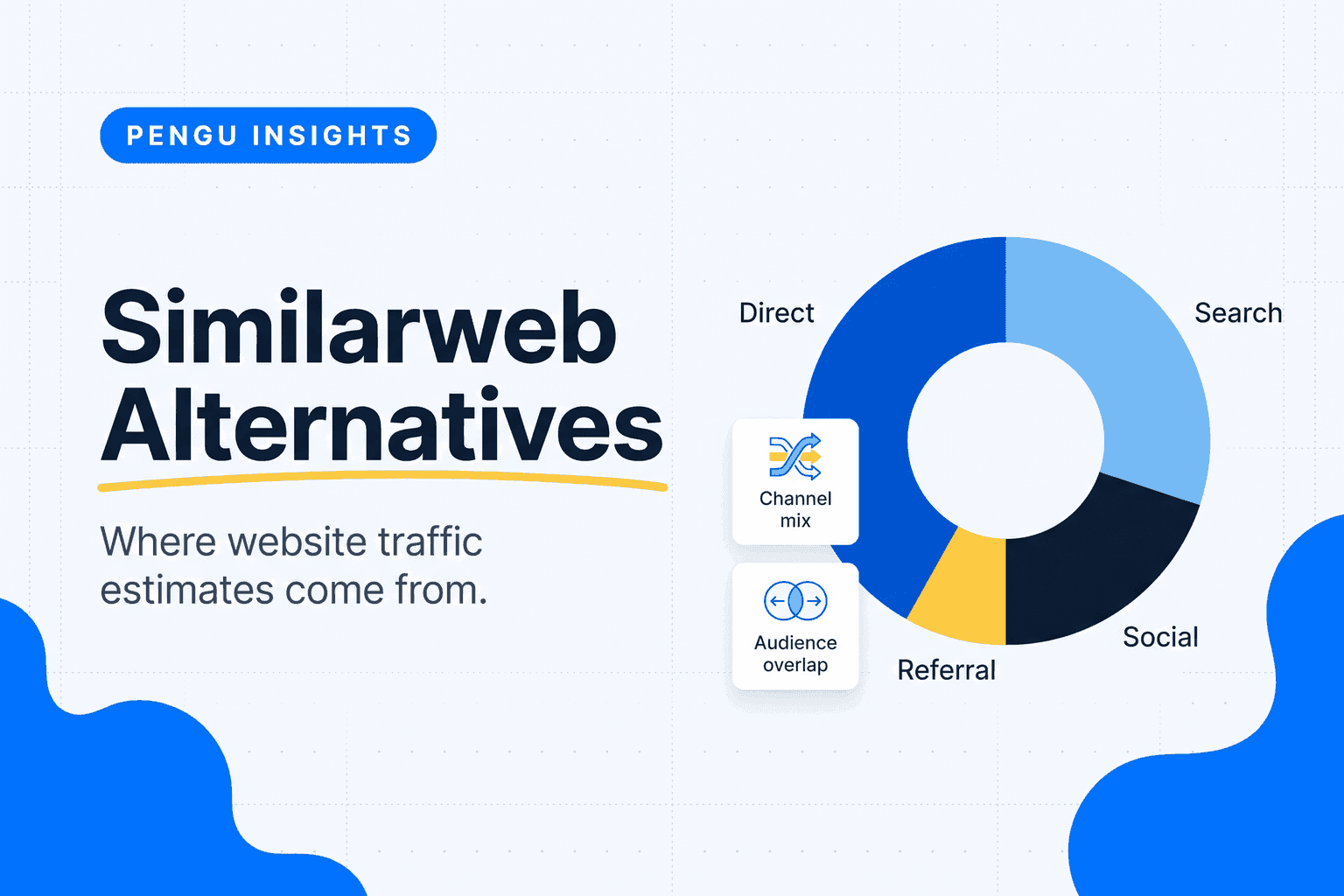
Similarweb answers one question better than almost anyone: where does a competitor's traffic come from? Not just search, but direct, referral, social, display, and email as a share of the whole. Most people searching for Similarweb alternatives are not after a better tool. They want a cheaper way to answer that one question.
That answer is expensive. The Web Intelligence Starter plan runs about $199 a month on monthly billing, or roughly $125 a month billed annually (Similarweb pricing) (Similarweb pricing, 2026). Higher tiers are quoted, annual, and enterprise-shaped.
Key takeaways
- Similarweb's estimates are modelled, not measured. Directional, not exact.
- Accuracy collapses on small sites. Below roughly 5,000 visits a month, treat the numbers as noise.
- The unique value is channel mix, not the visit count everyone quotes.
- Cheaper alternatives cover one slice each: keywords, traffic, or social.
Video: Similarweb vs Semrush vs Ahrefs, compared in six minutes
If you only have six minutes, this comparison covers the three tools most people are choosing between when they search for Similarweb alternatives.
Three things worth taking from it:
- Similarweb is the competitor research tool; Semrush and Ahrefs are SEO tools. The reviewer lands where we do: Semrush and Ahrefs help you improve your own content, Similarweb tells you what a rival's traffic looks like.
- Of the three, Similarweb's visit estimate is usually the closest to reality in his tests. That matches our experience on sites above a few thousand visits a month; below that, none of them is reliable.
- Pricing is closer than the marketing suggests. Similarweb Starter, Semrush Pro and Ahrefs Lite all land in the same $100 to $140 a month band. The difference is what the money buys, not how much it is.
Where we disagree: the video treats the choice as one tool. Most small teams end up with a cheap traffic estimate plus a keyword tool, because no single plan answers both questions well.
What Similarweb is actually good at
Three things justify the price when they matter to you:
- Channel mix. Learning that a competitor gets 60% of traffic from direct changes your strategy more than any keyword list. It means brand, not SEO, is doing the work.
- Audience overlap. Which other sites their visitors touch, which is how you find partnership and placement targets.
- Category benchmarking. Where a domain sits against its category, not just against one rival.
If none of those three is the question you have, you are paying for a research suite to answer a question a $39 tool answers.
Similarweb pricing in 2026
The entry plan is Web Intelligence Starter at $199 a month billed monthly, or about $125 a month on an annual contract, for one user and a capped number of results per report (Similarweb pricing). Professional, Team and Enterprise are priced on request, and the jump from Starter is large enough that most small agencies never see a quote.
Two things to know before you pay:
- The free version is not a trial of Starter. It is a separate, heavily capped view: a handful of lookups a month and headline numbers only.
- "Similarweb cheap" does not exist as a plan. The way to pay less is to buy only the question you need answered, which is what the alternatives below do.
The 5 Similarweb alternatives
1. Semrush Traffic Analytics: keyword-first estimates
Semrush bundles traffic estimates into plans starting at $139.95 a month, with the Traffic Analytics add-on gated higher. Its advantage is that traffic and keyword data live in one place.
Pick it if: you already pay for Semrush and only need directional traffic numbers. Skip it if: channel mix precision is the whole reason you are looking.
2. Ahrefs Site Explorer: organic traffic only
Ahrefs estimates organic search traffic from its keyword index, starting around $129 a month. It does not attempt to model direct or referral traffic.
Pick it if: you care about search visibility and links. Skip it if: you need the full channel picture.
3. Google Analytics and Search Console: free and true
For your own domain, these are measured data, not estimates, and they are free. Any argument about whose estimate is closest is settled by the fact that you already have the real number for your own site.
Pick it if: the question is about you. Skip it if: the question is about a competitor. They will never appear here.
4. SpyFu: historical competitor keywords
Around $39 a month (SpyFu), with several years of historical paid and organic keyword data per domain.
Pick it if: you want to see what competitors bid on over time. Skip it if: you need a whole-channel traffic view.
5. Pengu Insights: traffic checker plus the social layer
Ours. The traffic checker and web analytics tools are included from $39 a month, alongside competitor keywords and the social and ad intelligence that traffic tools do not carry: Instagram, TikTok and LinkedIn analytics, plus the Facebook ad library. Free tools such as the website health check, sitemap generator, and robots.txt checker stay free on every plan.
Pick it if: "where does their traffic come from" is one of five questions you have, and the others are about content and social. Skip it if: enterprise-grade market share modelling across a whole industry is the deliverable. That is Similarweb's home turf and we do not pretend otherwise.
Similarweb free vs paid: what the free version actually shows
The free Similarweb account and the browser extension are not a trial of Starter. They are a separate, capped view, and knowing the cap saves you a sign-up.
| Free account and extension | Web Intelligence Starter | |
|---|---|---|
| Domains per month | A handful of lookups | 100 results per report, one user |
| Traffic figure | Monthly visits, rounded | Monthly visits with trend and device split |
| Channel mix | Top-level share (direct, search, social) | Full breakdown with referral and paid sources |
| Keywords | Top 5 organic and paid | Full lists with volume and traffic share |
| History | Last 3 months | Up to 12 months, longer on higher tiers |
| Audience overlap and category | No | Yes |
| Export | No | CSV and PDF |
Use the free version to sanity-check one competitor. Once you need to compare five domains side by side, export a list, or see anything older than a quarter, you are in Starter territory at about $199 a month on monthly billing.
Similarweb vs Semrush vs Ahrefs for competitor research
The three tools people compare most answer different questions, and the mismatch is what makes reviews contradictory.
| Question | Similarweb | Semrush | Ahrefs |
|---|---|---|---|
| Where does their traffic come from (direct, referral, social, email)? | Best | Partial, search-centred | Organic search only |
| Which keywords do they rank for? | Top lists only | Best | Best |
| Who links to them? | No | Good | Best |
| Which ads do they run? | Display ads on some plans | Search ads and PPC history | Paid keywords |
| Audience overlap between competitors | Yes | No | No |
| Entry price, monthly billing | About $199 | About $140 | About $129 |
The short version: Similarweb if the question is "where does their traffic come from", Semrush or Ahrefs if the question is "which keywords and links". If you are paying for one and using it for the other question, that is the money to move.
How to read any traffic estimate without fooling yourself
Every tool in this category models. None measures. Four rules keep the numbers useful:
- Compare, do not quote. "Competitor A gets roughly twice competitor B" is defensible. "Competitor A gets 412,000 visits" is not.
- Check the floor. Under 5,000 monthly visits, most models are guessing.
- Watch the trend, not the level. A 40% drop over three months is real signal even if the absolute number is wrong.
- Triangulate. If two independent tools disagree by 5x, neither is usable for that domain. Our guide on how to check website traffic goes through the method in full.
The workflow this data belongs in
Traffic estimates are step three of a competitor audit, not step one. The sequence that produces decisions:
- Identify who you actually compete with in the SERP, not who you compete with in your head. Our post on examples of competitors covers the difference.
- Read their positioning and offer on the site itself, using the competitor website analysis workflow.
- Then check traffic and channel mix to learn which lever is carrying them.
- Finish with the keyword and content gap, which is the part you can act on this quarter.
Teams that start at step three end up with a slide of estimated visits and no decision attached to it.
To estimate a competitor's search traffic without paying for Starter, run the domain through the free website traffic checker, or use the Traffic Checker in Pengu Insights for history and channel mix. Free plan, no card.
Frequently asked questions
How much does Similarweb cost?
The Web Intelligence Starter plan is about $199 per month on monthly billing, or roughly $125 per month billed annually at $1,500 a year. Higher tiers are quoted rather than listed.
How accurate are Similarweb traffic estimates?
They are modelled from panel data, ISP data, and crawling, not measured analytics. Accuracy is decent for large sites and degrades sharply below roughly 5,000 visits a month.
What is the best free Similarweb alternative?
For your own site, Google Analytics and Search Console are free and measured. For competitors, free tiers of traffic checkers give limited monthly lookups.
Can I check competitor website traffic for free?
Yes, within limits. Free traffic checkers give an estimate of visits, top countries, and channel mix for a handful of domains per month.
Similarweb or Semrush for competitor research?
Similarweb is stronger on total traffic and channel mix. Semrush is stronger on keywords and paid search. Most teams pick one and fill the gap with a cheaper second tool.
Is Similarweb free?
There is a free account and a free browser extension, but they show a capped view: a few lookups a month, rounded visit numbers and the top-level channel split. The paid Starter plan is what most reviews describe.
Sources: Similarweb pricing 2026
Written by

Founder of Pengu Insights. Competitive intelligence practitioner for DTC brands and marketing agencies.