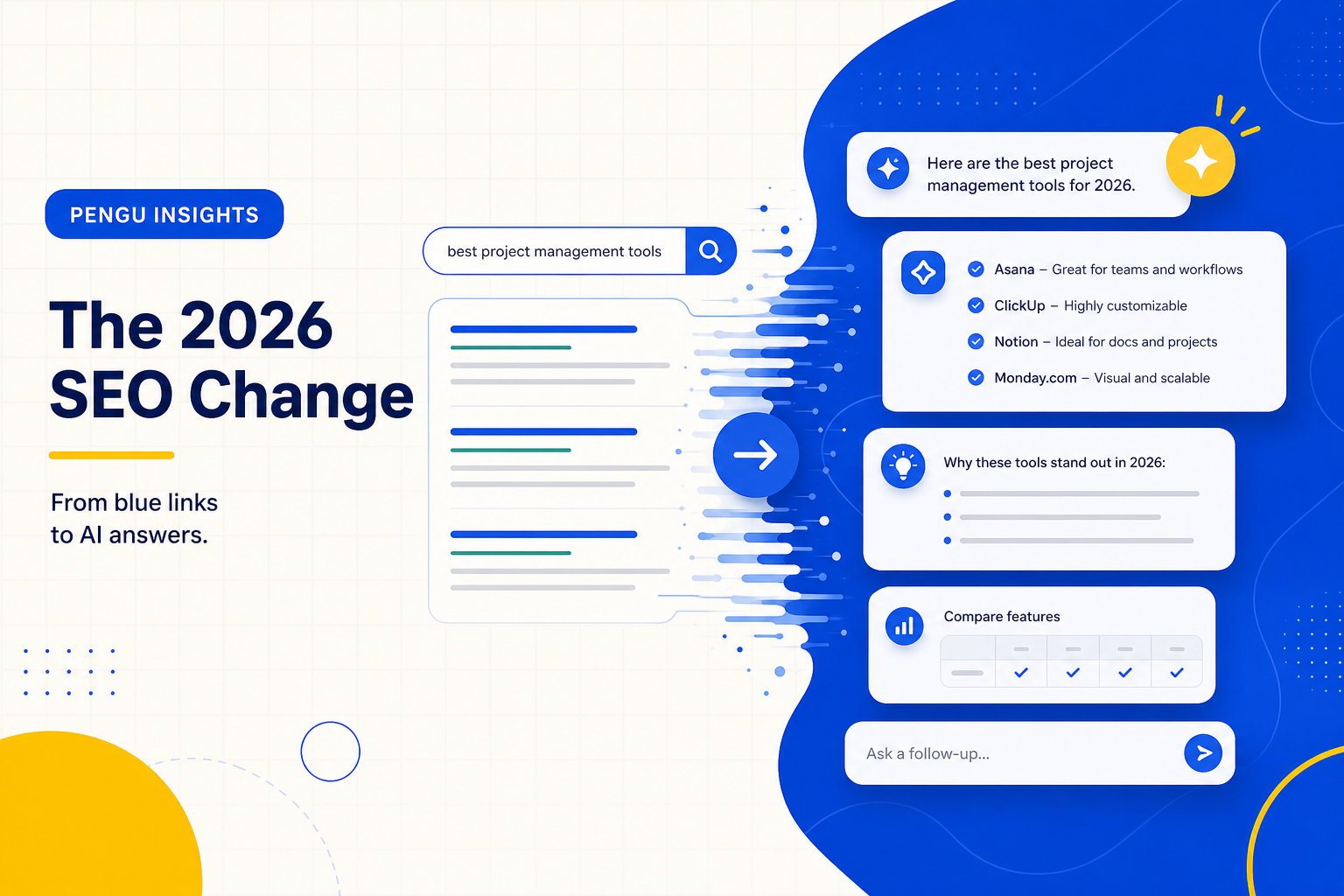
Most searches in 2026 get answered by AI before anyone clicks your site. AI SEO is the work of being the source that answer draws from. That sentence sounds dramatic until you watch a buyer ask ChatGPT for a shortlist and never open Google. Your traffic can soften even if you still rank number one. The teams that adapt early still win. They always have, through every algorithm era.
Thought-leadership walkthroughs like Neil Patel's 2026 AI-SEO breakdown frame the same five strategic shifts we see in competitive audits: entities over keyword density, author and brand authority, citation-ready answers, machine-readable structure, and a workflow built for generative search. This is not "SEO is dead." It is SEO with a new finish line. For the concept layer, start with what is generative engine optimization (GEO). For the beginner execution path, use the AEO beginners guide.
Key takeaways
- AI answers before the click. Rankings can hold while CTR falls. Plan for both visibility modes.
- Topical authority beats keyword density. Multi-study signals point to entity depth over stuffing.
- Authority is a citation filter. Average content from a known brand often beats great content from nowhere.
- Structure is the new link equity for LLMs. Schema, tables, FAQs, and multimodal assets help models parse and quote you.
- Track citations and revenue. Soft-attributed cases show AI under 1% of traffic but near 10% of revenue in some samples.
Why can your traffic drop even if you still rank number one?
In 2026, AI overviews and chat-style search satisfy more intent on the results page itself. Classic SEO still decides which sources models trust. It no longer guarantees the click. If your analytics show soft sessions while rankings look stable, AI answer coverage is a primary suspect.
Gartner predicted traditional search volume could drop about 25% by 2026 as users move toward AI answers (Gartner, 2024). Exact percentages will vary by vertical. Directionally, fewer clicks per query is already normal. The winning response is not rage-quitting SEO. It is becoming the source the summary quotes.
In our experience, the quiet loss looks like this: organic looks "fine," paid still spends, and the category shortlist inside ChatGPT already excludes you. That is a competitive intelligence failure dressed up as a traffic mystery.
What replaced keyword density in AI SEO?
In 2026, topical depth and entity clarity beat stuffing. One widely cited industry analysis of roughly 1,500 Google results found no consistent positive correlation between keyword density and ranking. Higher-ranking pages often showed lower density. Broader research covering hundreds of thousands of results has framed topical authority as a stronger on-page signal than crude domain traffic proxies.
What does that mean in practice? Build pillar pages that connect related entities, then interlink supporting posts. A complete guide should point to use cases, objections, comparisons, and adjacent how-tos. Use semantic variety: brands, methods, places, people, and techniques Google's NLP systems already associate with the topic.
This is also why competitive page maps matter. When you analyze a competitor website, look for cluster completeness, not only keyword hits. Thin pages that repeat a phrase twenty times lose to connected topic graphs.
Why do author and brand authority decide who AI quotes?
In 2026, AI systems ask who said it, not only what the page says. Average content from a recognized authority often outperforms excellent content from an unknown source. That mirrors human trust bias. Platforms reduce risk by citing identifiable experts and brands.
E-E-A-T for AI is practical, not decorative. Show experience with named case details. Publish author bios and credentials. Earn brand mentions on podcasts, industry blogs, and news sites, even when unlinked. Keep name, bio, and tone consistent across YouTube, LinkedIn, and your site. Soft-attributed industry observations repeatedly show that news and niche-site citations boost how often AI platforms quote a brand.
Do not wait for perfect PR. Start with proof on your own properties: methodology sections, first-hand process notes, and dated results. Then expand mentions outward.
How do you optimize for featured and summarized AI results?
In 2026, number-one blog posts lose clicks because people search like they chat. AI quotes pages. It does not always send visitors. Soft-attributed multi-company studies discussed in AI-SEO briefings report AI platforms under 1% of traffic while contributing about 9.7% of revenue in B2B samples and 11.4% in B2C samples. Roughly 14% or more of LLM users in some cohorts progress toward purchase behavior. Volume is the wrong scoreboard. Intent quality is the point.
Write like you are answering a question in the first paragraph. Structure for scanners with short blocks, bullets, and subheads. Target People Also Ask. For Google AI Overviews specifically, facts and comparisons travel well. Treat AI search like a conversation that needs a quotable line, not a brochure.
Want an operator system for turning those answers into a repeatable content machine? Pair this strategy with a ChatGPT SEO content system and, when ready, an SEO automation setup with AI agents.
What does "feeding the machines" mean for structured data?
In 2026, AI skims. If a human would bounce from a wall of text, a model will skip to a cleaner source. Traditional SEO still cares about thoroughness and links. Generative systems overweight structure, formatting, and cite-ready claims. Sentiment around your brand also matters more than classic SEO dashboards admit.
Practical moves that take about 30 to 60 minutes per cornerstone page:
- Add FAQ, HowTo, and Review schema where accurate.
- Include images, charts, and short video where they clarify the claim.
- Surface numbers in tables and lists instead of burying them in paragraphs.
- Prefer explicit comparisons AI can lift without rewriting your whole page.
Blogs still get cited heavily. Blogs with multimodal proof get cited more often in soft-attributed platform analyses. Structure is not "for bots only." Humans skim the same way.
How should SEO workflows change for generative search?
In 2026, annual "set and forget" refreshes fail. Models continuously resample the web. If your phrasing, frameworks, and proof stay vague, the model learns your competitors' voice instead.
Rethink the workflow in three moves:
- Add AI visibility metrics. Track citations and brand mentions for a fixed prompt set. Soft-attributed agency programs report meaningful AI-influenced sales (around 5.8% of online sales in some SEO-mature cohorts over roughly 12 months). Treat that as directional, then instrument your own funnel.
- Test your summaries. Paste a page into ChatGPT or Perplexity and ask for a summary. If the model misses your point, rewrite for clarity.
- Build recognizable patterns. Signature frameworks, named methods, and consistent visuals help models associate ideas with your brand.
Also connect assistants to live SEO data when you research gaps. That operating pattern is covered in dominate AI search results with Claude.
What should competitive intelligence teams watch monthly?
In 2026, SEO reporting without an AI answer audit misses the shortlist buyers actually see. Soft-attributed education cases keep repeating the same pattern: citation share moves before traffic dashboards do. Treat AI answers as a public competitor brief.
Monthly CI checklist (about 60 minutes):
- Run your fixed 20-prompt set in ChatGPT, Perplexity, and Google AI Overviews.
- Log who gets named, which URLs get cited, and which claims get paraphrased.
- Note new listicles, reviews, or comparison posts that entered the answer set.
- Flag pages where rivals gained extractable tables or FAQs you still lack.
- Assign one refresh owner for the three biggest citation gaps.
This is the same competitive discipline you already use for ads and social, applied to answer engines. If a rival owns the AI shortlist, paid and organic campaigns fight an uphill narrative.
To check today which of your keywords already trigger an AI Overview and who it cites, use the AI Overview Tracker in Pengu Insights. Free plan, no card.
Frequently asked questions
How is SEO changing in 2026 because of AI?
AI answers more queries before the click. You still need rankings, but you also need to be the source inside the summary. Entities, authority, and extractable structure moved up the priority list.
Does ranking number one still protect traffic?
Not alone. Position still helps you get selected as a source. It does not guarantee sessions. Track CTR, citations, and assisted conversions together.
What content wins AI SEO in 2026?
Topical clusters, clear authorship, answer-first sections, FAQs, tables, schema, and multimodal proof. Keyword-stuffed thin posts lose.
Is AI search traffic worth less than classic organic?
Often smaller in volume, sometimes stronger in conversion. Soft-attributed samples show revenue contribution far above traffic share. Validate in your analytics.
What new KPIs should SEO teams track?
Citation share, prompt-set brand mentions, AI referral conversions, and summary-accuracy tests. Keep rankings. Expand the scoreboard.
What should you do next?
Pick one pillar cluster and rebuild it for entities, authority, and citation format this month. Add schema and FAQs. Start a 20-prompt AI visibility log. If you want a live session on combining AI search strategy with competitive intelligence for marketing teams, join penguinsights.io/webinar/marketing-ai.
2026 SEO is dual-track. Win the blue link when humans still click. Win the quote when AI answers first. Teams that only watch rankings will misread the market. Teams that watch citations will see the real competitive map.
Written by

Founder of Pengu Insights. Competitive intelligence practitioner for DTC brands and marketing agencies.