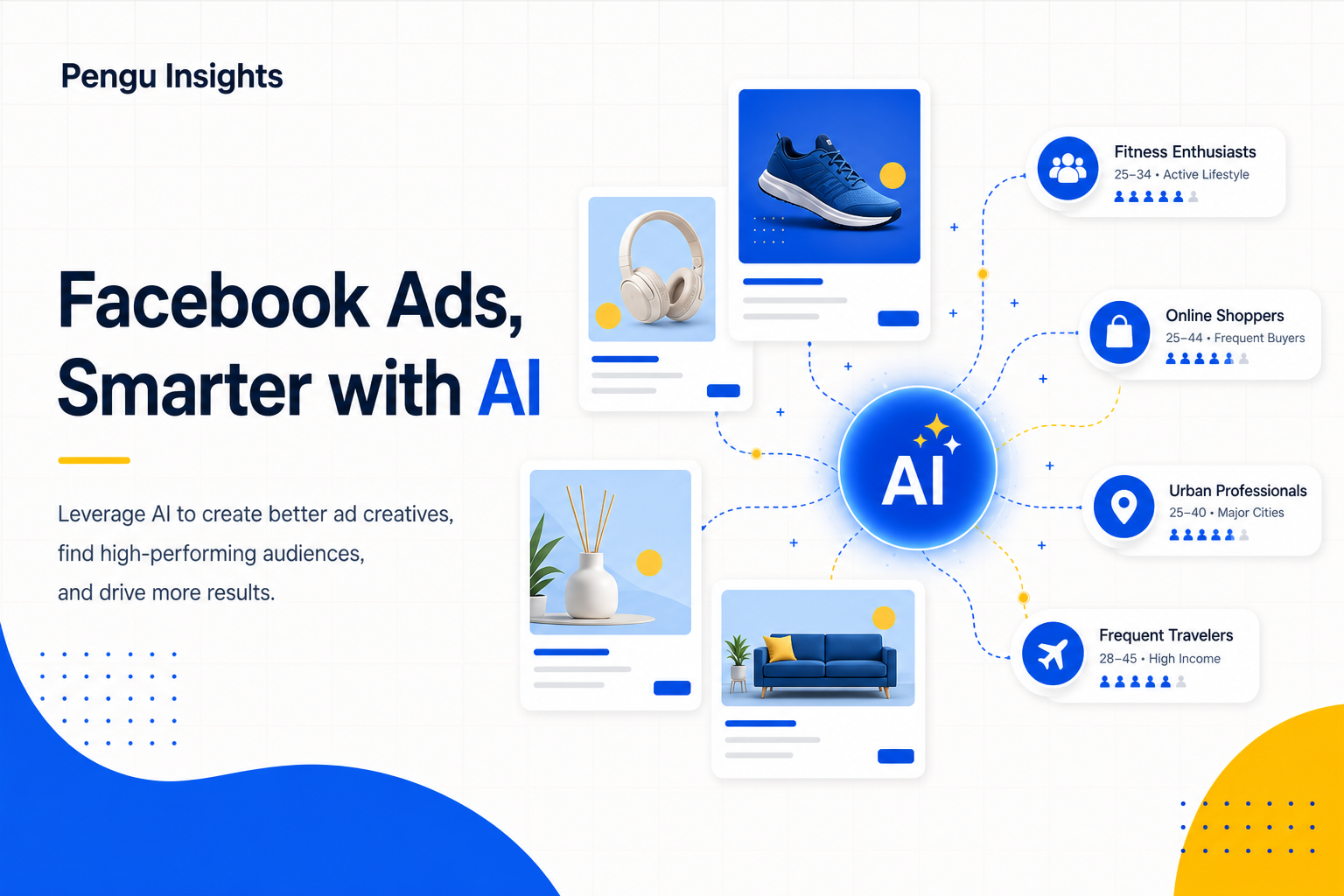
AI made Meta creative faster. It did not make strategy optional.
In Q1 2026, Meta reported that over 8 million advertisers were using at least one generative AI ad creative tool, roughly double the 4 million figure from late 2024 (PPC Land summarizing Meta earnings, 2026; Meta Q1 2026 results). That adoption wave means your competitors can ship UGC-style ads in hours. The edge is no longer "can we make an ad?" It is "do we know which angles are winning before we generate the next batch?"
This guide walks through a full Facebook ads with AI workflow for 2026: competitor research, AI scripting, AI UGC production, editing, launch, and testing. We also show where competitor ad intelligence belongs in that loop so you do not burn budget on pretty losers.
Key takeaways
- Meta AI creative is mainstream. Over 8 million advertisers used generative AI ad tools in Q1 2026 (Meta via PPC Land, 2026).
- Spy before you generate. Ads Library plus live feed research beats guessing hooks.
- Edit AI UGC like real UGC. Cut pauses, mix actors, green-screen offers.
- Test frameworks, not vibes. Scale only creatives that hold unit economics.
- Intelligence multiplies AI. More ads without competitor context just accelerates sameness.
Why does Facebook ads with AI matter more in 2026?
In 2026, Meta advertising revenue hit $55.0 billion in Q1 alone, up 33% year over year, while ad impressions rose 19% (Meta Q1 2026 results). More auction pressure means creative volume and iteration speed decide who stays efficient. AI is the production layer. Competitive research is the filter.
Advertisers using Meta's video generation tools saw more than a 3% conversion rate lift in large-scale company tests (PPC Land, 2026). That is incremental, not magic. Teams that win combine those tools with a clear angle library pulled from what rivals already prove in market.
When we review Meta accounts for agencies, the pattern repeats: AI creative tools are on, but the brief still says "make something UGC." Without a competitor angle bank, every AI script defaults to the same pain-agitate-solve template. Speed without direction just floods the auction with lookalikes.
If you need a broader stack view beyond ads, compare how teams measure social performance in our social media analytics tools roundup.
How do you research competitor Meta ads before writing scripts?
In our experience, the strongest AI ads start with 15 to 30 minutes of competitive research, not a blank ChatGPT prompt. Meta Ads Library remains free and public. Spy tools add network-level discovery. Neither shows full engagement. That is why feed research still matters.
Step 1: Map who is actually spending (20 minutes)
Search your category keyword in a creative intelligence tool or Ads Library. List 5 to 8 pages with active ads. Note formats: talking-head UGC, green screen, static, carousel, Remotion-style product demos. Save the hooks that appear across multiple accounts. Patterns beat one-off "pretty" ads.
Step 2: Read live ads in feed (15 minutes)
Click through competitor landing pages a few times so Meta serves more ads in niche. Scroll Instagram and Facebook. Read comments. Comments reveal objections, praise, and whether an ad is getting real attention. Library screenshots cannot replace that signal.
Step 3: Build an angle bank, not a swipe file (10 minutes)
For each winning creative, extract: hook line, proof type, offer, CTA, and visual format. Do not copy scripts word for word. Feed the structure into your AI writer. That is how you stay original while staying market-aware.
Need a cleaner competitor set first? See examples of competitors and how to analyze a competitor website before you open Ads Manager.
How do you write UGC scripts with AI for Meta ads?
In 2026, the useful script prompt is not "write a viral ad." It is a structured brief: product, audience, dream outcome, proof, ease, and speed of results. Creators who scale AI UGC usually lock that brief into a custom GPT or reusable prompt so every draft shares the same scene logic.
A solid UGC structure still wins:
- Hook (0 to 3 seconds): Call out the waste, fear, or desire.
- Credibility: Who you are or what proof you have.
- Mechanism: What makes the offer work.
- Proof: Numbers, names, or social proof.
- CTA + urgency: Clear next step without fluff.
Paste 2 to 3 competitor hook patterns into the prompt as examples of tone, not as copy to steal. Ask the model for three hook variants and one full scene list. Then consolidate by hand. AI drafts. You decide.
How do you generate and edit AI UGC actors?
AI avatar tools now ship large actor libraries with voice previews and tags. That matters because Meta audiences still respond to faces that feel demographically close to the buyer. Pick 4 to 6 actors per concept, preview the same line in each voice, then generate only the keepers.
Editing rules that make AI UGC feel human (30 to 45 minutes)
- Cut awkward pauses. Dead air is the biggest AI tell.
- Keep cuts fast. Treat it like short-form, even for feed ads.
- Test a raw cut and an edited cut. Sometimes raw wins.
- Mix actors mid-script for energy shifts.
- Use auto cutout or green screen to put the actor over your landing page or product UI.
Meta also reported that over half a billion people on Facebook and Instagram watch AI-generated videos each week (MediaNama covering Meta earnings commentary, 2026). Viewers are used to synthetic media. They still bounce when the delivery feels stiff. Edit for rhythm first, polish second.
What launch and testing framework works for AI Facebook ads?
In Q1 2026, Meta's Adaptive Ranking Model drove a 1.6% conversion lift across Facebook and Instagram in company-reported tests (PPC Land, 2026). The platform is optimizing harder. Your job is to feed it distinct creatives, not near-duplicates.
A simple test matrix (60 minutes to set up)
| Variable | What to change | Keep fixed |
|---|---|---|
| Hook | First 3 seconds only | Offer, actor, CTA |
| Actor | Face and voice | Hook and script body |
| Edit style | Raw vs green screen | Same script |
| Primary text | Ad copy framework | Same video |
Launch with constrained budgets. Kill losers early. Scale winners into Advantage+ or your proven campaign structure. Log which competitor angle each variant came from. That log becomes your next brief.
How we decide kill vs scale (15 minutes weekly)
Hold a creative for enough spend to read early CPA or ROAS against your floor. If a variant burns budget with weak thumb-stop and no downstream events, kill it. If it hits the floor, clone the winner into two new hooks before fatigue sets in. AI makes the next variants cheap. Judgment still decides the budget.
Also test primary text separately. Many teams reuse one weak caption across every AI video. Pull two proven frameworks from your angle bank (problem-agitate-solve, proof-first, offer-first) and rotate them on the same creative. That is still a controlled test if the video stays fixed.
Where does competitor ad intelligence fit in an AI ads stack?
AI tools generate volume. Competitive intelligence decides priority. In 2026, Gitnux reported that 61% of organizations use AI or ML to automate portions of market and competitor analysis (Gitnux Competitive Intelligence Statistics, 2026). Ads teams should be in that 61%, not only brand teams.
Practically, that means:
- Track which rival creatives stay active for weeks (likely profitable).
- Cluster hooks by theme: price, speed, ease, social proof, fear of waste.
- Compare your test winners against the category so you know if you found an edge or just matched the baseline.
- Feed those clusters into weekly AI production, not random inspiration.
Pengu Insights is built for that competitor content and Meta Ads layer: hooks, formats, and patterns across social and ads, then white-label reports when agencies need client-ready output. Pair it with your Ads Manager tests. Do not confuse production tools with intelligence tools.
For monitoring brand and rival conversations outside paid social, see social media monitoring tools.
How do agencies keep AI Meta ads from looking identical?
In our experience, agencies hit a sameness wall around week three of AI production. Every avatar says the same "stop wasting money" hook. Every green screen sits bottom-right. Every CTA rushes. Clients notice. So do auctions.
Fix it with constraints:
- Cap each actor to two live concepts at a time.
- Require one non-talking-head format per sprint (static, carousel, product UI demo).
- Ban recycled opening lines until they clear a 30-day cooldown.
- Score variants against competitor hooks so you know you differentiated.
Meta ad impressions grew 19% year over year in Q1 2026 while average ad price rose 12% (Meta Q1 2026 results). More inventory and higher prices punish generic creative. Distinct angles are the cheapest efficiency lever left when targeting automation does most of the heavy lifting.
What should marketers do next with Facebook ads and AI?
Ship one complete loop this week. Spy five competitors. Extract ten hooks. Generate three AI UGC variants. Launch a clean test. Document winners. Then refresh the angle bank.
Want the live marketing AI playbook for creative plus competitive research? Join the free session at penguinsights.io/webinar/marketing-ai.
Related reads: social media analytics tools, analyze a competitor website, and examples of competitors.
To see the Meta ads your competitors are running right now, with creatives and start dates, use the Facebook Ads Library analyzer in Pengu Insights. Free plan, no card.
Before you generate a single creative, read what competitors are already running in the Facebook Ad Library.
Frequently asked questions
Can you make Facebook ads fully with AI in 2026?
Yes for production speed, not for strategy. You can research angles, draft UGC scripts, generate AI actors, and edit variants with AI tools. You still need human judgment on hooks, offers, and which competitor patterns are actually converting. Meta reported over 8 million advertisers using generative AI creative tools in Q1 2026.
What is the best way to research competitor Facebook ads?
Start with Meta Ads Library for free creative visibility, then layer a spy tool or competitive intelligence platform for hooks, formats, and longevity. Engagement on live ads in feed still reveals comments and social proof that libraries omit. Pair that with your own creative tests, not blind copies.
Do AI UGC ads still work on Meta in 2026?
They can, when they look native and pass a quick authenticity edit. Cut awkward pauses, match voice to audience, and test raw AI cuts against lightly edited versions. Advertisers using Meta video generation tools saw more than a 3% conversion lift in company-reported tests. Fatigue still kills winners fast, so refresh often.
How should I structure a Meta creative test with AI ads?
Test one variable at a time when possible: hook, actor, offer, or edit style. Launch a small set of variants, kill losers early, and scale only creatives that hold CPA or ROAS. Document which competitor angles you borrowed so you do not retest dead frameworks next month.
How does competitor ad intelligence help AI Facebook ads?
AI makes production cheap. Intelligence tells you which angles deserve production. Without competitor context, teams generate more creatives that all say the same thing. Track rival hooks, formats, and Meta Ads patterns, then feed those insights into your script prompts and test matrix.
Written by

Founder of Pengu Insights. Competitive intelligence practitioner for DTC brands and marketing agencies.