Picture a library where books are filed five different ways: by topic, by author, by year, by genre, and by reading level. The types of keywords work the same way: one word, five filing systems.
Keywords work the same. One keyword can be short-tail, informational, brand, exact-match, and top-funnel all at once.
Keyword research slides fail when everyone uses the same word to mean different things. SEO wants topics. PPC wants match types. Leadership wants "high volume." This guide maps keyword types practitioners actually use so teams stop talking past each other.
Key takeaways
- Keywords are classified multiple ways: length, intent, brand vs generic, and paid match type.
- SEO keywords map to pages. One primary keyword per URL, supported by related terms.
- PPC keywords map to auctions. Match types decide which queries trigger spend.
- Intent beats volume for revenue-focused plans.
- Negative keywords are a type too. Exclusions protect budget in paid campaigns.
Video: keyword types in a real research session
Seventeen minutes of keyword research in a keyword tool, where every type on this page shows up as a filter or a column.
Three things worth taking from it:
- The four intent labels appear next to every keyword in modern tools: informational, transactional, commercial, navigational. The types are not theory; they are a column you sort by.
- Difficulty is a type in practice. Filtering to "easy" keywords first, then choosing by intent, is how a new site finds anything it can win. The tutorial does exactly that.
- Long-tail is where the specific angles live. Her example, a cookie recipe "without brown sugar", is a long-tail keyword with low volume and a clear need. With AI-written content flooding the broad terms, the specific ones are the open ground.
The taxonomy below is the vocabulary that makes those filters useful.
Keywords by length: short-tail vs long-tail
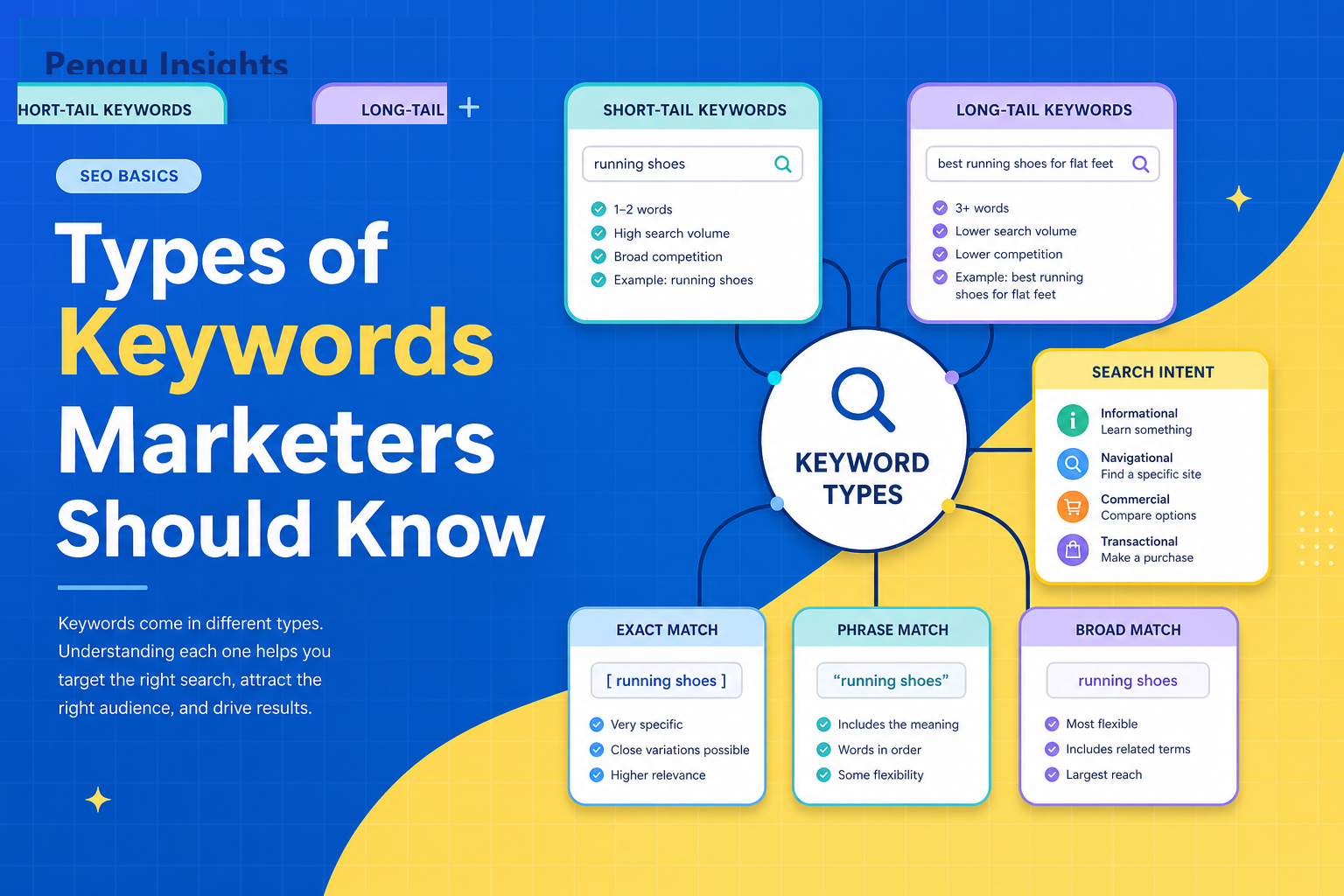
Short-tail (head) keywords are broad queries, often one to two words: "CRM," "running shoes," "lawyer." Lots of people search them. Lots of competition. The searcher might want almost anything.
Mid-tail keywords add a useful detail: "CRM for nonprofits," "marathon running shoes."
Long-tail keywords are longer and more specific: "best CRM for small animal shelters," "marathon shoes for flat feet under $150." Fewer searches, but usually clearer intent.
How teams use them in practice:
- Short-tail → category pages and brand awareness ("project management")
- Mid-tail → solution pages ("project management for agencies")
- Long-tail → blog guides, landing pages, and exact-match ads ("project management tool for 10 person creative agency")
Long-tail terms often convert better because the person already knows what they need. Head terms still matter for visibility and market definition. Deep dive: long-tail vs short-tail keywords.
Types of keywords by intent
Intent classification drives content format and bid strategy. The four standard buckets:
Informational: User wants to learn. "What is Ad Rank?" Blog posts, guides, videos.
Navigational: User wants a specific site or brand. "Salesforce login." Brand pages, support docs.
Commercial investigation: User compares options. "Best CRM for startups." Comparison pages, reviews.
Transactional: User ready to act. "Buy CRM annual plan." Product pages, demo requests, checkout.
Mixed intent on one page confuses Google and users. Split formats when SERP types differ (guides vs product carousels).
Our search intent keyword types guide expands each bucket with examples and SERP checks.
Brand vs generic vs competitor keywords
Brand keywords include your company or product name. Usually cheapest in paid search. Must-win organically.
Generic keywords describe the category without a brand: "email marketing software."
Competitor keywords target rival names: "Alternative to Mailchimp." Higher CPC, sensitive legally and reputationally. Useful for conquesting when unit economics allow.
In App Store optimization, brand and generic split behaves differently. See brand vs generic keywords for ASO.
SEO keyword types by page role
SEO teams often tag keywords by content job:
- Primary keyword: Main target for a URL
- Secondary keywords: Subtopics and H2 themes
- LSI / related terms: Natural language variants (use carefully; do not force)
- Question keywords: Who/what/how queries for FAQ and snippet capture
Build topic clusters: pillar page on head intent, supporting posts on long-tail questions, internal links flowing upward.
Time estimate: 45 minutes to assign one primary keyword per money page in your sitemap spreadsheet.
Paid search keyword types: match types
In Google Ads, a keyword is not only what you bid on. Match type decides how closely a person's search must match before your ad can show.
Plain-language version:
Exact match ([keyword]): Tightest control. Best for brand terms and proven converters.
Phrase match ("keyword"): Middle ground. Captures useful extra words around the same idea.
Broad match (no quotes): Widest reach. Finds related searches, including synonyms. Needs Smart Bidding and negatives.
Negative keywords: The opposite job. They tell Google when not to show your ad. Example: block "jobs" if you sell products, not hiring.
Broad match changed a lot with Smart Bidding. Treat it as a discovery engine, not a set-and-forget default. Full walkthrough with examples: Google Ads keyword match types.
Keywords by funnel stage
Map types to funnel for planning:
Top funnel: Informational, short-tail discovery, social trends
Mid funnel: Commercial investigation, comparisons, integrations
Bottom funnel: Transactional, branded, demo/trial queries
Retention: Navigational support, pricing update queries from customers
Paid and SEO should cover each stage. Teams that only chase bottom-funnel terms leave competitors to own the conversation earlier.
Local and geo-modified keywords
Local businesses add:
- Geo modifiers: "plumber Austin TX"
- Near me patterns: often mobile-heavy
- Service + city landing pages: one primary city per URL when possible
Local keywords need Google Business Profile alignment and location assets in Ads.
How many types of keywords are there: 4, 9 or 16?
Depends on which axis you are counting on, which is why every list disagrees.
- By intent, there are four: informational, navigational, commercial investigation, transactional. This is the classification search engines and keyword tools use, and the only one every marketer should agree on.
- By length, two or three: short-tail and long-tail, with mid-tail if you want it. Length is a proxy for specificity, and specificity is what matters.
- By ownership, three: brand, generic, competitor.
- By page role, four or five: primary, secondary, supporting, related, and negative in paid search.
- By match type in Google Ads, three: broad, phrase, exact, plus negatives.
Add those up and you get the "16 types of keywords" lists that circulate. They are not 16 separate things; they are one keyword described on five axes. A keyword can be long-tail, commercial, generic, primary and exact match at the same time. Classify on the axis that decides your next action, and ignore the rest.
How to build a shared keyword taxonomy
Use a spreadsheet with columns:
- Keyword phrase
- Length type (head/mid/long)
- Intent bucket
- Brand/generic/competitor
- Target URL or ad group
- Match type (if paid)
- Priority (P1 to P3)
- Volume and difficulty estimates
Review monthly. Keywords are not static. Products, SERPs, and competitors shift.
For AI-assisted research workflows, see ChatGPT keyword research guide.
Where ChatGPT and SEO tools differ on keyword tasks
Here is how the tools compare for common keyword tasks:
Idea generation: ChatGPT is strong. SEO tool is strong.
Search volume: ChatGPT is unreliable (makes up numbers). SEO tool is strong.
Keyword difficulty: ChatGPT is unreliable. SEO tool is strong.
SERP analysis: ChatGPT is weak (no live data). SEO tool is strong.
Intent labeling draft: ChatGPT is moderate. SEO tool is moderate (you still SERP-check).
Cluster naming: ChatGPT is strong. SEO tool does not usually do this.
Negative keyword ideas for PPC: ChatGPT is strong. SEO tool is moderate.
Use both. ChatGPT for language patterns. SEO tool for metrics.
Common mistakes when labeling keyword types
Mistake: Calling every high-volume term "priority." Priority requires intent fit and rankability.
Mistake: Same ad group for brand and generic. Blends CPC and CVR metrics.
Mistake: Ignoring question variants in SEO. PAA boxes and AI answers pull from question phrasing.
Mistake: No negatives on broad campaigns. Match type without negatives is a budget leak.
What to do next
Audit your top 20 URLs and top 20 ad groups. Label each primary keyword by length and intent. Fix mismatches where a transactional ad sends traffic to a blog post. Taxonomy work is boring. It saves five figures in wasted spend.
To classify a keyword list by type and intent with real volumes, use the Keyword Research tool in Pengu Insights. Free plan, no card.
FAQs
What are the main types of keywords in marketing?
Marketers usually classify keywords by length (short-tail vs long-tail), intent (informational, navigational, commercial, transactional), brand vs generic, and for paid search by match type (broad, phrase, exact, negative).
What is the difference between SEO keywords and PPC keywords?
SEO keywords map to pages and topics you want to rank for organically. PPC keywords trigger paid ads and use match types to control query eligibility. The same phrase can serve both, but execution differs.
What are short-tail and long-tail keywords?
Short-tail keywords are broad, often one to two words with high volume and competition. Long-tail keywords are longer, more specific phrases with lower volume but often clearer intent and higher conversion rates.
What are negative keywords?
Negative keywords are words or phrases you add so your ads do not show on unwanted searches. Example: if you sell software and people search "free jobs," a negative like jobs can stop that waste. They matter most with broad match and automated bidding.
How many keyword types should a content plan include?
Cover all intent stages: informational guides, comparison pages, product pages, and branded queries. A healthy cluster mixes head terms for visibility and long-tail terms for conversions.
What are the four main types of keywords?
By intent: informational, navigational, commercial investigation and transactional. Lists that count 9 or 16 types are describing the same keyword on extra axes such as length, brand versus generic, page role and match type.
Written by

Founder of Pengu Insights. Competitive intelligence practitioner for DTC brands and marketing agencies.