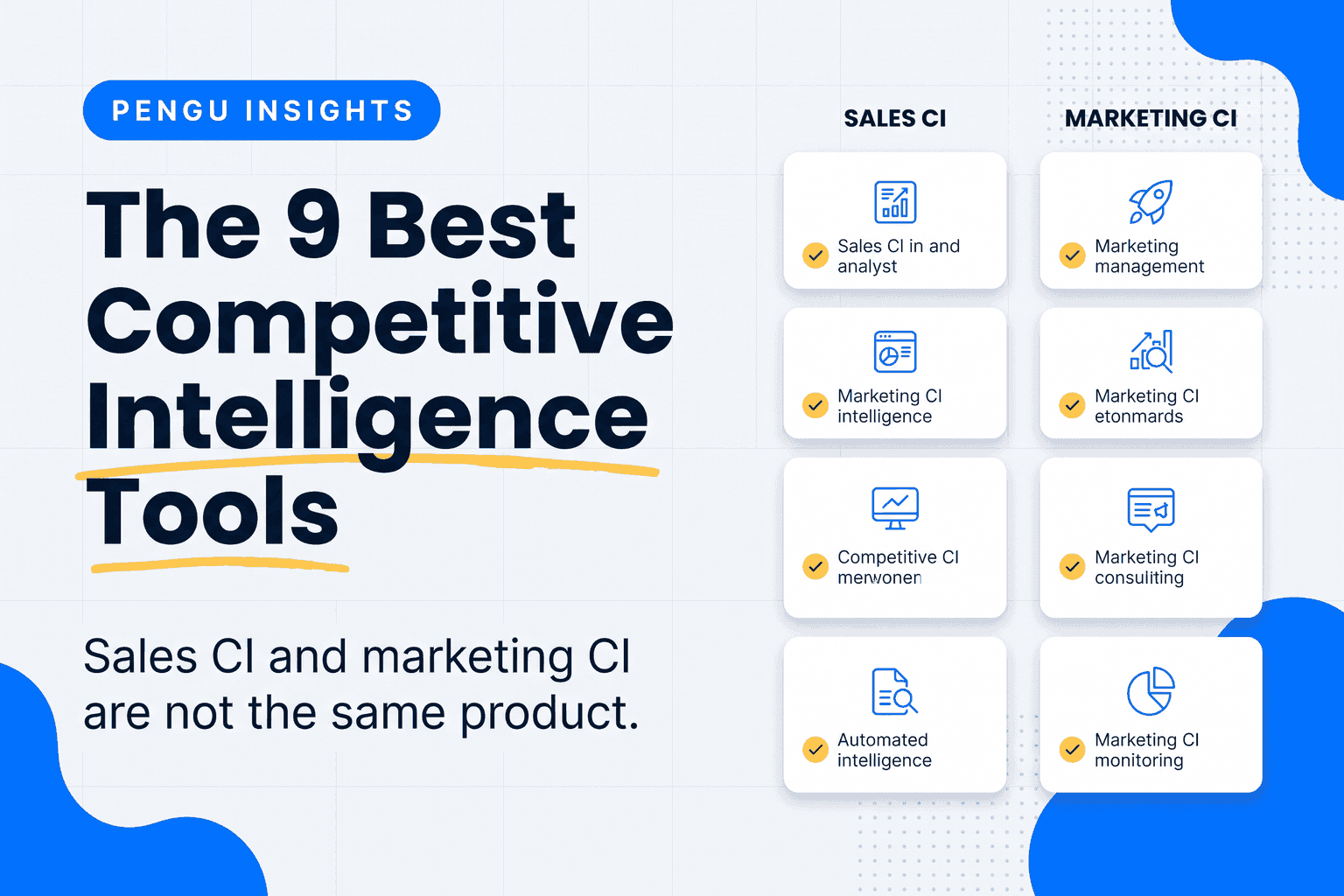
Buying competitive intelligence tools goes wrong in the first ten minutes, because two very different products share the name. One category arms sales reps with battlecards. The other tells marketers what rivals publish and pay to promote. They cost different amounts, serve different teams, and do not substitute for each other.
This comparison splits them, then ranks nine tools by the job they actually do.
Key takeaways
- Sales CI (Crayon, Klue) produces battlecards and win-loss. Quoted annually, five figures.
- Marketing CI (SEO and social platforms) produces content gaps, ad research, and share of voice. $39 to $200 a month.
- Nobody covers everything. Every tool here is strong on one layer and thin on two others.
- The free layer is larger than people expect: ad libraries, alerts, and native analytics.
The two categories, plainly
| Sales CI | Marketing CI | |
|---|---|---|
| Buyer | Product marketing, enablement | SEO, content, social, agency |
| Output | Battlecards, win-loss, objection handling | Keyword gaps, ad creative, share of voice |
| Data | News, reviews, pricing pages, deal notes | SERPs, ad libraries, social feeds, crawls |
| Price | Annual contract, five figures | $39 to $200 a month |
If you cannot say which column you are shopping in, you will end up on a demo call for the wrong one.
The 9 competitive intelligence tools
1. Crayon: sales CI for product marketing teams
Crayon tracks competitor websites, pricing pages, reviews, and news, then packages the changes into battlecards for sales. Pricing is quoted, annual, and aimed at teams with a dedicated competitive intelligence owner.
Strong: change detection across thousands of sources, battlecard workflow. Thin: SEO and social depth. It is not a marketing research tool.
2. Klue: battlecards with CRM integration
Klue's differentiator is how deeply it plugs into the sales workflow, surfacing competitor cards inside the CRM at the moment a rep needs them.
Strong: enablement adoption, win-loss. Thin: anything a content team would use daily.
3. Semrush: the search layer
At $139.95 a month for Pro, Semrush answers what competitors rank for, what they bid on, and what content earns them traffic.
Strong: keyword and SERP depth, site audits. Thin: organic social, ad creative beyond search.
4. Ahrefs: links and organic share
Around $129 a month for Lite. The best backlink index in the category and a strong content gap tool.
Strong: links, organic keyword overlap. Thin: paid social, no social listening.
5. Similarweb: traffic and channel mix
From roughly $125 a month annual for the entry Web Intelligence tier. The clearest answer to "where does their traffic actually come from", across direct, referral, and social, not just search. See our Similarweb alternatives breakdown for the caveats on estimate accuracy.
Strong: channel mix, audience overlap, category benchmarks. Thin: creative and content-level detail.
6. Brandwatch: enterprise social listening
Conversation volume, sentiment, and share of voice across social and the wider web, priced for enterprise.
Strong: listening breadth and historical archives. Thin: search data, and the price for a small team.
7. Meta Ad Library and TikTok Creative Center: free ad intelligence
Free, public, and the single highest-value free source in this list. Every active ad your competitors run, with start dates and variant counts. Our Facebook Ad Library guide covers how to read it properly.
Strong: creative and offer research at zero cost. Thin: no history once an ad stops, no aggregation.
8. Google Alerts and Search Console: the free baseline
Alerts catch mentions and news; Search Console tells you the truth about your own rankings. Both free, both usually skipped.
Strong: cost, reliability. Thin: everything competitive beyond mentions.
9. Pengu Insights: marketing CI across search, social, and AI
Ours, so weigh it accordingly. Starter is $39 a month and combines the layers that normally cost two subscriptions: competitor keywords, traffic checker, and site audits on the search side; Instagram, TikTok and LinkedIn intelligence, social benchmarking, the Facebook ad library, and influencer discovery on the social side. Pro at $69 adds AI visibility tracking for ChatGPT and Google AI Overviews, which no tool in this list covered two years ago. Agency at $129 adds white label reports and multi-brand workspaces.
Strong: breadth per euro, and the AI visibility layer. Thin: backlink index depth, and no battlecard workflow for sales teams.
How much do competitive intelligence tools cost, tool by tool?
The published prices, and the ones that are not published, as of this update.
| Tool | Entry price | How it is sold |
|---|---|---|
| Crayon | Not published | Annual contract, quoted per team |
| Klue | Not published | Annual contract, quoted per seat; typically enterprise |
| Semrush | About $140 a month | Monthly or annual, self-serve |
| Ahrefs | About $129 a month | Monthly or annual, self-serve |
| Similarweb | About $199 a month | Monthly on Starter, annual above |
| Brandwatch | Not published | Annual enterprise contract |
| Meta Ad Library, TikTok Creative Center | Free | No account needed |
| Google Alerts, Search Console | Free | Google account |
| Pengu Insights | Free plan; paid from 49 euros a month | Monthly or annual, self-serve |
"Not published" is itself information: it means a sales call, an annual commitment and a price that scales with seats. If you need a number this week, the self-serve tools are the only ones that will give you one.
What are good sources of competitive intelligence?
The tools organise sources; they do not replace them. The sources that produce most of the useful signal, in rough order of value per hour:
- Lost deals and churned customers. Ask why. Nobody else has this data.
- The competitor's own site over time. Pricing pages, changelogs, job postings and case studies, diffed monthly.
- Public ad libraries. What they pay to say is what they believe sells.
- Search results for your money keywords. Who ranks, who bids, and who is cited in AI answers.
- Their social accounts and the comments under them. Complaints are a roadmap.
- Review sites. Sort by lowest rating and read the last 90 days.
- Earnings calls and filings for public companies, and press releases for the rest.
A monitoring tool is worth paying for when it watches sources 2 to 6 for you every week. Source 1 is yours to collect.
The free competitor keyword finder is the quickest way to see which of these questions a tool answers for a rival you already have in mind: run the domain, and the twenty keywords that carry its traffic tell you whether the gap is search, social or ads.
How to choose in one pass
Answer these four, in order:
- Who reads the output? Sales reps means Crayon or Klue. Marketers means everything else.
- Which channel decides your growth? Search, social, or paid. Buy depth where you compete, not where the demo looked best.
- How many competitors and brands? Agencies pay per client; check that before the seat price.
- Do you need AI visibility? If people ask ChatGPT about your category, being absent from those answers is a gap most legacy tools still do not measure.
What good competitive intelligence looks like weekly
Tools do not create the practice. This rhythm does:
- Monday: check ad library rosters for new creatives across five competitors.
- Midweek: review keyword movements and any new content they published.
- Monthly: benchmark social engagement and publish the share of voice number.
- Quarterly: rebuild the competitor set. The list you wrote a year ago is stale.
If nobody owns that calendar, the software becomes a dashboard you log into twice.
Where to go next
Start with the definition and the loop in what is competitive intelligence, then decide what to watch with competitor tracking and how to package the output as white label reports.
Start free in Pengu Insights and run your first competitor through the SEO, social and ads tools in the same afternoon. No card needed.
Frequently asked questions
What are competitive intelligence tools?
Tools that collect and organise public information about competitors: what they publish, rank for, advertise, and how their pricing and positioning change. The good ones produce alerts and reports rather than a dashboard you interpret yourself.
What is the difference between sales CI and marketing CI?
Sales CI produces battlecards, win-loss, and objection handling. Marketing CI produces content gaps, keyword opportunities, ad research, and share of voice. Buying the wrong category is the most common mistake in this market.
How much do competitive intelligence tools cost?
Marketing-side tools run from about $39 a month to $139 and up. Sales-side platforms are quoted annually and typically start in the five figures.
Is there a free competitive intelligence tool?
Parts of the job are free: the Meta Ad Library, Google Alerts, and native platform analytics. Free plans from paid platforms cap monthly searches rather than removing features.
How often should you run competitive intelligence?
Monthly is the minimum for content and ads. Pricing and positioning changes deserve alerts, not a schedule.
How much does Klue cost?
Klue does not publish pricing. It is sold on annual contracts quoted per seat and per feature set, and most published estimates put it in enterprise territory. If you need a price this week, the self-serve tools in the table above are the ones that show one.
Related guides
Start with the workflow rather than the software: how to analyze a competitor website, then examples of competitors to make sure you are watching the right companies in the first place.
Written by

Founder of Pengu Insights. Competitive intelligence practitioner for DTC brands and marketing agencies.