Most "AI will run your store overnight" clips are theater. The useful question is narrower: which AI tools automate the marketing and ops loops that eat a DTC team's week? This guide to AI tools for ecommerce automation maps a practical stack by job, with clear tradeoffs, so you can automate without gambling the brand on demos.
In 2026, industry roundups put the global AI-in-ecommerce market around $11.21 billion, with 96% of online retailers using AI fully or experimentally (Resourcera, 2026). Marketing automation is often the first function on the list. The video 10 AI Tools That Automate My Ecommerce Business is a useful creator loadout. Below we reorganize those ideas into marketing-relevant categories plus a competitive intelligence layer most tool roundups skip.
Key takeaways
- Adoption is high. Workflow maturity is not. Roughly 96% of online retailers use AI somehow (Resourcera, 2026).
- Automate the loops that repeat weekly: SEO drafts, creatives, copy variants, and support FAQs.
- Copy tools need guardrails. Fact-check claims. Test variants. Do not ship invented stats.
- Add competitive intelligence. Watch rival ads and angles before you scale creative automation.
- Tools amplify strategy. They do not replace merchandising, brand voice, or supplier trust.
Where can you get AI ecommerce automation that improves SEO and chatbot performance?
The short answer: not from one product. SEO automation and chatbot performance are two different jobs, and the tools that do one well are rarely the ones that do the other. For SEO, the automation lives in your storefront platform's AI features and in a research tool that pulls competitor keywords, search intent and AI Overview citations for you. For chatbots, it lives in a support platform trained on your own catalog, order data and policies, measured on resolution rate rather than on how human it sounds.
What to look for in each:
- SEO automation: it should start from data you can check (real search volume, real competitor rankings), draft briefs and product descriptions from that data, and leave publishing to a human. Pengu Insights covers the research half; the storefront covers the drafting half.
- Chatbot performance: it should read your live inventory and order status, escalate to a person on anything about refunds or complaints, and report resolution rate and CSAT weekly. If a vendor cannot show those two numbers, the demo is theater.
- An answer engine inside the tool: some support platforms now answer product questions from your catalog the way an AI search engine would. Useful, but only if it cites the product page it drew from, so you can fix the page when the answer is wrong.
The categories below go job by job.
Which ecommerce AI categories actually move marketing results?
McKinsey reports that 88% of organizations use AI in at least one business function (McKinsey State of AI, 2025, via industry summaries such as Shopify's AI marketing stats). For ecommerce marketers, the categories that usually pay first are SEO and content ops, creative production, copy testing, conversational support, and competitive intelligence. Store builders and treasury tools matter, but they are enablers more than growth engines.
| Category | Job to automate | Example tools from the creator loadout | Best for |
|---|---|---|---|
| Storefront / UX scaffolding | First draft of site structure | Relume (+ Webflow / Figma export) | Rebuilds and landing systems |
| SEO page optimization | On-page drafts that match SERP patterns | Surfer | Product and blog pages |
| AI search readiness | Signal preferred URLs to assistants | llms.txt | Early GEO experiments |
| Creative production | Carousels, variants, background removal | Canva Magic, Photoroom | Paid social and PDPs |
| Copy and email | Headlines, PDPs, subject lines | Claude, ChatGPT, Jasper | Always-on testing |
| Support containment | FAQ and WISMO deflection | Lyro-style Shopify / WhatsApp bots | High ticket volume stores |
| Competitive intelligence | Rival ads, angles, creative patterns | CI platforms + ad libraries | Agencies and DTC growth teams |
If you need a wider monitoring landscape beyond ecommerce-specific bots, compare options in our social media monitoring tools and social media analytics tools guides.
How do AI storefront and SEO tools save build time?
In Resourcera's 2026 ecommerce AI breakdown, marketing automation leads use cases at about 48.9% of companies, ahead of chatbots and analytics (Resourcera, 2026). That matches how operators talk about Relume and Surfer-style tools: they compress the blank-page tax on sites and product pages, then humans refine.
Relume-style site scaffolding (half day saved on first drafts)
Describe the brand, colors, and sections. Get structured output as code, Figma, or Webflow-ready layouts. The win is not "perfect site." The win is starting at roughly 80% structure so designers spend time on conversion details instead of wireframe archaeology.
Surfer-style SEO collaboration (1 to 2 hours per priority page)
Paste a draft. Compare it to top-ranking pages. Add missing entities, cut fluff, fix structure. Use it as a collaborative editor, not a score to game. Product pages that climb usually combine this with real proof, shipping clarity, and unique photos.
llms.txt as a cheap AI search bet (15 minutes)
Drop a markdown file in the site root listing product and policy URLs you want assistants to quote. Only a handful of models use it today. If AI search keeps growing, early clarity helps. It does not replace GEO fundamentals or classic technical SEO.
Automate scaffolding and on-page checks first. Those loops repeat every launch. Do not automate brand strategy until the team can brief AI with ICP language, offers, and proof points.
Which AI creative tools speed ecommerce advertising?
Shopify's 2026 AI marketing roundup notes that generative tools are pushing content creation deeper into day-to-day teams, not only centralized studios (Shopify, 2026). For ecommerce, that usually means Canva-class Magic Studio workflows and Photoroom-class product cutouts. The metric that matters is creative testing speed, not "wow" screenshots.
Canva Magic for scroll-stopping sets (20 to 40 minutes)
Drop a product shot. Prompt a carousel style that matches brand colors. Export platform-ready frames. Keep a human pass for offer clarity, legal claims, and typography hierarchy. Templates without brand constraints still look like templates.
Photoroom for launch-day variants (10 minutes)
Remove backgrounds, add shadows, generate platform crops when a photographer is late. Nine variants beat one hero image when you need Meta, TikTok, email, and PDP assets on the same afternoon.
What not to automate yet
Do not auto-publish unreviewed UGC-style ads with medical, financial, or absolute claims. Platforms punish sloppy policy violations faster than AI can generate replacements. Use AI to draft. Use humans to approve.
For competitive creative intel, monitor how rivals frame offers before you scale. Soft stack tip: Pengu Insights helps teams track competitor social content and Meta Ads patterns so your Canva batch is responding to the market, not guessing in a vacuum.
Which AI copy tools convert scrollers into buyers?
Supermetrics' 2026 Marketing Data Report found 87% of marketers using AI for content creation, copywriting, and creative ideation, while only 6% had fully embedded AI into workflows (Supermetrics, 2026). That gap is the copy lesson: generation is easy. Governance is the product.
Claude for warm conversion copy (30 to 45 minutes per brief)
Strong for conversational PDP and email drafts that sound like a helpful friend. Weakness: it invents statistics if you let it. Require sources or ban numbers unless the brief supplies them.
ChatGPT for volume brainstorming (10 minutes)
Thirty headline options, character-limit rewrites, quick angle lists. Watch for adjective inflation. Force plain language. Pick five candidates for testing, not thirty live ads.
Jasper for rapid campaign deployment (20 minutes)
Useful when you need formula-driven subject lines and hooks at scale. Best paired with a product brief and an A/B testing plan. Speed without measurement just creates expensive noise.
| Tool role | Strength | Risk | Guardrail |
|---|---|---|---|
| Claude | Natural conversational tone | Fabricated stats | Provide approved claims only |
| ChatGPT | Fast ideation and rewrites | Fluffy adjectives | Hard word limits + examples |
| Jasper | Campaign and email formulas | Generic hooks | Brand voice sheet + tests |
Words still close the sale. An image stops the thumb. A clear sentence unlocks the wallet. Automate drafts. Never automate truth.
How do chatbots and ops tools protect margin?
Resourcera reports virtual agents and chatbots in roughly 31% of ecommerce AI deployments (Resourcera, 2026). Operators using Lyro-style Shopify and WhatsApp assistants often claim high containment on repetitive "where's my order" tickets when FAQs and handoff rules are solid. Treat vendor percentages as directional until you measure your own CSAT and escalation rate.
Support bot setup that does not annoy buyers (1 weekend)
- Feed real FAQs and shipping policies (2 to 3 hours).
- Connect Shopify chat and WhatsApp where your buyers already message.
- Set a human handoff after repeated failure or carrier outages.
- Review transcripts weekly. Fix the top five failure reasons.
Payments and cash-flow automation (ops, not marketing)
Creator loadouts often include multicurrency payment platforms such as WorldFirst for supplier payouts. That is not a creative tool. It is survival infrastructure when banks freeze or delay transfers. Marketing automation dies during stockouts. Keep treasury on the checklist even if it sits outside the ad stack.
Want to systematize SEO production after the marketing stack is stable? See SEO automation with AI agents and our AI search strategy GEO playbook.
How should you add competitive intelligence to an AI ecommerce stack?
Omnisend's compilation of AI marketing stats notes that 92% of firms plan to increase AI budgets over three years (Omnisend roundup citing industry surveys, 2025-2026). Budget without market context just scales mediocre creatives. Competitive intelligence tells you which angles, offers, and formats already earn attention in your category.
A simple CI loop for ecommerce marketers (60 minutes weekly)
- Pull competitor Meta and TikTok ads for your top five rivals.
- Tag hooks: price, social proof, demo, UGC, scarcity, bundle.
- Note landing page claims and proof modules.
- Feed the winning patterns into Claude / Jasper briefs and Canva prompts.
- Retire your losing angles faster than you invent new ones.
This is where marketing automation and competitive intelligence meet. AI makes more assets. CI decides which assets deserve spend. If you are mapping rival sites and product lines first, start with how to analyze a competitor website and competitor product analysis.
How do you automate ecommerce with data from your own website?
Start with what your site already produces: search queries from Search Console, product pages, order history and support tickets. That data is the training set no vendor has.
- Search Console first. Export the queries that already show your pages and feed them to whatever writes your briefs. A page in position 9 with a hundred impressions is a better target than any keyword idea a tool invents.
- Product data to the chatbot. Connect inventory, shipping rules and the returns policy before you connect anything else. Most bad answers come from a bot that does not know what is in stock.
- Competitor data to the roadmap. What competitors rank for, post and pay to promote tells you which categories to automate next. Pull it monthly, not once.
- Keep a human on publishing. Automate the research and the first draft. Let a person decide what goes live.
Which AI agents are best for ecommerce?
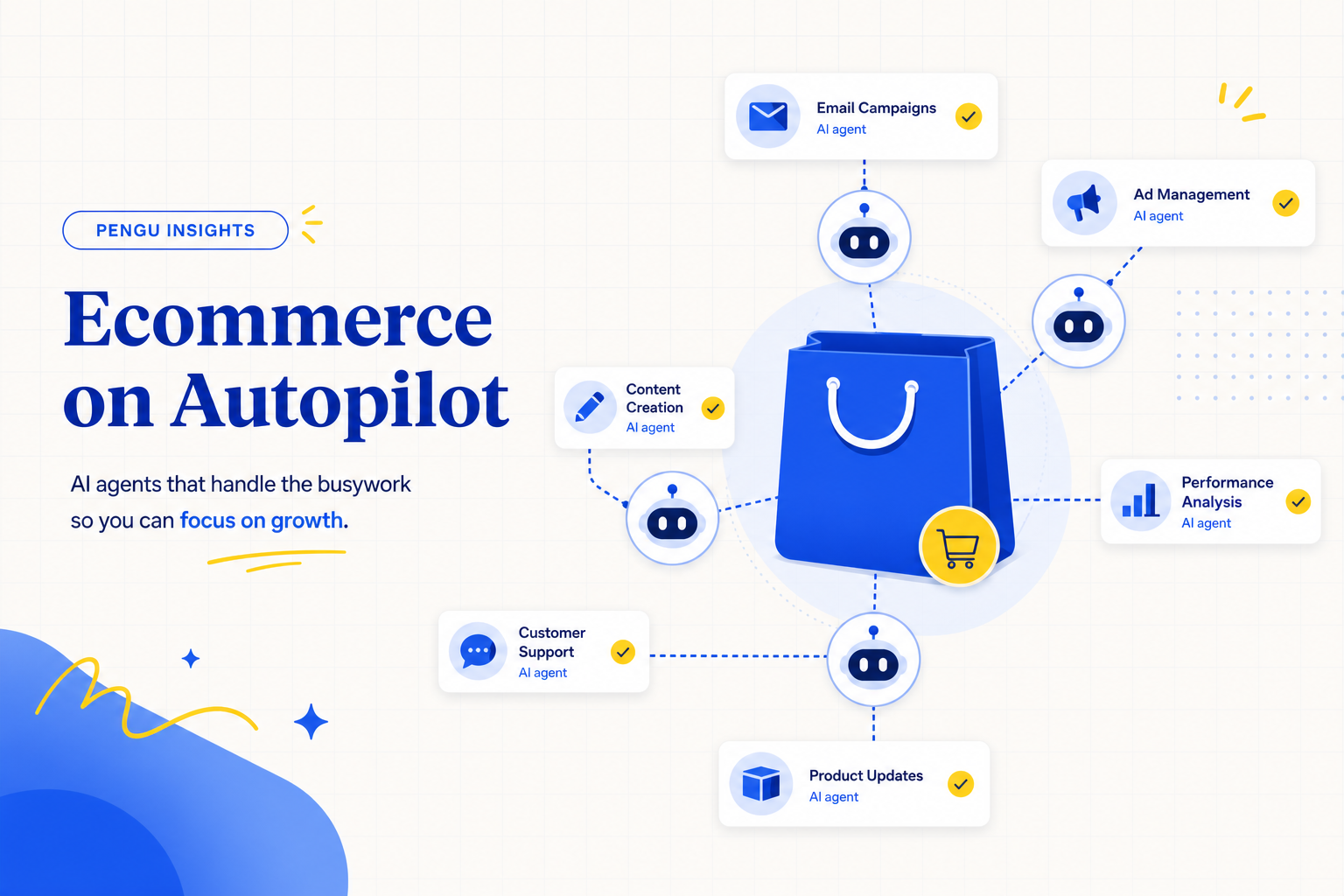
The honest answer in 2026: the useful "agents" are workflows with a chat interface on top, and the best one is the one wired to your store's data. The pattern that works, demonstrated in several public automation templates, has three parts:
- A store agent connected to the commerce platform's API. It reads orders, inventory and product data, answers "what sold today", flags products running low, and can create or update listings on request. Add ad spend from the ad platforms and it can report cost per order without a spreadsheet.
- A marketing agent that drafts posts and emails from the same data, so a low-stock product does not get promoted and a best-seller does. Human review before send.
- Task agents for narrow jobs: an on-page SEO check for a URL, order fulfilment in batches once payments are confirmed, a weekly competitor scan.
What to look for before you trust one: it should quote the numbers it used, refuse to act on ambiguous requests, and log every write to the store. An agent that updates products silently is a liability, not automation.
Off-the-shelf tools that market themselves as ecommerce AI agents mostly do one of those three jobs. The stack above is what you get by connecting them, and it is why the competitive intelligence layer earlier in this guide matters: an agent that only sees your own data optimises toward yesterday.
What 14-day rollout should a DTC team follow?
HubSpot-era marketing surveys already showed majority AI usage among marketers by 2024, and later studies only raised the ceiling (HubSpot State of Marketing; Shopify AI stats, 2026). The teams that win are not the ones with the longest tool list. They are the ones with a rollout sequence and owners.
Days 1 to 3: Measure the pain (3 hours)
- List the three tasks that steal the most hours: creatives, copy, tickets, or SEO drafts.
- Baseline time per task and conversion metrics you refuse to hurt.
Days 4 to 7: Install one tool per pain (half day each)
- Creative: Canva Magic or Photoroom.
- Copy: Claude or ChatGPT with a brand voice sheet.
- Support: FAQ-trained chatbot with human handoff.
- SEO: Surfer-style editor on two money pages only.
Days 8 to 14: Add intelligence and tests (4 hours)
- Stand up a weekly competitor ad review.
- Launch two A/B tests on subject lines or hooks.
- Kill any tool that does not change cycle time or conversion after two weeks of honest use.
FAQ: AI tools for ecommerce automation
Which AI tools matter most for ecommerce marketing automation?
Prioritize tools that cut recurring work across SEO page optimization, creative production, copy testing, and support containment. Site builders and payment rails help ops, but marketing ROI usually shows up first in content velocity, creative testing speed, and ticket deflection.
Can AI fully run an ecommerce store?
No. AI amplifies strategy. It does not replace merchandising judgment, brand voice, or supplier relationships. Adoption surveys show wide AI use, while only a minority of teams fully embed AI into end-to-end workflows. Treat tools as operators inside a human-owned system.
How should DTC brands use AI for competitive intelligence?
Automate monitoring of competitor creatives, landing angles, and ad claims on Meta, Instagram, TikTok, and YouTube. Then feed those patterns into your copy and creative briefs. Soft stack tip: pair your SEO and creative tools with a CI layer such as Pengu Insights for competitor and ad intel.
Is llms.txt worth adding for ecommerce SEO?
It is a low-cost experiment. An llms.txt file can list product and policy URLs you want assistants to prioritize. Only some models use it today, so treat it as future-proofing next to classic technical SEO, not a ranking switch. For the broader answer-engine playbook, see generative engine optimization.
Where can I get AI ecommerce automation that improves SEO?
Split the job in two, because no single product does both well. For the SEO half you need keyword and competitor data plus a way to ship pages: a search intelligence platform for the research, and your CMS or a content tool for the publishing. For the automation half you need a workflow layer such as n8n or Zapier to move data between the store, the CRM and the tools. The pairing that works for most DTC teams is one research platform, one content tool and one workflow runner, not a single suite promising all three.
Which AI ecommerce automation tools work for SEO and chatbots at the same time?
Almost none, and the ones that claim to usually do one well and the other badly. Chatbots optimise for containment and response time; SEO tools optimise for search demand and rankings. Run them as separate tools connected by your workflow layer, then feed the chatbot transcripts back into keyword research. The questions customers ask support are the same questions they type into Google, which is the highest-converting content source most stores never mine.
What is the best AI tool for ecommerce automation that includes competitor data?
Ask what the tool measures rather than what it automates. A store automation tool sees your data. A competitive intelligence platform sees the market: what rivals rank for, what they publish, and which ad creatives they keep paying to run. You need both, and the second one is the half most ecommerce stacks are missing entirely.
How do I avoid AI copy that hurts conversions?
Fact-check every claim. Ban invented statistics. Keep brand voice constraints in the prompt. Generate many variants for A/B tests, then promote winners based on open rate, CTR, and conversion, not how clever the draft sounded in chat.
Which AI agents are best for ecommerce?
The useful ones are workflows connected to your store data: a store agent that reads orders and inventory, a marketing agent that drafts from those numbers, and narrow task agents for SEO checks and fulfilment. Judge any of them on whether it quotes its data and logs every change it makes.
Automate the loops. Keep the judgment.
Ecommerce AI works when it compresses boring, repetitive work and feeds better tests. It fails when teams confuse generation volume with strategy. Build a stack around SEO drafts, creatives, copy variants, support containment, and competitor intel. Review outputs like an editor, not like a spectator.
Next step: pick one category from the table, install one tool this week, and attach a metric you will check in 14 days. For a live session on how marketers are operationalizing AI stacks, join the Marketing AI webinar.
Before you automate anything, see what your competitors rank for and pay for: run their domain through Competitor Keywords in Pengu Insights. Free plan, no card.
Written by

Founder of Pengu Insights. Competitive intelligence practitioner for DTC brands and marketing agencies.