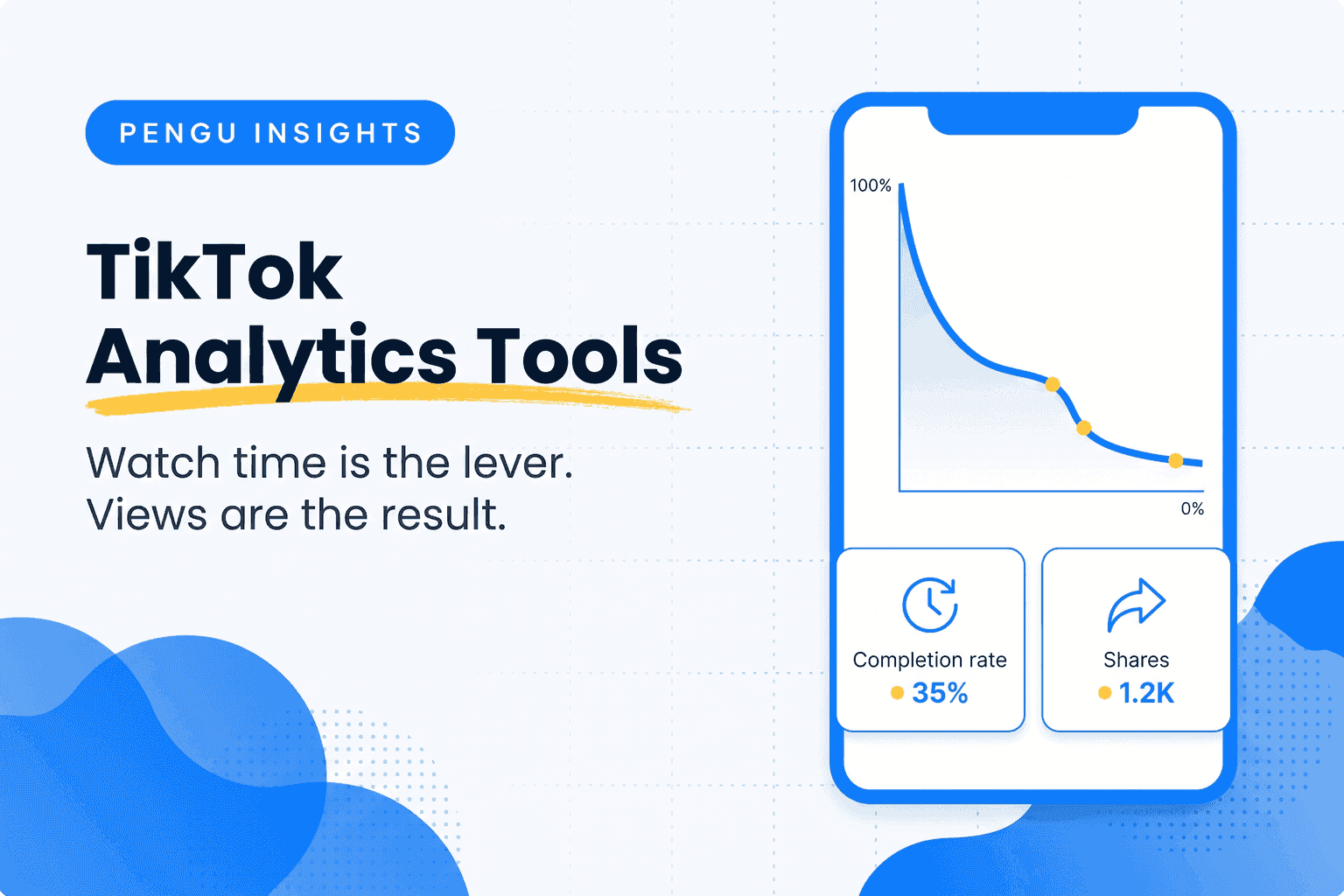
TikTok's own analytics are underrated. A Business or Creator account gets watch time, average time watched, traffic sources, and audience territories for free, measured rather than estimated. Most teams buy TikTok analytics tools before they have read the free one properly.
Paid TikTok analytics tools solve a narrower problem than the marketing implies: they tell you what other accounts are doing, and they make that presentable for a client.
Key takeaways
- Native analytics is the most accurate source for your own content, at zero cost.
- Third-party tools exist for competitors, cross-account reporting, and history.
- Watch time and completion drive reach. Views are the result, not the lever.
- The TikTok Creative Center is free and better than most paid research features.
Video: TikTok Shop analytics, which is a different job
Most TikTok analytics tools measure content. This walkthrough covers the other category: tools that track TikTok Shop products and the creators selling them.
Three things worth taking from it:
- Product data is separate from content data. The tool shown tracks units sold, commission and order growth per product, which no content analytics tool reports. If you sell on TikTok Shop, you need both kinds.
- Creator search by sales, not by followers. The reviewer filters creators by engagement rate and units sold, and notes that smaller accounts often outsell big ones in a niche. That is the same finding as our competitor routine below.
- Look past page one. His practical tip: trending lists on page three or four show products that are rising but have not peaked, which is where the margin is.
If you do not sell physical products through TikTok Shop, skip this category entirely. The four metrics below cover content.
What native TikTok analytics already gives you
- Video views, profile views, likes, comments, shares
- Average time watched and watched full video rate
- Traffic source: For You, Following, personal profile, search, sound
- Follower activity by hour and day
- Audience territories
That covers roughly everything you need to improve your own content. What it will not do is show you a competitor, and it will not survive an agency's need to report on eight brands in one PDF.
The TikTok analytics tools worth considering
1. TikTok Creative Center: free competitive research
Top ads by industry and region, trending sounds, hashtags, and creative themes. This is the best free asset in the category and it is public.
Use it for: finding proven hooks and formats before you write a brief.
2. Metricool
Free tier plus low-cost paid plans, with scheduling, reporting, and competitor tracking across networks.
Use it for: monthly reports where TikTok is one of several channels.
3. Later
From about $25 a month, with TikTok scheduling and analytics tied to the content calendar.
Use it for: planning-led teams.
4. Sprout Social and Hootsuite
$99 to $299 per seat per month. Suite-level reporting where TikTok is one tab among many. Compare the per-seat math in our Sprout Social alternatives and Hootsuite alternatives breakdowns before committing.
Use them for: larger teams needing one login and an inbox.
5. Pengu Insights
Ours. The TikTok Analyzer covers competitor accounts from $39 a month: posting cadence, format mix, hook patterns, engagement rate, and benchmarking against your own account, alongside Instagram and LinkedIn intelligence and the Facebook ad library for the paid side.
Use it for: the competitor half. It does not schedule posts or replace your native analytics.
The four metrics that actually move TikTok reach
- Average watch time. The single strongest signal. Optimising for it means writing tighter, not shorter.
- Completion rate. A 20-second video held to the end beats a 60-second one abandoned at 15.
- Shares. The cheapest form of distribution on the platform, and a direct signal of value.
- Comments per view. Conversation keeps a video circulating after the first push.
Likes are the weakest signal on the list. Follower count is not a metric, it is a lagging outcome.
A competitor research routine that takes 30 minutes a week
- Pull the roster. Pick five competitor accounts and log their last ten posts: hook, format, sound, topic, engagement.
- Cluster the hooks. Question, claim, demo, before-and-after, POV, stitch. Note which cluster earns most for each brand.
- Find the outlier. One video usually outperforms the account average by five times or more. That is the format to test.
- Cross-check the paid side. If the same hook shows up in their TikTok ads, it has survived a budget decision, not just the algorithm.
- Ship four tests. Never judge a format on one video. TikTok distribution is too variable for a sample of one.
Where to go next
The same eight metrics belong in one view: see social media dashboard. For the other networks, Instagram analytics tools and LinkedIn analytics.
To analyze any public TikTok account, yours or a competitor's, run it through the TikTok analyzer in Pengu Insights. Free plan, no card.
Can you see analytics for a competitor's TikTok?
Not through TikTok. Native analytics only covers accounts you manage. What you can see on any public account is the public record: video count, likes per video, posting cadence, sounds and hashtags used, and comment volume. From those, three things are measurable without any access:
- Posting cadence over the last 30 days, which predicts reach more than most people expect.
- Median views per video, by counting from the public grid. The median matters more than the top video, which is usually an outlier.
- Which formats repeat. If a competitor posts the same hook structure five times in a month, it is working for them.
Tools that report competitor engagement rates are computing them from these public numbers. The TikTok analyzer in Pengu Insights does that for any public handle and dates each figure.
Frequently asked questions
Does TikTok have built-in analytics?
Yes. Business and Creator accounts get views, watch time, average time watched, traffic source, follower activity, and audience territories, free and measured.
What is the best TikTok analytics tool?
Native analytics for your own account. Third-party tools pay off when you need competitor tracking, cross-brand comparison, or client reports.
Can you track a competitor's TikTok performance?
You can see public numbers: views, likes, comments, shares, cadence, sounds, hashtags. Watch time and retention for other accounts are not available to anyone.
Which TikTok metrics predict reach?
Average watch time and completion rate first, then shares and comments. Views are the output.
Is the TikTok Creative Center free?
Yes, and it publishes top ads, trending sounds, and hashtags by region and industry.
How do I check TikTok analytics for a competitor?
Native analytics only shows your own accounts. For a competitor, use the public profile: posting cadence, median views per video and repeated formats are all visible, and third-party tools compute engagement rates from those public numbers.
Related guides
If TikTok is one channel among several, compare the full category in social media analytics tools, and read Instagram analytics tools for the platform that usually shares the same content calendar.
Written by

Founder of Pengu Insights. Competitive intelligence practitioner for DTC brands and marketing agencies.